
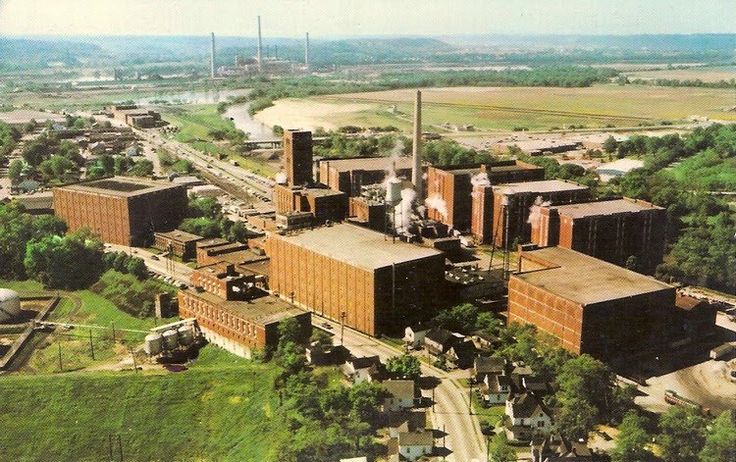
Part 1 – Questions Surrounding Schenley’s Purchase of W.P. Squibb.
I’ve had a nagging question that’s been bothering me.
“Why did Schenley chose W.P. Squibb Distillery in Lawrenceburg, Indiana as their major production site for spirits after Repeal?”
I mean, there are the obvious reasons for choosing Lawrenceburg; The city had always been a location well suited for distribution, and Schenley was very ambitious, so it seemed as good a place as any to invest large amounts of money in a distillery…but why Squibb? Schenley already owned the distillery in Aladdin, Pennsylvania and the George T. Stagg plant in Frankfort, Kentucky. They could have chosen to invest in any number of shuttered facilities after Prohibition. Perhaps the question should be, “What did Schenley know then that we don’t know now?”
While digging into Lew Rosenstiel and the Jacobi brothers (Schenley’s leadership) over the last few months, I found a strange piece of information.
“Lester Jacobi, of Cincinnati, was one of the men that founded the Glenwood Distilling Company on June 3, 1925. His partners were William Lucking, G.H. Dinkleman, George R. Landon, and Alfred Bettman.”
I included this seemingly arbitrary bit information in my Schenley timeline to illustrate the various businesses in which Lester Jacobi had been involved…alongside less-than-savory characters. I just wasn’t sure where the name “Glenwood Distilling Company” came from, which, as usual, sent me down a rabbit hole to uncover the history behind Lawrenceburg’s distilleries. I began digging into the history of Glenwood Distillery and discovered the following:
1. The Glenwood Distillery was owned by James Walsh & Company during the 1880s.
2. James Walsh & Co. of Cincinnati had owned the Rossville Distillery since 1877.
These were my first clues toward uncovering what led Lester Jacobi to invest heavily in the Squibb Distillery. He named his Prohibition era company after a distilling business made famous by a fellow Cincinnatian, so there had to be something here.
The distillery that would eventually become James Walsh’s Glenwood Distillery was built in Lawrenceburg, Indiana in 1851. It was built by Jabez L. Owenby, J. Anson Marshall, and Jacob B. Shepperd. A year after its construction, the firm shuffled its partners and changed its name to Bradley, Marshall, & Blasdel. This “new” group ran the plant for two years before deciding to sell a majority stake to James Wade Gaff of Cincinnati, though J. Anson Marshall continued to retain some interest in the company.
I’ve written about James W. Gaff before in relation to Pennsylvania’s Sunnyside Distillery as well as his connections with the Fleischmann empire. The Gaff brothers were a very big deal in Cincinnati, so buying a distillery in Lawrenceburg in the 1850s was a pretty big deal, too. Gaff & Marshall operated the plant for about a decade until Marshall’s retirement in 1863. With Marshall gone, the the firm’s name became Gaff & Co. until 1869 when it was changed again to John H. Gaff & Co. (More on this later.) When John Gaff died in 1879, the plant was sold again, this time to Nathaniel J. Walsh, the son of James Walsh, Sr. (James Walsh Sr. already owned the Rossville Distillery, which was right next door- he’d purchased the distillery just two years earlier.) N.J. Walsh only operated the distillery, now known as the “Glenwood Distillery”, for 6 years- right up until it burned down on Aug 27, 1885. The fire was determined to have been the work of an incendiary. It’s impossible to know what drove the arsonist to burn the distillery (and the cooperage next door), but this was the time of the Whiskey Trust, and James Walsh, Sr. had never been cozy with the Trust. Walsh would not rebuild on the same site until 1906 when Lawrenceburg began to look more friendly to his rectifying businesses than Kentucky.
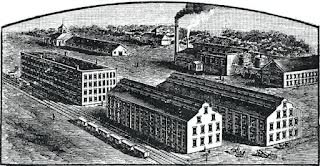
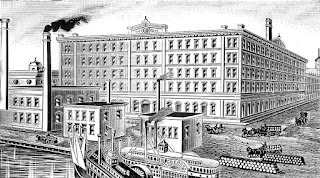
James Walsh & Co. had always been a Cincinnati-based firm. In 1883, James Walsh was able to invest in a distillery in Kentucky known as the Paris Distillery. The Paris Distillery had previously been known as the Sam Clay Jr. Distillery until Sam Clay’s death in 1883. References show that the distillery was sold to T.J. Megibben in 1883, but Walsh must have either been an investor or bought out Megibben very soon thereafter, because his name was associated with the ownership of the plant after 1883. 1883 was also the year that James Walsh & Co. was reorganized as Walsh & Co. Walsh & Co. also owned a large rectifying plant in Covington, Kentucky (built in 1868, just across the Roebling suspension bridge from Cincinnati). In 1884, letterheads described Nicholas J. Walsh as the owner of the Rossville Distillery and the Glenwood Distillery, both in Indiana. (We’ll look more closely at the locations for these plants in a latter part of this post to help make sense of it all.)
This diversification of James Walsh’s portfolio from his offices in Cincinnati sheds light on how the whiskey industry was developing at the time. The owners of Cincinnati’s largest wholesale liquor firms were buying properties to gain financial independence from the Whiskey Trust. It was a tough time to want to be independent- though that description of independence might seem a bit odd from a modern perspective. One might ask, “How can a company in Ohio that owns distillery properties in Kentucky and Indiana and blended whiskey in Covington be considered an independent company? Wouldn’t they have been the modern equivalent of non-distiller producers? Weren’t they carpetbaggers looking to capitalize on the whiskey being made in Kentucky and Indiana?” Let me put it to you this way. These companies in the 1880s were unique and unprecedented. There had not been corporations buying up distilleries to diversify their portfolios before, so it’s difficult to judge their business model from a modern perspective. No one saw these consolidations as being a negative move for the industry because the concept of “brand loyalty” had not been introduced yet, and marketing departments did not exist.
When James Walsh retired in 1888, he was a very wealthy man. When he died in 1890, his $1,500,000 estate (the equivalent of over 50 million today) was divided between his two sons, Nicholas and Dennis. Walsh’s recipe for success was followed by his fellow Cincinnati business friends and partners. The syndicates formed by like-minded individuals in Cincinnati would continue for the next several decades. In essence, James Walsh laid out a business strategy for others to follow. Knowing this, it seems only fitting that Schenley would want to own James Walsh’s legacy through his distillery.
Part 2 – Making sense of the distilleries in Lawrenceburg, Indiana.
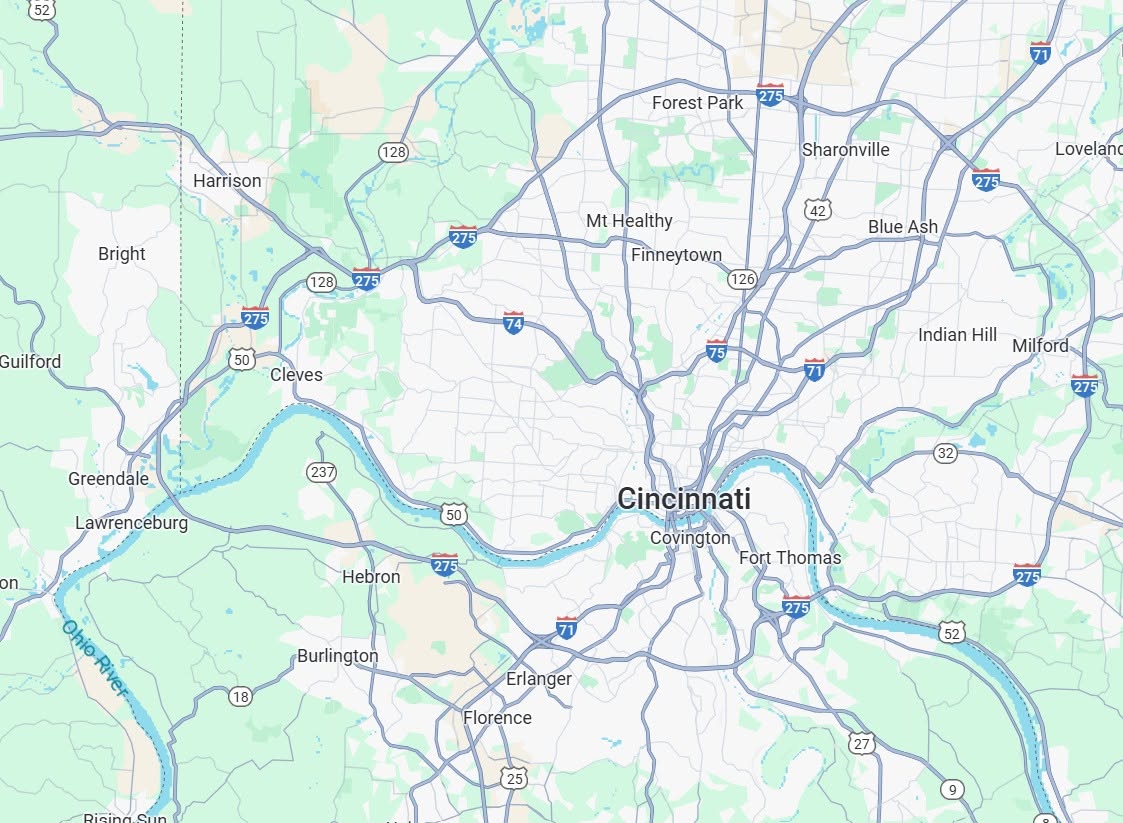
Today, when whiskey drinkers think of Lawrenceburg, Indiana, they think of one distillery- the Ross & Squibb Distillery. But Ross & Squibb, better known among whiskey enthusiasts as MGP (Midwest Grain Products), is a relatively modern company. Ross & Squibb’s history is most closely connected to that of Seagram’s (which owned Rossville Distillery) or Schenley (which owned the Squibb Distillery and renamed the Old Quaker Distillery), so it’s understandable that its marketing department has been focused on those companies’ histories. But Ross & Squibb’s campus literally covers the remains of at least FIVE different pre-Prohibition distillery properties, each of which had its own dynamic history, as well.
The history of distilling in Lawrenceburg belonged to one particular neighborhood in the northern segment of the city along Tanners Creek. The neighborhood is nearly as old as our nation, so it’s had several names- Greendale, Rossville, Glenwood, Newtown or Newton…depends on who you’re talking to or which timeline you’re looking at. (250 years of history can get confusing when you’re talking about distilleries😊.) I’d like to spend some time over the next few days talking about the history of the distilleries in Lawrenceburg. Let’s start with an overview.
Ross & Squibb’s website describes its history in a nutshell:
“(In 1809) Isaac Dunn and Stephen Ludlow established a distillery at the northern end of the current Ross & Squibb campus. Two barrels per week, at best, were produced…When George Ross opened Rossville Distillery—now Ross & Squibb Distillery—on the banks of the Tanner’s Creek in 1847, it was one of Lawrenceburg’s first distilleries. It was the legendary ryes crafted by George Ross that drew in whiskey loyalists and other distilling enthusiasts. It didn’t take long for Lawrenceburg to grow into the whiskey capital of the world.”
In all fairness, it’s very difficult to summarize over 200 years of history in a few sentences, but I think it’s important to mention that many men distilled whiskey in Lawrenceburg, Indiana, and they all deserve to be recognized for their REAL contributions.
To be clear, the George Ross Distillery was founded by George Ross, Anthony Swatz, and Cid Benner in 1847. It WAS one of Lawrenceburg’s first distilleries, but another 600 bushel-per-day distillery had been established 11 years earlier by Amaziah P. Hobbs. Hobbs built the city’s first steam-powered distillery in 1836. Hobbs’ distillery was destroyed in a fire in 1839, but it was rebuilt by “Hobbs and Craft.” Hobbs and Craft’s distillery suffered the same fate when it burned down in 1850, but it was never rebuilt. The location of Hobb’s Distillery was described in the “History of Dearborn and Ohio Counties” (published 1885) as being “just below the present Glenwood malthouse” which would have put it below 2nd Street. James Walsh’s Old Glenwood Distillery, previously known as the John H. Gaff Distillery, was built in 1851. While historic references state that the Hobbs and Craft Distillery was never rebuilt, the erection of another distillery by different men at the same (or similar) location was clearly meant to capitalize on its success. The tradition of building new distilleries upon the remains of historic distilleries was certainly not unique to Lawrenceburg, but it became common practice in the Greendale neighborhood.
The Ross & Squibb website also references George Remus, but it should be noted that Remus had nothing to do the manufacture of whiskey in Indiana, so his inclusion in the distilling history of Lawrenceburg is irrelevant here. If we’re only looking at the Rossville/Greendale/Newtown section of Lawrenceburg, where the Ross & Squibb campus is located today, the focus of Lawrenceburg’s distilling history should remain on its distilling sites. Over the next few days, I’ll focus on five distillery companies, their histories, their owners, and their locations, all of which evolved over time.
To help flesh out these historic distilleries, I’ve created a modern map of Lawrenceburg with the historic distillery sites marked by numbered rectangles approximating their locations. Among the distilleries, I’ve included other important sites like the John Garnier brewery, cattle pens, and the Bauer cooperage.
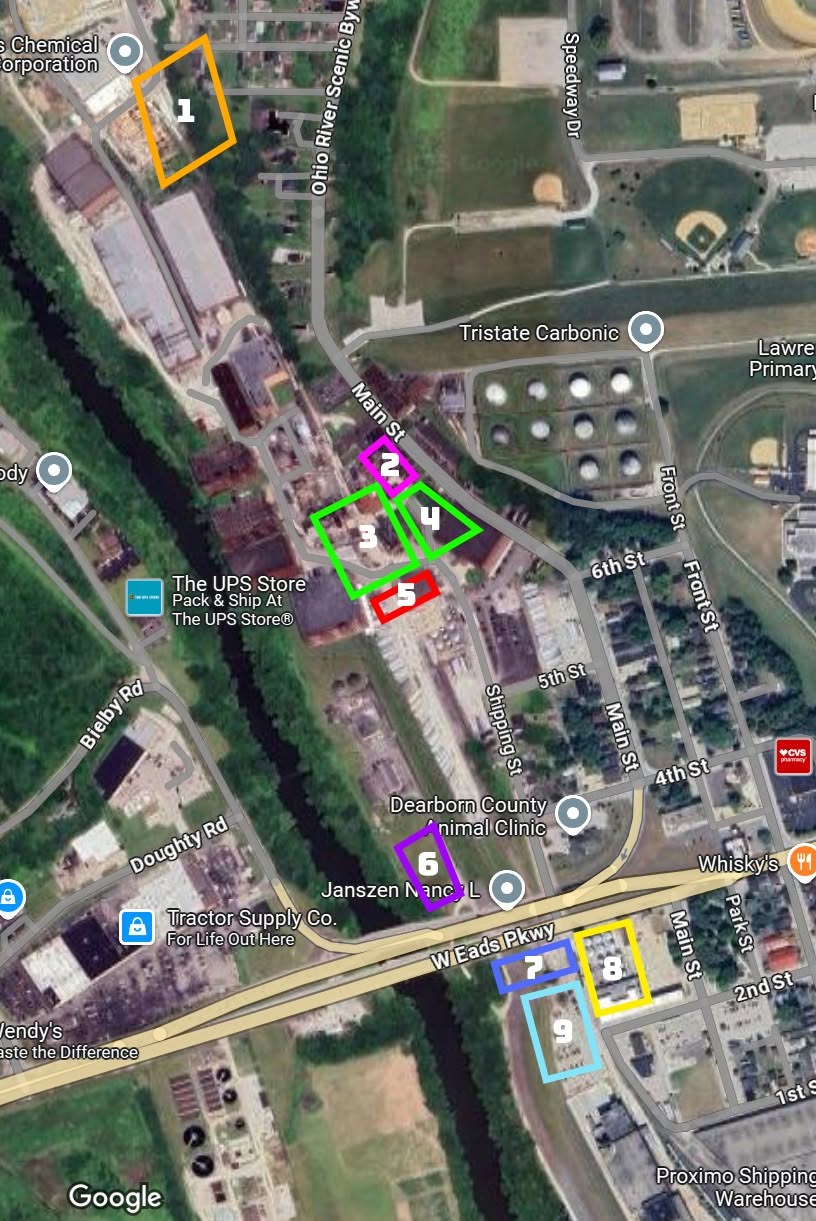
The 9 properties appearing on the map represent the following companies:
1. W.P. Squibb Distillery- RD #8
2. Kosmus Frederick Distillery (1875)/Nicholas Oester Distillery (1877)/Cereal Distillery (1895)/ Greendale Distillery (1898)- RD #9
3. Rossville cattle pens (representing multiple business owners)
4. Rossville Distillery/James Walsh Distillery- RD #7
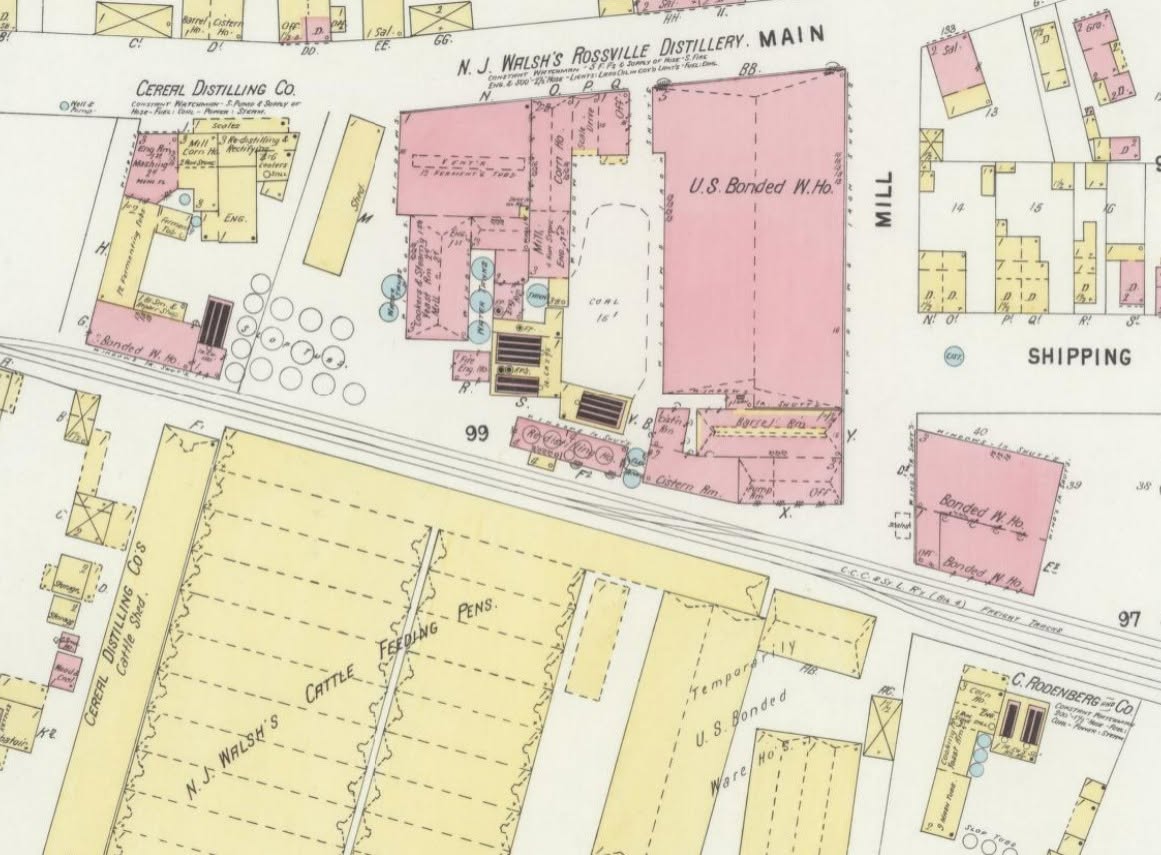
5. Frederick Rodenburg & Co. Distillery
6. Original location of the Frederick Rodenburg Distillery, RD #12- built in 1880. Sold to the Whiskey Trust.
7. John B. Garnier Brewery
8. Bauer Cooperage. The Bauer Cooperage initially owned the northern half of the block between 2nd and 3rd streets, with James Walsh’s Glenwood Distillery warehouse occupying the southern half. Bauer would eventually expand to own the entire block.
9. Location of the Old Glenwood Distillery, destroyed by fire Aug. 27, 1885.
Part 3 – Dunn & Ludlow, Lawrenceburg’s First Distillery.
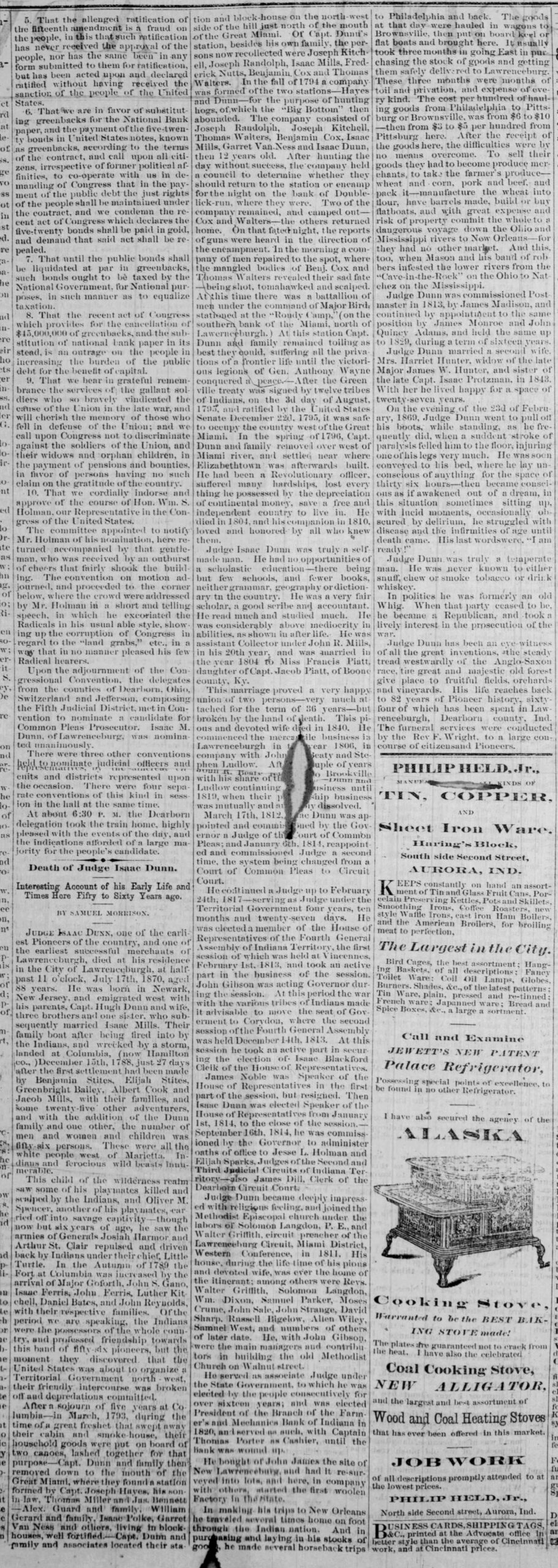
Isaac Dunn and Stephen Ludlow were among Lawrenceburg’s earliest and most influential citizens. Isaac Dunn was born in New Jersey on September 25, 1782. His father, Captain Hugh Dunn, a Revolutionary soldier, moved Isaac to Lawrenceburg while he was still a boy, braving Indian attacks along the Great Miami River along the way. Captain Dunn died in 1804, the same year Isaac married Miss Frances Piatt, daughter of Captain Jacob Piatt of Boone County, Kentucky. It’s likely that his marriage to Frances was a boon to both his social and his financial standing. Just two years later, Dunn joined John R. Beaty and Stephen Ludlow in the mercantile business. Beaty moved away to Brookville, Indiana after several years, leaving Dunn & Ludlow to form their own firm. Dunn & Ludlow built a small distillery in 1809 along Tanner’s Creek (on Ludlow’s land, known as Edenborough at the time) which produced about 2 barrels per week under ideal conditions. The distillery’s equipment was powered by the efforts of a blind horse. The “History of Deaborn and Ohio Counties” explained that Dunn & Ludlow remained in the mercantile business until 1819, though it’s hard to say when they ceased distilling. One reference shows them increasing production in the 1820s, “shipping 500 gallons of whiskey to New Orleans for two bits a gallon” in 1825.
Stephen Ludlow had been a principal purchaser of real estate in Lawrenceburg around the time their distillery was built. It should also be said that Dunn & Ludlow were among the first 13 men in Lawrenceburg to commence trading with New Orleans, Dunn often having to make the return journey on foot through Indian territory. Both pioneering businessmen helped to found Lawrenceburg’s Farmer and Mechanic’s Bank in 1815. Isaac Dunn became the bank’s president in 1820, so distilling was not their primary business. Dunn also established the state’s first woolen factory and became an influential judge and politician for the growing town.
The Dunn & Ludlow Distillery was never a large business, simply a means to an end for the influential men that built it as young men. What it did was establish a distilling tradition in Lawrenceburg, which many other men would follow. It was built at the northern end of the settlement on land belonging to Stephen Ludlow. When other distilleries were built in Lawrenceburg over the next several decades, they followed in Dunn & Ludlow’s footsteps. The next distillery to be built on the site of the 1809 distillery was built in 1870 by Kosmus Frederick, but there were many other efforts to continue what Dunn & Ludlow started. In 1821, Harris Fitch & Co. established a distillery on Wilson Creek, a few miles west of Tanner’s Creek. In 1836, the Hobbs Distillery was built, which employed steam power in the still house, revolutionizing the trade by opening the flood gates of increased production. Perhaps Amaziah P. Hobbs deserves more credit for his contributions to the history of distilling in Lawrenceburg. While his distillery was destroyed in 1850, it was built about a mile and a half south of the Dunn & Ludlow distillery- the site where the Gaff Distillery, later known as the Glenwood Distillery, would be built the following year. To be clear, in 1840, Ohio was the second largest producer of distilled spirits in the United States, Indiana ranked 6th. Kentucky was 7th. Lawrenceburg, being along the Ohio River, shared similar timelines with Aurora and Terra Haute, but the most significant influence on whiskey production and investment in the distilling industry in Lawrenceburg would come from its neighbor to the East- Cincinnati.
Part 4 – Kosmus Frederick, distiller. (And so much more than the founder of the W.P. Squibb Distillery!)
Kosmus Frederick was born on September 25, 1823 in Sarsbach on the Rhine, Baden, Germany. He came to the US in 1844 at the age of 21. His ship arrived in Havre de Grace Maryland, but he continued on to New Orleans. It seems he did not remain in New Orleans long, because by the outbreak of the Mexican American War in 1846, he was living in Louisville, Kentucky. Kosmus joined a military regiment in Louisville and fought in some of the war’s major campaigns. On August 8, 1850, he was married to Elizabeth Wissert in Jefferson County, Kentucky. Just over a month later, Kosmus and Elizabeth Frederick were settled in Lawrenceburg, Indiana. The 1850 US census, which was taken on the 11th of September 1850, shows Kosmus listed as a “cooper” with Lawrenceburg real estate valued at $1300. The “History of Dearborn and Ohio Counties” explains that Frederick founded a brewery that same year (1850), which may explain those valuable real estate holdings. While it’s unclear where the brewery was precisely located within Lawrenceburg, the same historic reference explained that by 1885, Frederick’s brewery property was owned by John J. Hauck. By 1885, J.J. Hauck was owner of the Lawrenceburg Furniture Company which occupied the same block as Bauer’s Cooperage (and what remained of Walsh’s Distillery after a recent fire). What this says to me is that the block between 2nd and 3rd streets along Shipping Street in Lawrenceburg had been an important site within the city, and that businesses like Kosmus Frederick’s were shuffled around on that site as the city and its businesses grew. Kosmus may have sold his brewery, the first of several large businesses he would launch in Lawrenceburg, to J.J. Hauck, but he did not remain idle. He simply moved his business interests about a mile north.
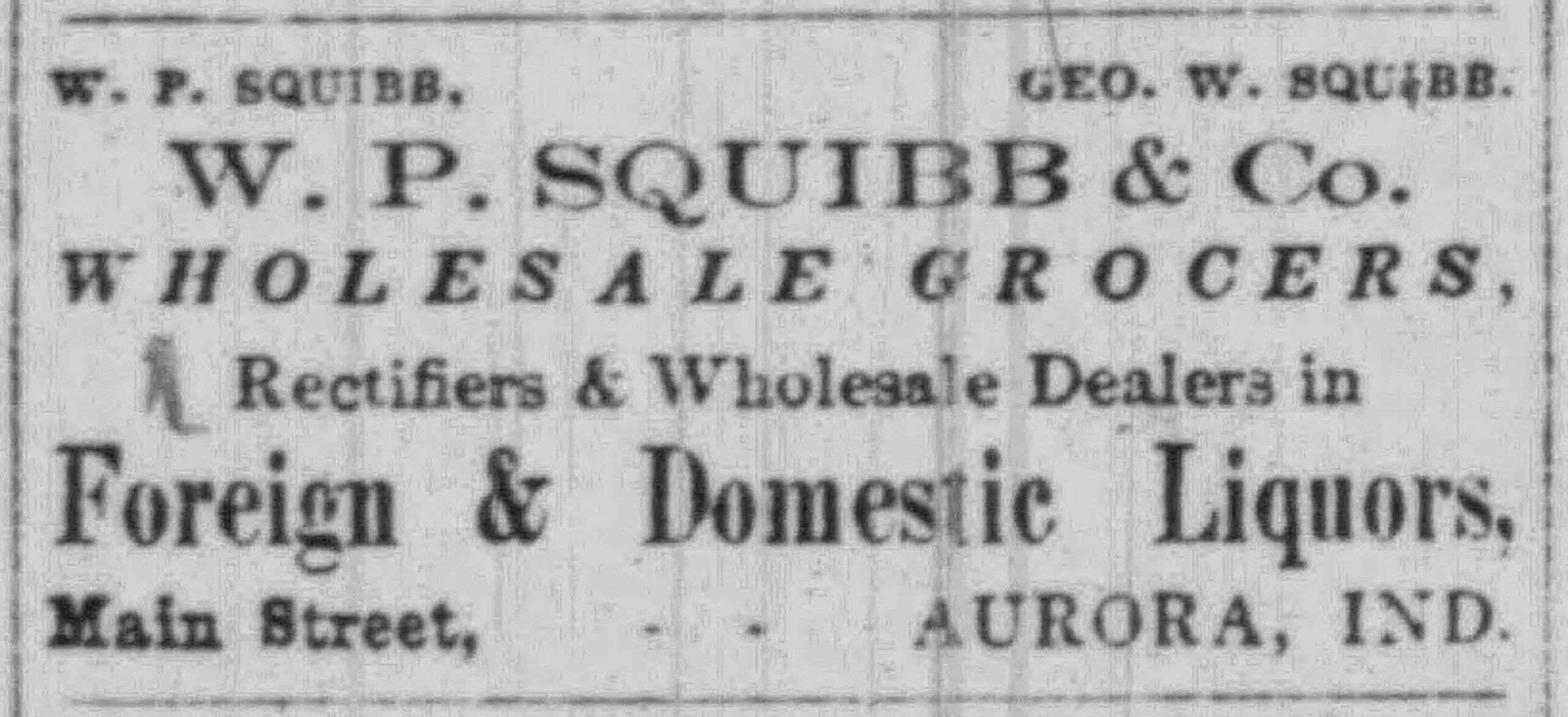
In June 1863, Kosmus enlisted in the military again, this time on behalf of the Union during the Civil War. His enlistment paperwork lists him as a “whiskey maker”, which implies that he was already more than just a cooper and a brewer by the 1860s. There were several distillery properties in Lawrenceburg before the Civil War, though it’s unclear who may have employed him. After the war, Kosmus returned home, and in 1868, he purchased land at the northern end of Greendale where he would build his own new distillery. His intention was to manufacture bourbon whiskey and high wines for the rectification trade. Before the buildings were completed, he entered into a partnership with William P. and George W. Squibb of Cincinnati. Just as he had done with his brewery, after a year of establishing his business, he sold his distillery to a Cincinnati-based business- this time, to the Squibb brothers. The Squibbs owned the business, but Kosmus stayed on as their partner and head distiller until 1870 when the partnership was dissolved. It’s unclear which businesses Kosmus was involved in between 1870 and 1875, but what is clear is that his home remained in Lawrenceburg. 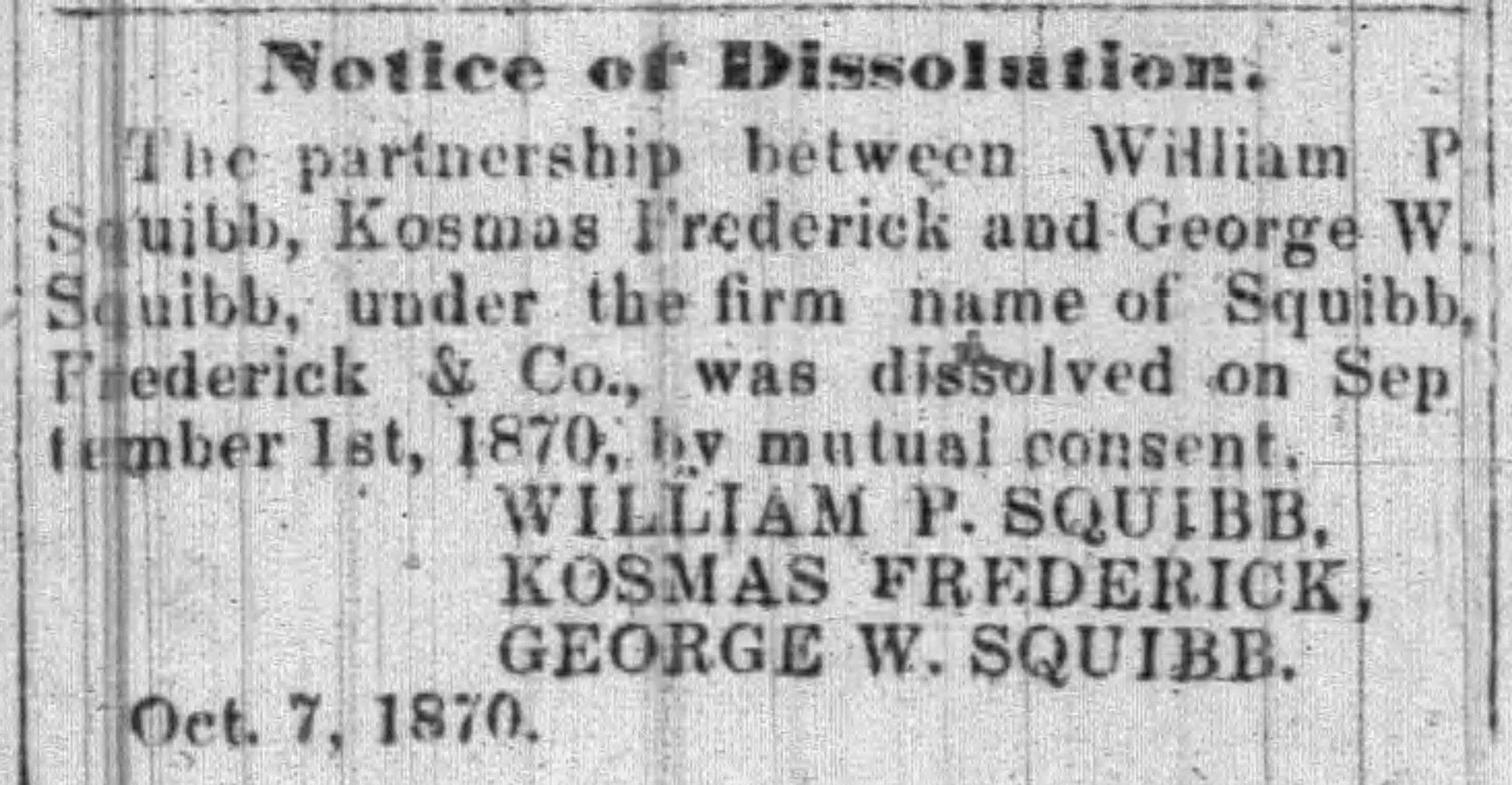
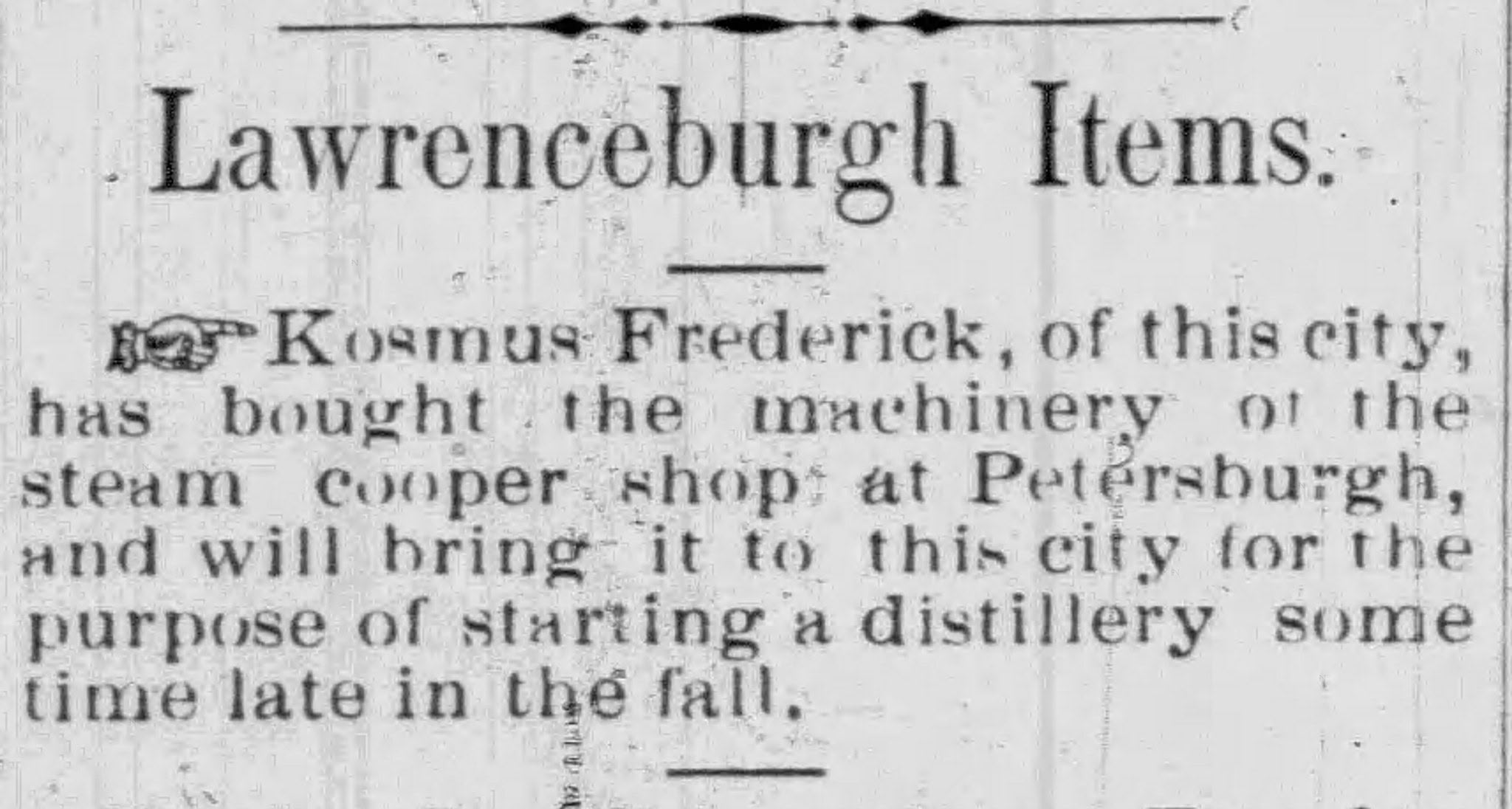
In 1872, Kosmus mourned the death of his first wife, Elizabeth. Two years later, Kosmus remarried, this time to Josephine Weisert (possibly Elizabeth’s younger sister?). By September 1873, the Aurora News was reporting that “Kosmus Frederick, of (Lawrenceburg), has bought machinery of the steam cooper shop at Petersburg, and will bring it to (Lawrenceburg) for the purpose of starting a distillery some time late in the fall.”
In 1875, Kosmus purchased ground adjoining the property he sold to the Squibbs. There, he erected a second distillery. He maintained this new property for two years, but there seems to have been legal issues which forced Kosmus to sell the property to Nicholas Oester for $12,000. Oester began his career in the US as a cooper, initially settling with his family in Cincinnati. He established himself as a wholesale liquor trader in Aurora, Indiana during the 1870s and bought Frederick’s distillery in 1877. After the sale of his second Lawrenceburg distillery, Kosmus Frederick would leave Lawrenceburg for good, choosing to commit his money and distilling talents elsewhere.
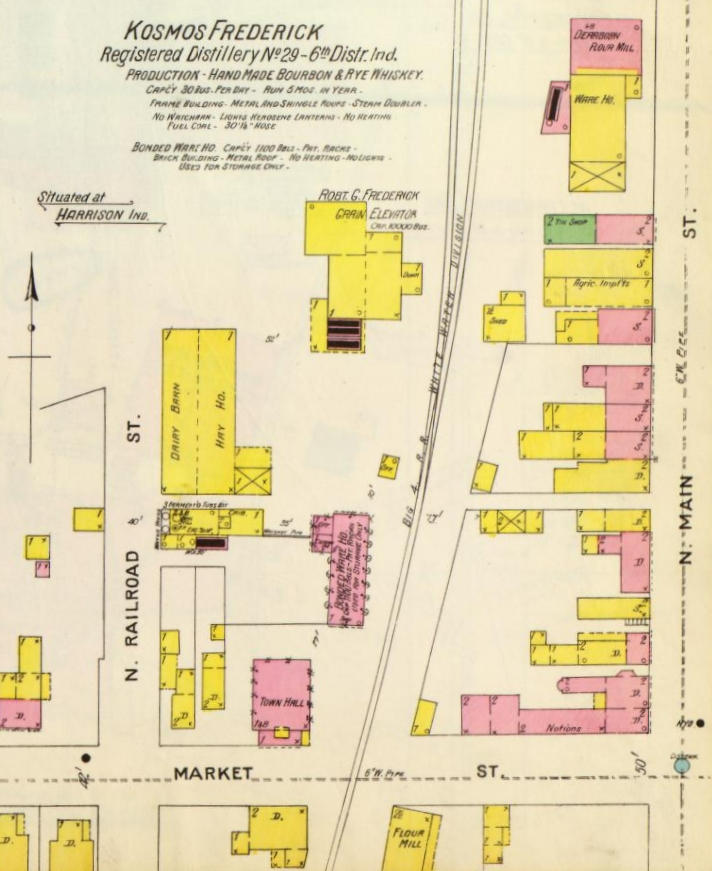
Kosmus Frederick relocated to Harrison, Ohio in 1881, where he would live out the rest of his days. While Harrison is technically a city in Ohio, a small slice of the city- the sliver of land between State Street and the Whitewater River- is technically in the state of Indiana! (This made research interesting, to say the least😊. If you look at the map below, you’ll see that his Harrison distillery was located west of Main Street, now known as State Street.) Harrison had always been a relatively short distance from Lawrenceburg, easily accessible by the Whitewater River. The Whitewater empties into the Great Miami River which flows south into Lawrenceburg. It was not a strange thing for Kosmus Frederick to relocate to Harrison, Ohio, especially with the city’s easy access to Cincinnati via railroad. Cincinnati, after all, was where Kosmus Frederick conducted most of his business.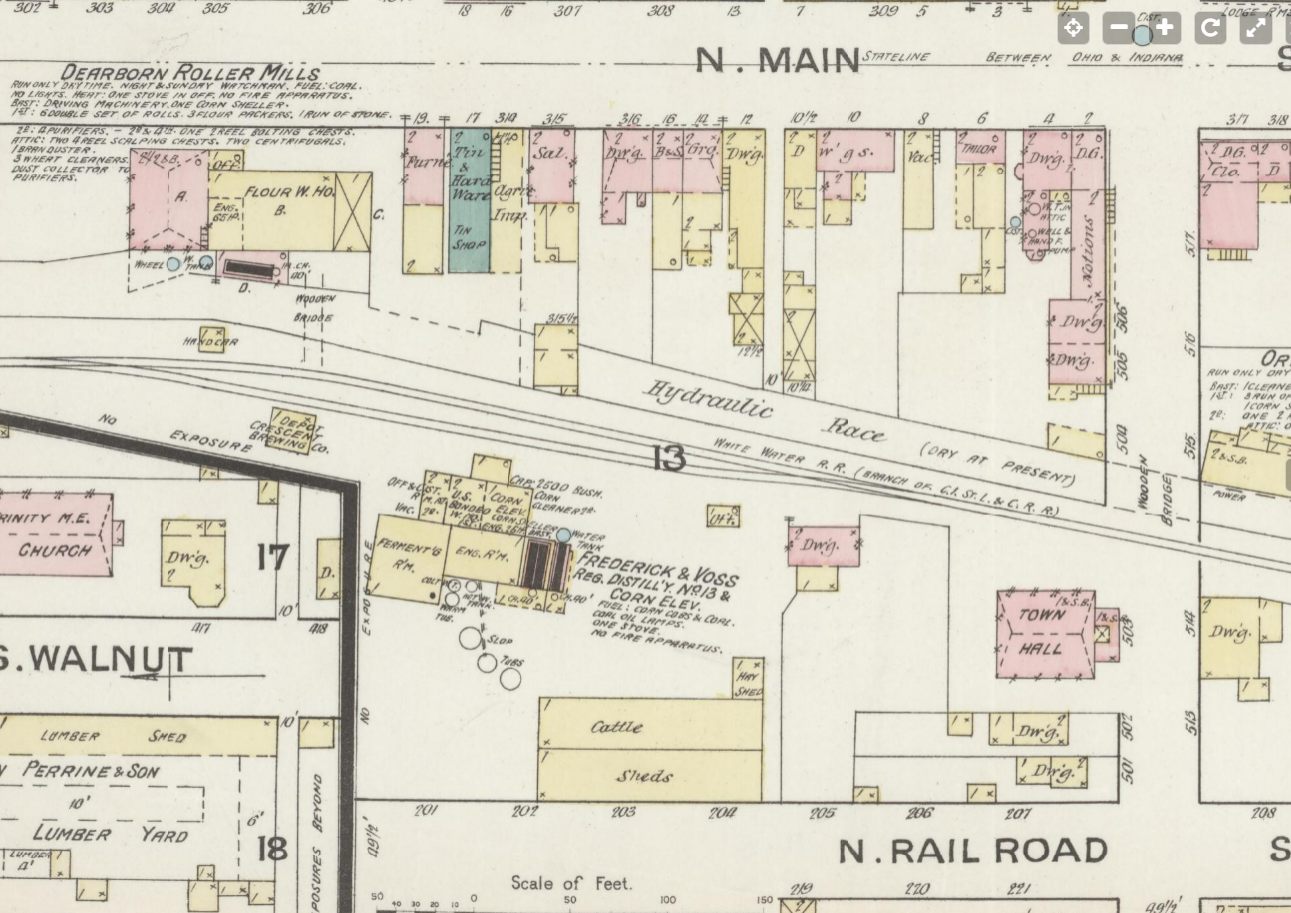
Kosmus worked alongside his sons, bringing them into the business over the years. Robert S. Frederick purchased his elder brother Joseph’s share of their father’s Harrison distillery in 1887 and sold one half interest to Henry W. Voss of Cincinnati. The firm’s name then became Frederick & Voss and the distillery’s name was changed to the Whitewater Distillery. Frederick & Voss were also involved in the manufacture and sale of flour. While their offices were in Cincinnati, Frederick & Voss owned the Union Roller Mills in Harrison (most likely the property that had been the Dearborn Roller Mills in the 1880s, across the tracks from Frederick’s distillery in Harrison) and advertised their “Snow Ball Flour” during the 1890s. Robert remained a partner of the flour mill in Harrison until around 1910, when he became a traveling salesman for the National Milling Company of Toledo, Ohio. As Prohibition approached, the Harrison distillery was in the hands of Kosmus’ much younger son, George H. Frederick. George was the son of Kosmus and Josephine, born in 1884. While Robert was involved in grain and flour until his death in 1912, George was listed as a “distiller” on his marriage certificate in 1914. Kosmus Frederick outlived Robert, finally passing away at the age of 91 in 1914. The George H. Frederick Distilling Company would not survive into Prohibition- It was dissolved in 1919. This is where it gets curious.
George H. Frederick was among the names listed in relation to the Stitzel Distillery during Prohibition. The George H. Frederick Distilling Company was sold to Minnie Kiewit in 1919 when the company was dissolved. Minnie’s husband, Arnold Kiewit, had been Robert Frederick’s partner before the mill in Harrison was sold around 1910. (Frederick & Kiewit was listed as a company in Cincinnati’s “Chamber of Commerce Merchant’s Exchange” between 1907-1908.) As I stated earlier, Robert was associated with the roller mills in Harrison and had offices in Cincinnati. When the contents of the Stitzel Distillery were being auctioned in 1925, George H. Frederick’s barrels were among those being sold. They were labeled “Union Distilling Company”, a Cincinnati concern. It is curious to me that barrels belonging to George ended up in Stitzel’s Louisville warehouse during Prohibition. You can see the listing posted below. Listings of auctions for whiskey barrels in bonded warehouses were very common in the mid-1920s as warehouse owners were consolidating their assets and buying out any private owners of barrels that were being stored within their warehouses.
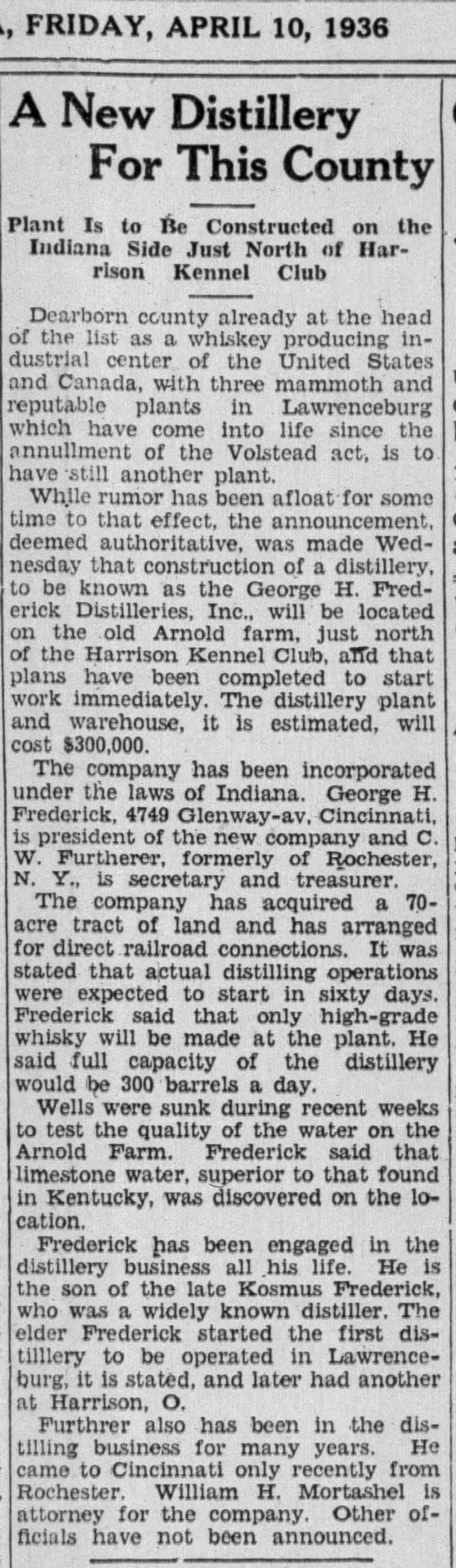
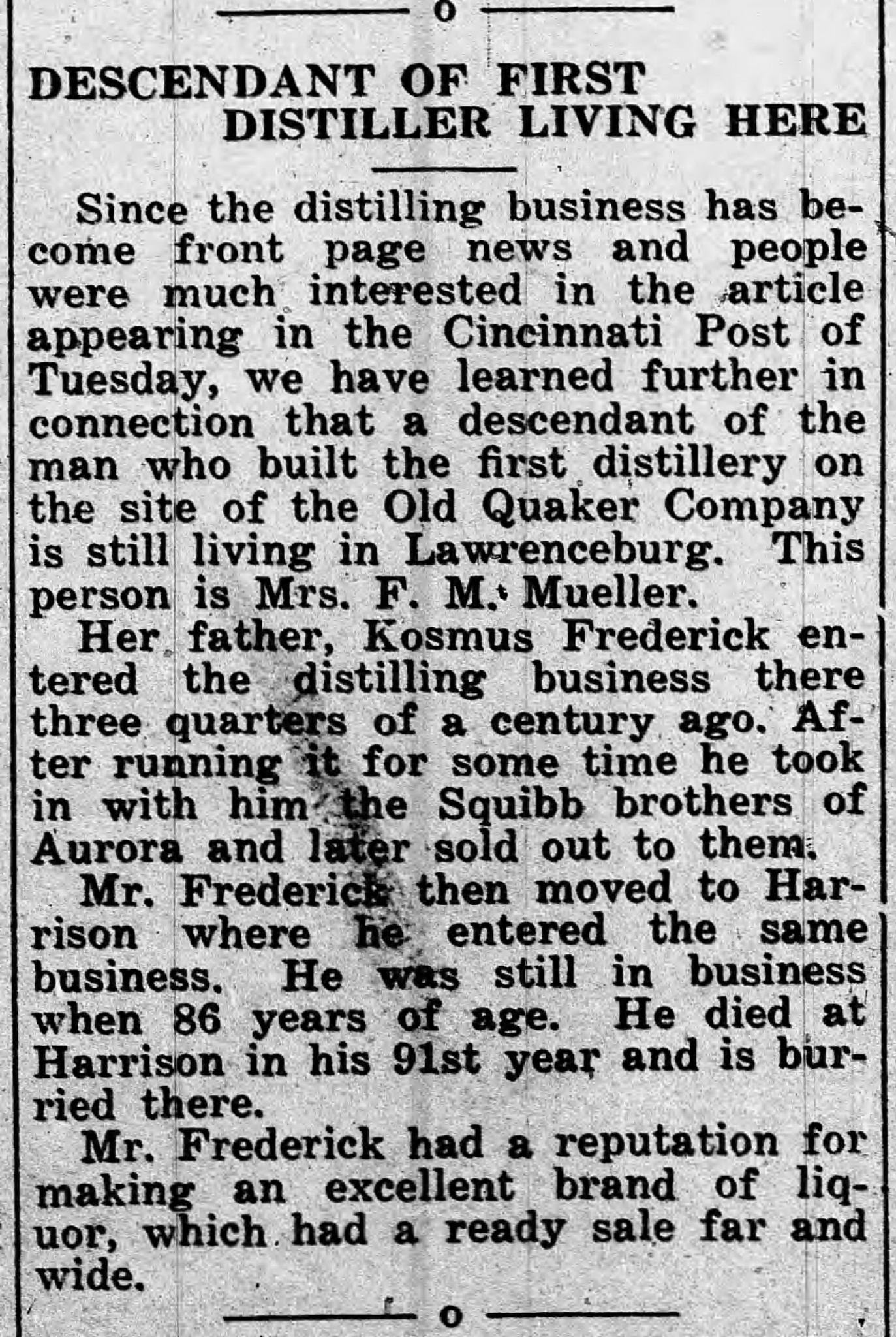 George H. Frederick would attempt to relaunch his distilling company in 1936. He invested $300,000 into rebuilding his father’s distillery in West Harrison. Many newspapers noted the intention to build a distillery, but the 1938 Sanborn survey of Harrison does not show a distillery within the town. I wonder what happened?
Part 5 – The Glenwood Distillery
As I began to write about the Glenwood Distillery, I decided it was probably important to explain why a distillery that was destroyed in 1885 was worth taking the time to research and write about. To be honest, the Glenwood Distillery was the reason I began looking into the history of Lawrenceburg in the first place. In a way, its history serves as an excellent example, summarizing the history of distilling in the United States.
1. A distillery is built in a very advantageous location along a major navigable river.
2. That distillery is purchased by investors NEARBY.
3. One investor takes the reins and becomes the distillery’s principal owner, incorporating their children and family members as investors in the business, as well.
4. A more influential investor buys the family out.
5. A tragedy forces the company to rebuild, relocate, or demolish the building.
6. Prohibition forces the distillery to close.
7. A major corporation absorbs the company’s patents, using the reputation of the distillery and its brands to sell products unrelated to the original distillery.
That’s pretty much the gist of it. In the case of Glenwood, the distillery (and part of a cooperage next door) was destroyed in an incendiary fire in 1885. Its owner, Cincinnati’s James Walsh & Company, would decide not to rebuild, but that was likely due to the company owning a second distillery several blocks away.
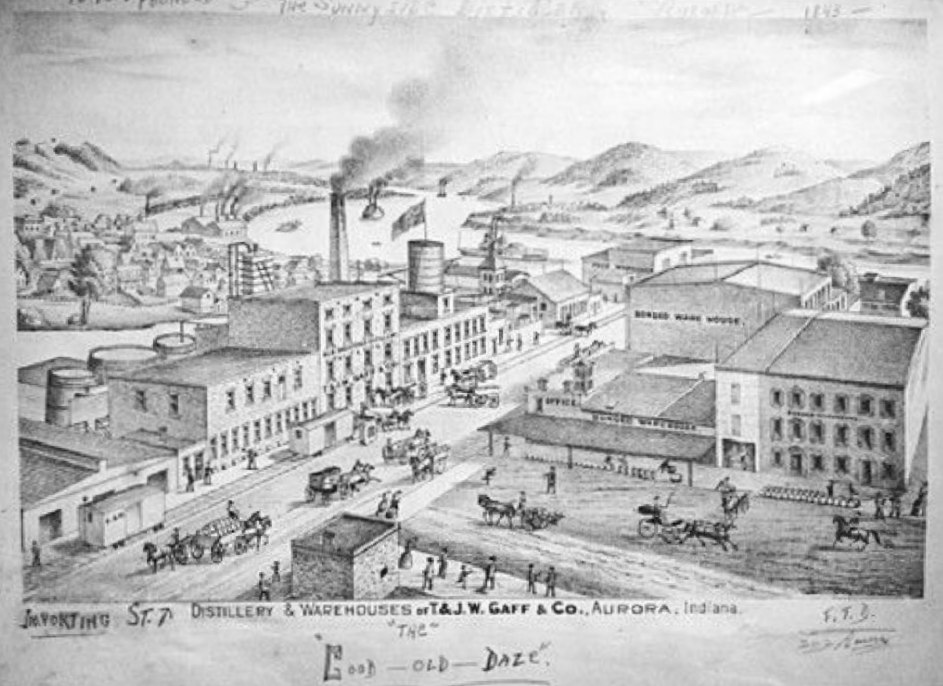 The Glenwood Distillery was known as the Gaff Distillery before James Walsh purchased it in 1877. I’ve written about the Gaff brothers before in reference to the Sunnyside Distillery in Pennsylvania and the Gaff brothers’ association with the Fleischmann family. The brothers, Thomas and James Wade Gaff, first established a distillery in 1843 in Aurora, Indiana, just 4 miles downriver from Lawrenceburg. The Gaffs decided to expand into Lawrenceburg about a decade later.
The original distillery buildings at 2nd and Shipping Streets in Lawrenceburg were built by Jabez L. Owensby, J. Anson Marshall, and Jacob B. Sheppard in 1851. The company reorganized as Bradley, Marshall, and Blasdel the following year. By 1854, the distillery was sold to the James W. Gaff of Aurora, though J. Anson Marshall maintained interest in the company. Gaff & Marshall distilled bourbon and high wines, most likely to supplement the Gaff brothers’ liquor houses, but also sold flour to the public. Marshall retired in 1863, so his name was dropped from the firm’s name to become simply Gaff & Company. When John H. Gaff moved to Lawrenceburg in 1864, he took over management of the Gaff brother’s interests there. By 1869, the name of the distillery had become the John H. Gaff Distillery. He would continue to manage operations in Lawrenceburg until his death in 1879. (James W. Gaff died the same year.) After John’s death, the plant was sold to James Walsh & Company, another large Cincinnati firm. It was at this point that the Gaff Distillery was renamed as the “Glenwood Distillery”.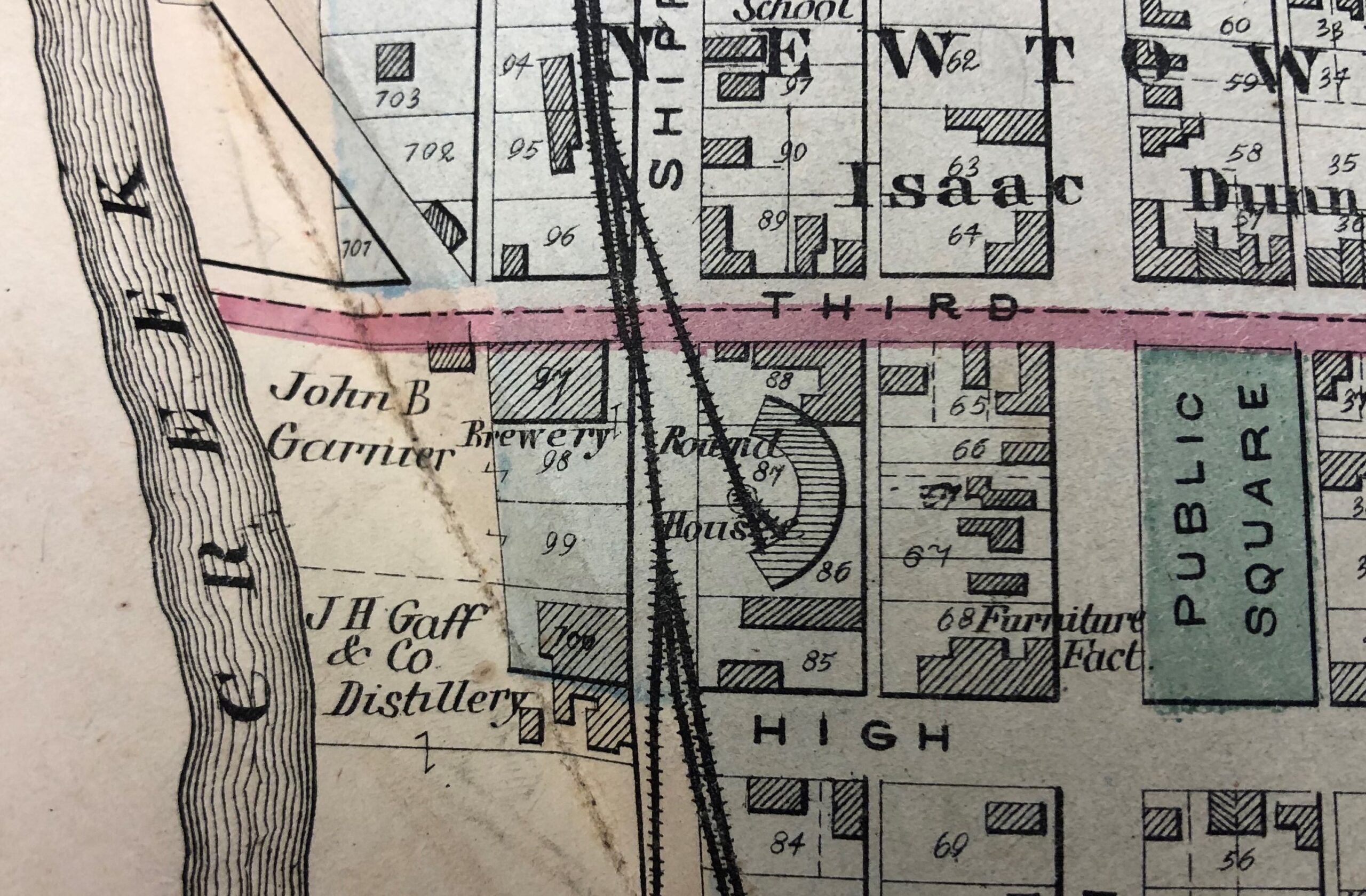
James Walsh already owned a large rectification plant in Covington, Kentucky and a distillery in Cincinnati (images in Part 1). He acquired the Rossville Distillery in Lawrenceburg in 1877. When the John H. Gaff Distillery went up for sale in 1879, Walsh did not hesitate to invest. With two distilleries in Lawrenceburg just four blocks from one another, Walsh was flexing his dominance over the local whiskey trade. The plant continued to manufacture whiskey and high wines until August 1885 when the property was set aflame. Walsh did not rebuild, but he did not have to with a larger plant just up the street.
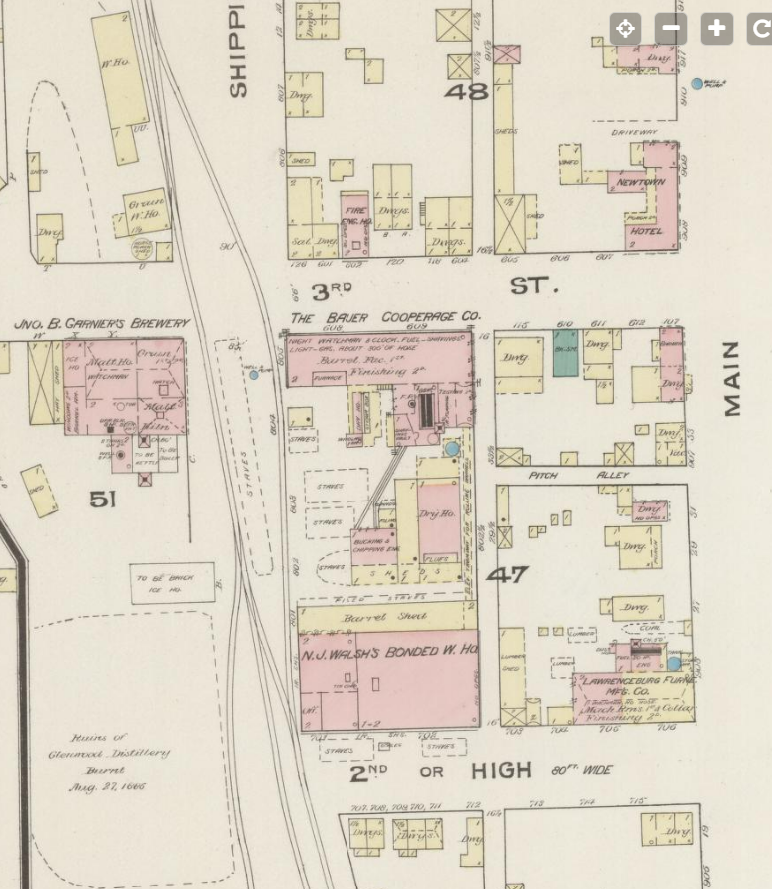
James Walsh was a wholesale liquor dealer based in Cincinnati, Ohio. The Glenwood Distillery in Lawrenceburg was managed by James’ son, Nicholas. Over the years, after it was demolished, the Glenwood Distillery’s property was absorbed by the John B. Garnier Brewery, which grew to envelop the site. Today, there’s an American Legion building where the distillery once sat.
Part 6 – Nicholas Oester Distillery
I started to talk about Nicholas Oester in Part 4 as he related to Kosmus Frederick.
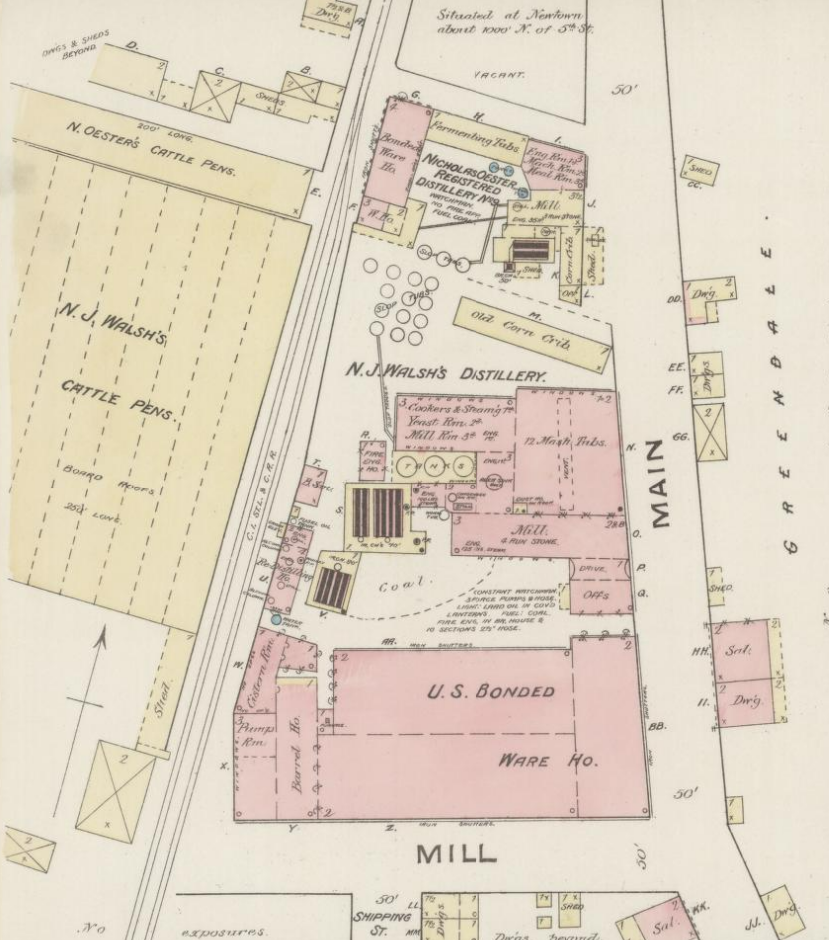
“In 1875, Kosmus purchased ground neighboring the Rossville Distillery, at the northern end of the distillery property. There, he erected a second distillery. He maintained this new property for two years, but there seems to have been legal issues which forced Kosmus to sell the property to Nicholas Oester for $12,000.” It’s odd to imagine that the Rossville Distillery had another distillery directly beside it, but that was, indeed, the case. I’ve attached a summary of the distillery which was printed in the “Dearborn County Register” in 1876. This was less than a year after its construction and before Frederick sold the property to Oester. It describes the facility:
“The buildings front on Ridge Avenue (Main Street), Greendale, 103×53 feet, four stories high, built of frame, with a brick warehouse 20×20 feet, and three stories high; a fermenting house 25×72 feet, and cattle and hog pens sufficient for all stock. The capacity of the building is for mashing 400 bushels of grain per day, producing 1,600 proof gallons of spirits. The value of the building and real estate is $ 30,000. When run to its full capacity, it will give employment to twelve persons, and require an annual expenditure for labor of over $7,000, and for materials to be used in the process of manufacture of over $80,000, and will pay a revenue tax to the General Government of $400,000. The value of the manufactured goods, exclusive of the tax, is over $100,000, and the value of stock fattened on slop $50,000.”
“The History of Dearborn and Ohio Counties, Indiana”, published in 1885, used these exact words to describe Oester’s Distillery nearly a decade later. Instead of “Kosmus Frederick’s Registered Distillery No. 27, it simply described “The Nicholas Oester Registered Distilling, No. 9.” Clearly, Nicholas Oester did not alter the facility enough to warrant a rewrite😉
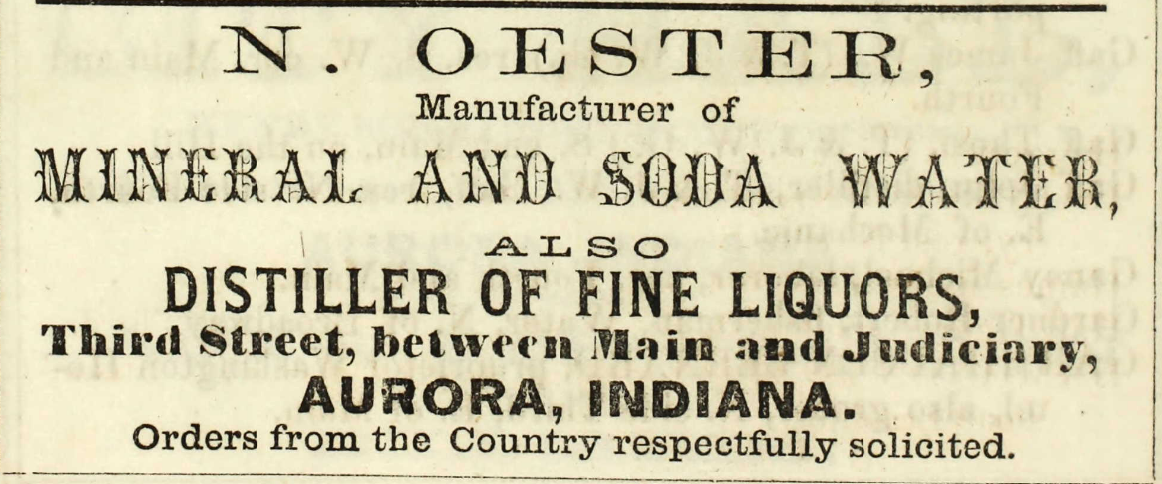
Nicholas Oester was born in Bavaria on November 22, 1829. He came to the United States with his parents in 1846, initially settling with his family in Cincinnati. His parents died of cholera days after their arrival, so Nicholas and his brothers would have to find their own way. The 1850 US census for Aurora, Indiana shows Nicholas, 19, and his brother John, 15, working as coopers. By 1853, he was married to Eliza Loheide of Hanover, Germany. After having their first child in 1860, Nicholas sought a new trade. During the 1860s, Oester established himself as a dealer of mineral water and wholesale liquor in Aurora, Indiana. As a rectifier of spirits, Oester often purchased whiskeys from Kosmus Frederick in nearby Lawrenceburg. The two men became business associates, so Oester’s purchase of the distillery from Frederick in 1877 made sense, especially considering the legal issues and debt that Frederick was negotiating at the time. After the construction and sale of his second distillery in Lawrenceburg, Kosmus Frederick left Lawrenceburg for good, choosing to commit his money and distilling talents elsewhere- upriver in Harrison, Ohio. Nicholas Oester renamed the property “The Greenburg Distillery”.
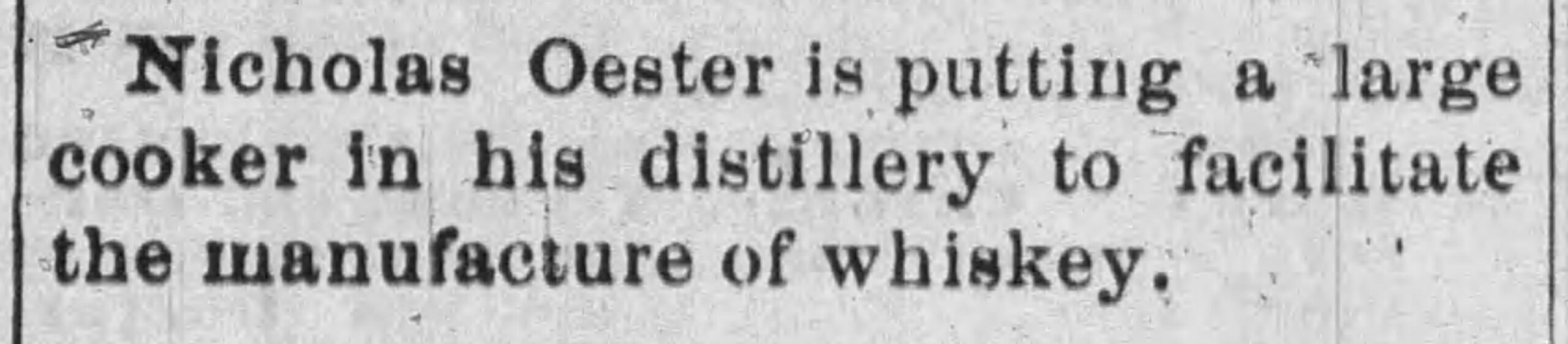
Nicholas Oester manufactured bourbon and high wines in his Greenburg distillery during a time when the Whiskey Trust was buying up distilleries in the region. It appears that the Lawrenceburg distilleries avoided the Trust’s buyouts until 1894- James Walsh’s Rossville Distillery was sold to the Trust in 1894, though Walsh negotiated a lease to continue manufacturing spirits at the plant. Nicholas Oester died on October 21, 1894 “after an illness of only 10 days of lung trouble” at the age of 65. After his death, the plant was renamed the Cereal Distilling Company.
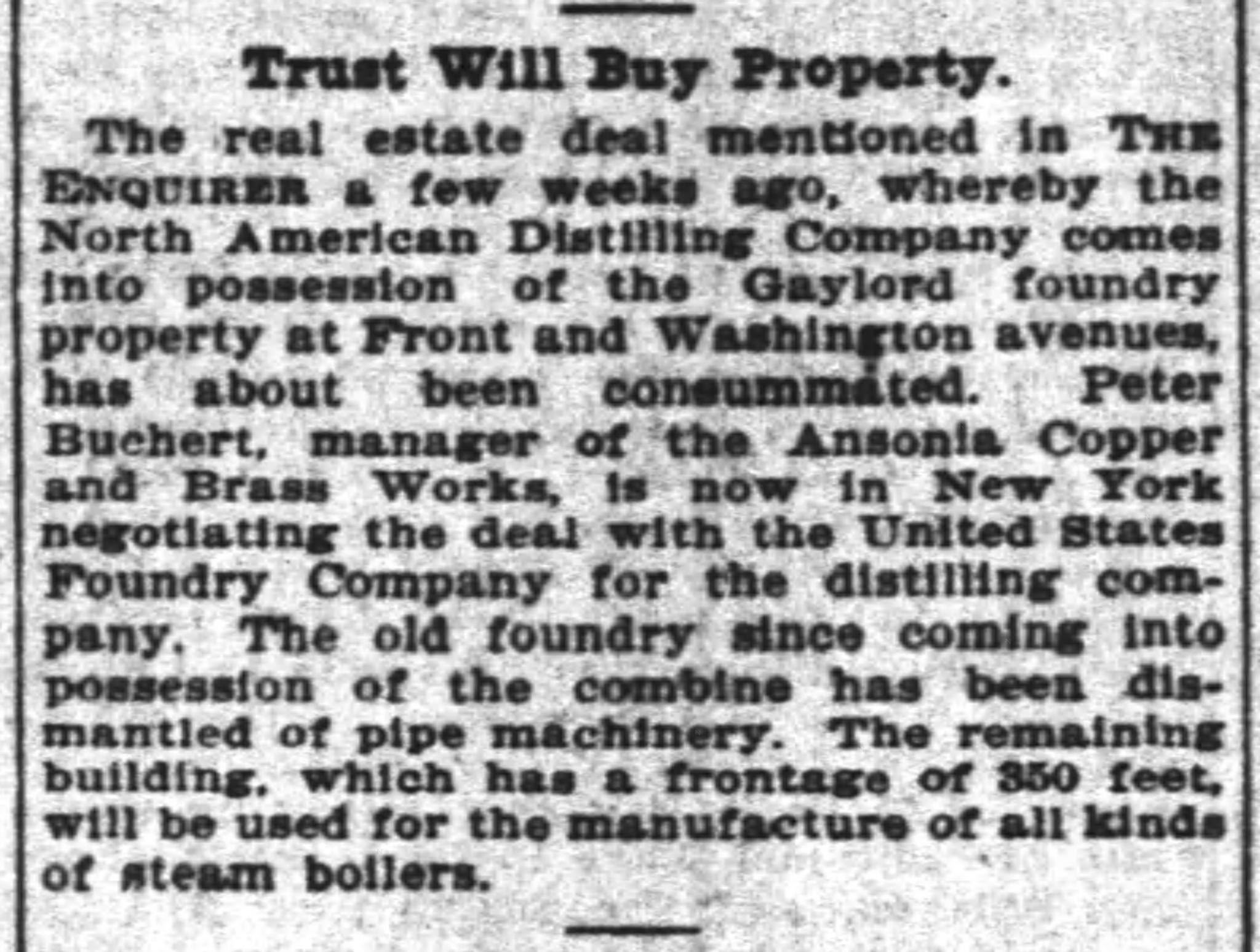
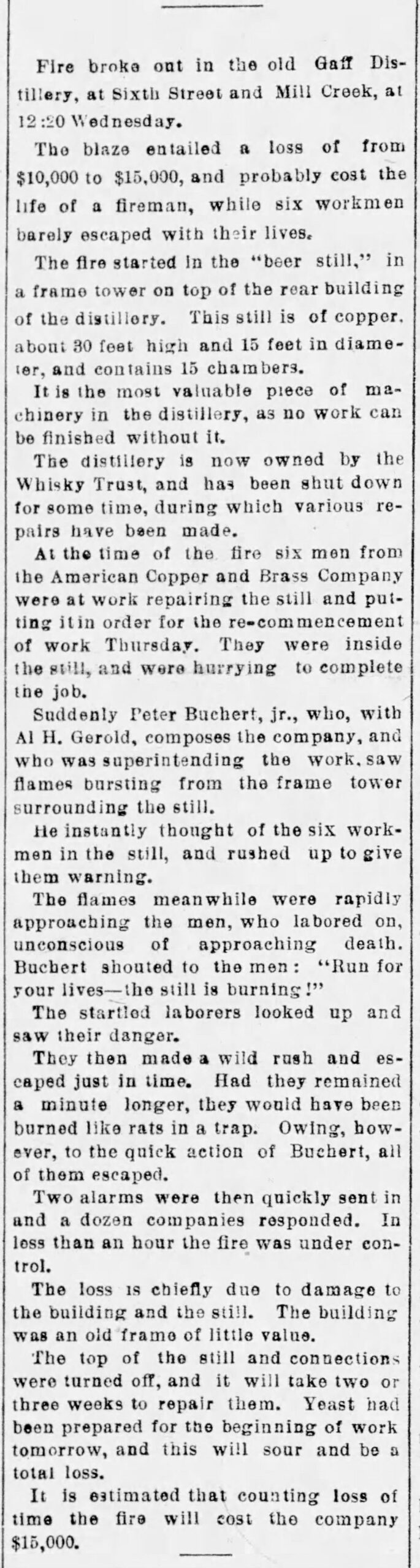 A curious detail- 5 months before his death, Nicholas Oester signed on to a limited partnership with Peter Buchert, Jr. and Albert H. Gerald. Buchert and Gerald were the owners of the American Copper and Iron Works in Cincinnati, Ohio. (Around 1900, Peter Buchert, Jr. became president of the Ansonia Copper and Brass Works in Cincinnati while J.G. Ellerhorst took over at the American Copper and Brass Works.) Buchert was clearly working for the Whiskey Trust since the 1890s, handling negotiations for the purchase of plants and equipment. The American Copper and Brass Works, which was responsible for building, installing, and repairing many distillery properties in the US, Canada, and Cuba around the turn of the century, formed a five-year partnership with Nicholas Oester in May 1894.
 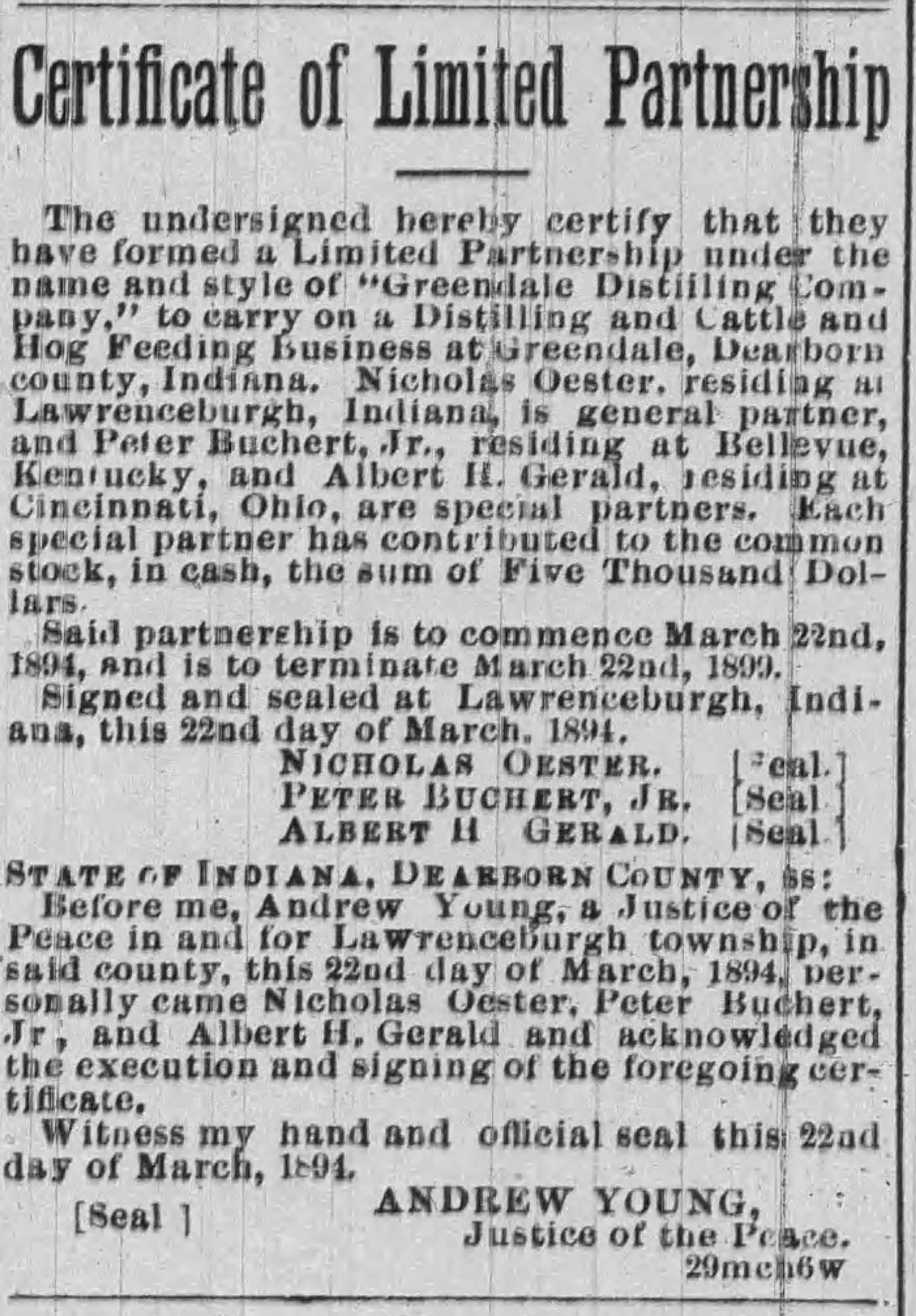 What were the owners of a copper and brass company doing buying the distillery next door to the Rossville Distillery in 1894? Was this the same group that bought the Rossville Distillery? As a copper fabrication company, it would make sense if they were partnering with him to dismantle and sell the plant’s equipment, but this partnership was to distill spirits and raise cattle! Curious that this partnership took place at all, but it’s certainly worth looking further into! It does seem strange that a company working almost exclusively for the Trust would invest in Oester’s plant.
In 1898, another distillery owner in Lawrenceburg, Frederick Rodenberg, bought the Oester Distillery. By 1902 (according to Sanborn maps), the cattle sheds at the Rossville plant had been demolished after a large fire. In their place, a drying facility was constructed to convert spent mash into dried grains for cattle feed. The Old Oester plant maintained its cattle sheds and partnered with a neighboring cattle dealer and slaughter house owner, Gustave Kestner. By Prohibition, the plant would be converted to manufacture vinegar. The distillery was demolished in 1933, most likely to make way for improvements at the Rossville Distillery by Seagram’s.
Part 7 – Frederick Rodenburg Distillery, RD #12
Frederick Rodenburg established himself as a distiller in Lawrenceburg, Indiana in 1880. The History of Dearborn and Ohio Counties describes his first distillery at 4th street along Tanner’s Creek:
“The Frederick Rodenburg & Co. Registered Distillery, No. 12 is located on Tanner’s Creek near the bridge (West Eads Parkway), the main building being a large frame three stories high. The business was established in 1880, by Fred Rodenburg, at a cost of about $ 15,000. Other members of the firm are Christ Rodenburg and Charles Aring. Eight men are employed, and the distillery has a capacity of mashing 310 bushels of grain per day. High wines and Bourbon whisky are distilled here.”
This description is of Rodenburg’s distillery as it existed in 1885. Christ Rodenburg was Frederick’s brother and had been a Cincinnati-based distiller since the 1870s. Charles F. Aring was a “stair builder” from Covington, KY, but his wife, Emma’s maiden name was Branstettner- Covington was home to the Branstettner Mill, which may partly explain the partnership with Rodenburg. It appears the men did business in Cincinnati and Aurora, as well.
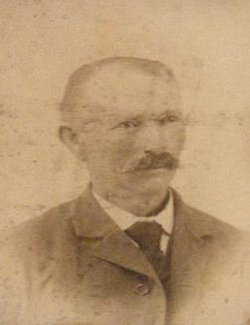
Frederick Rosenburg was born on January 7, 1838 in Messlenger, Germany. He came to the United States in 1854 with his parents, settling first in Cincinnati. Before Frederick Rosenburg became a distillery owner, he had been a soldier. At the start of the Civil War, Rosenburg enlisted early with Ohio’s Sixth Ohio Infantry, also known as the “Guthrie Greys.” He served throughout the war, never taking a furlough, which earned him respect and admiration and helped him gain political capital in Lawrenceburg after the war. In 1865, he married Janette Lommel and took on a career as a grocer in Lawrenceburg, but transitioned to distilling in the 1870s.
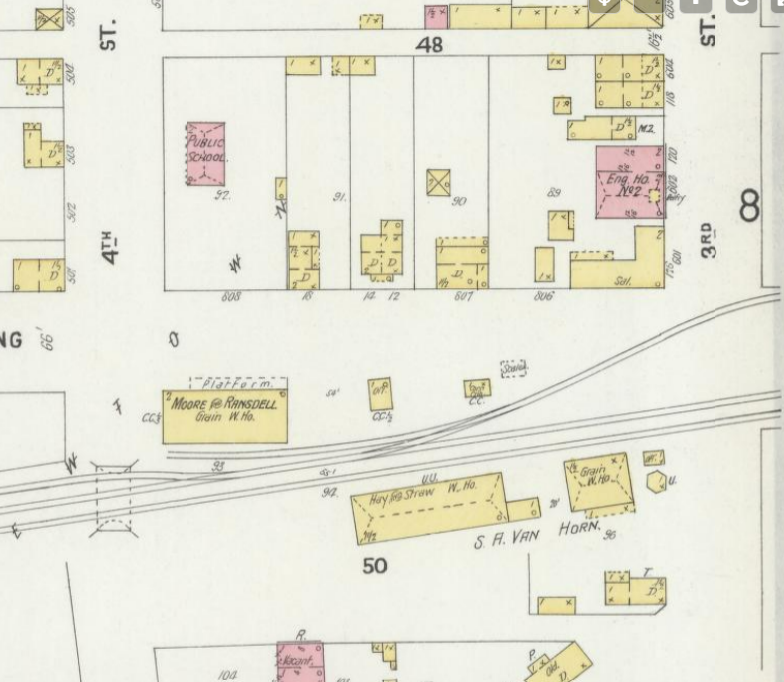
Frederick and his brother, Christian, built the Rodenburg Distillery in 1880. This distillery was originally located at 4th and Shipping Streets in Lawrenceburg. By the 1890s, the Whiskey Trust was putting pressure on local distillers to sell their properties, which Rodenburg reluctantly agreed to do. While he sold his property at 4th Street, he was defiantly disassembling his wood-frame distillery and moving it a few blocks north, just below Rossville Distillery’s cattle pens! The Trust’s 25-year contract was for the property, not the structures themselves, which left the Trust holding a 25-year contract on an empty lot! On May 30, 1893, the Cincinnati Post bragged about Rodenburg’s “trick” of outwitting the Trust and its machinations.
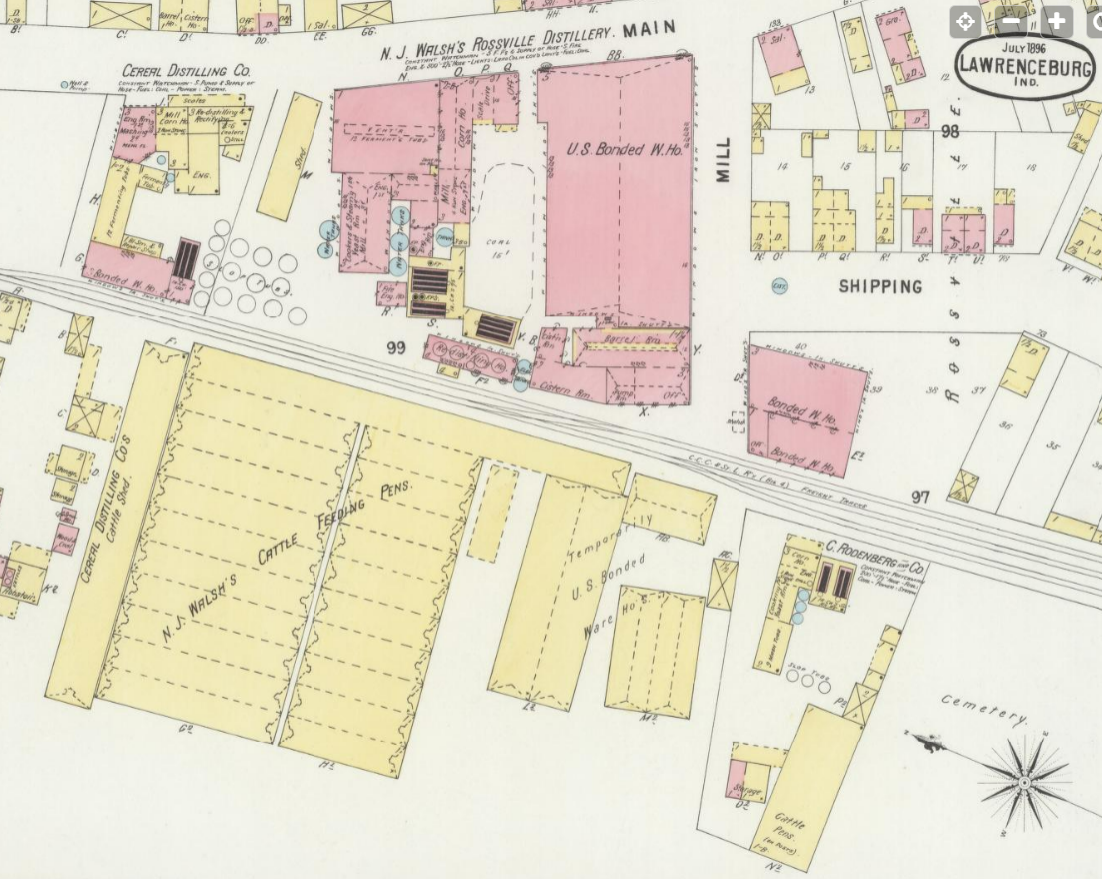
In 1898, a disastrous fire burned the Rossville (Walsh) Distillery, the Oester Distillery, and the “new” Rodenburg Distillery. This was the fire that ceased the Rossville plant’s large cattle facility (see Tuesday’s post on Nicholas Oester’s Distillery). The newspaper’s description of the fire explained that a “sky rocket” had fallen on the roof of the Rossville cattle pens! After the fire, it appears that Christian Rodenburg purchased (or leased) the Oester Distillery, continuing to manage it as the Greendale Distillery/Cereal Distillery. Fred and Christian remained in the distilling business until Fred’s retirement, due to illness. Frederick Rodenburg died on January 14, 1909. Christian remained a distiller in Cincinnati after his brother’s death, right up to Prohibition. The 1920 US census lists 75-year-old Christian Rodenburg, still employed as a “Distiller”.
Part 8- Greendale/Rossville/Newtown
Last week, I began to describe the historic distilleries of Lawrenceburg, Indiana because I wanted to understand how all the pieces of that Hoosier puzzle fit together. I knew that the Old Quaker Distillery was built in July 1933 on the site of the old Squibb Distillery, but I didn’t understand how Schenley’s famous plant fit in relation to the “new” Ross & Squibb Distillery. Where did the Rossville Distillery begin and the Squibb Distillery end? Thankfully, I was able to work it out in a way that made more sense to me- by drawing a map and by digging into the unique histories of the other distilleries that shared those several square miles of land along Tanner’s Creek with the Rossville and Squibb plants. But then, I realized that I had not written about either the Squibb or the Rossville Distilleries! Perhaps I felt it unnecessary because those sites have been written about in the past. Jack Sullivan, for instance, did a great write-up on the Squibb brothers and their distillery.
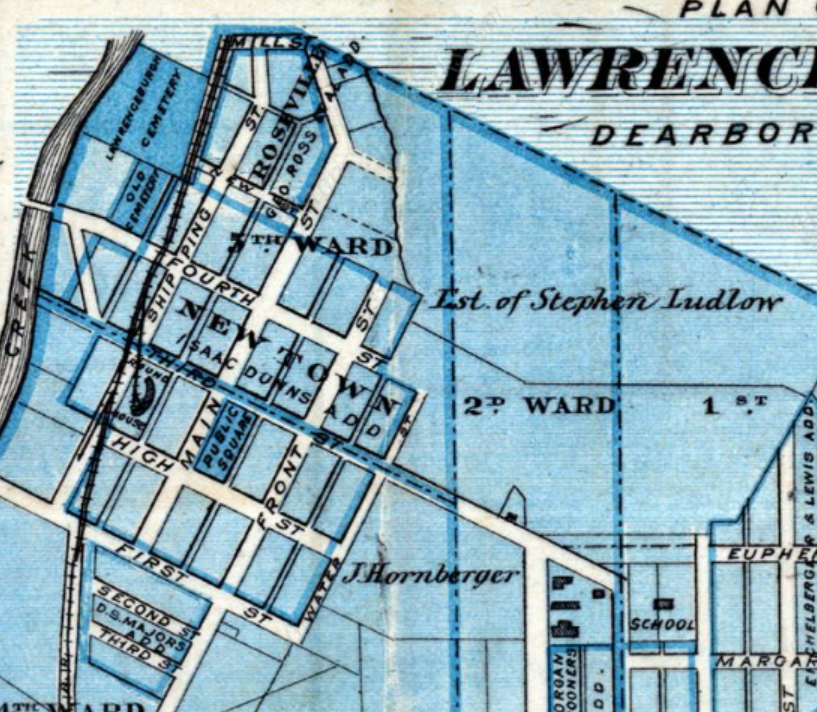
The Rossville Distillery’s history is a bit more nuanced as it had several owners over the years, arguably the most important of which was James Walsh of Cincinnati. And yes, the Rossville Distillery was named after a place! Several references imply there was no such place, but I assure you that Rossville was the name given to the stretch of land that extended north of Lawrenceburg along Tanner’s Creek. Rossville was also known as Greendale or Newtown (Newtown Park is at 2nd and Main Street in Lawrenceburg. The town of Rossville was annexed as a part of Lawrenceburg around 1850, so when George Ross, Gid Renner and Antony Swatz built the Rossville Distillery in 1847, Rossville was very much a place. In fact, Rossville continued to remain a place- it was the area in which the Rossville Distillery functioned. Rossville was named in real estate descriptions well into the 20th century. Historic names tended to stick with distilleries, often because there was a railroad stop associated with them, which helped to keep the name viable even as the town around the distillery changed and modernized. We see similar phenomenon like this today where you have Mill Street or Distillery Ave in a town where no trace of a mill or distillery remain.
Anyway, I’ll return to this topic in the next post to discuss the importance of the Squibb and Rossville Distilleries.