(This post follows the previous one involving Lew Rosenstiel’s Origins with Schenley.)
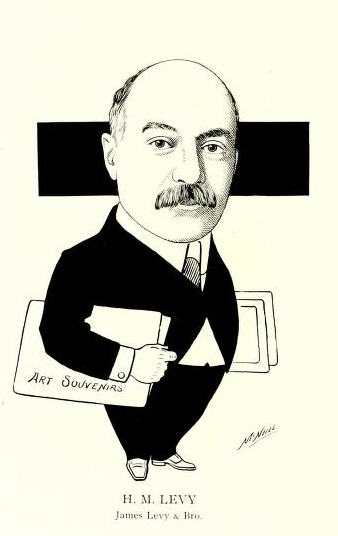
Schenley’s origin story is incomplete without the inclusion Cincinnati’s James Levy & Bro. The company was founded in 1866 by James Levy and his brother, Albert Levy, but it would be carried into the 20th century by Albert’s son, Harry M. Levy.
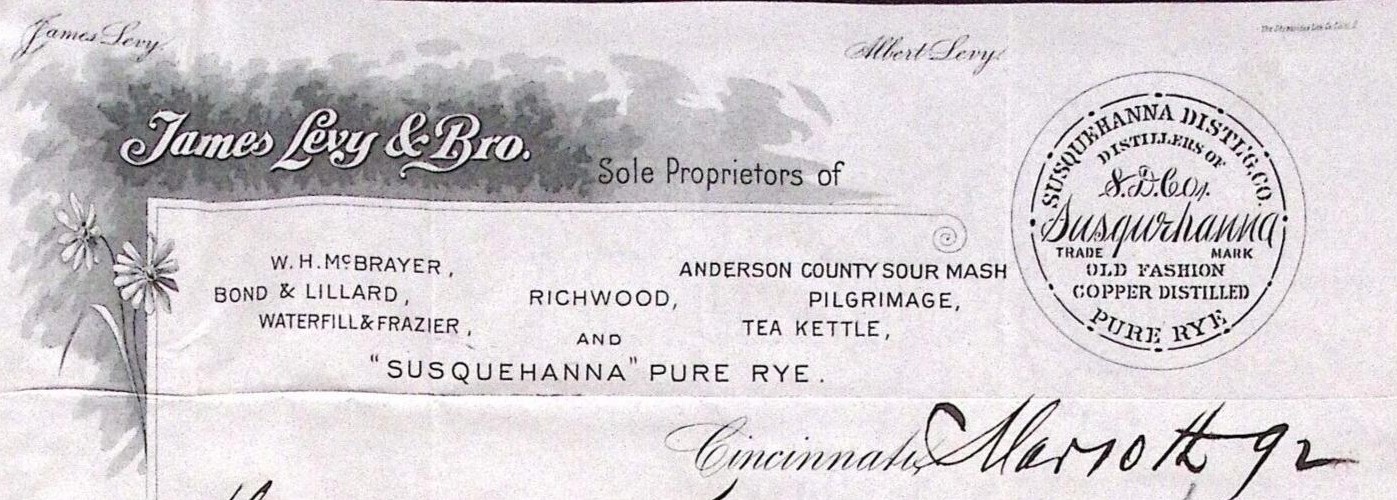
By the 1880s, The Levy brothers’ wholesale liquor company had secured sole proprietorship of product sales for W.H. McBrayer, Bond & Lillard, and Waterhill & Frazier distilleries for their business- meaning they bought ALL of the whiskey manufactured by those companies. To be clear, the arrangement for sole proprietorship over the sale of these brands was NOT uncommon within the industry- in fact, many liquor firms across the country were granted sole proprietorship of sales by distilleries to sell their products in the late 1800s and early 1900s. That’s precisely how the industry worked! Distilleries manufactured the whiskey, but liquor firms sold and distributed the whiskey. Most distilleries diversified their contract business, but some chose to simplify things by selling to one well-established liquor firm that could reliably handle all of their business. James Levy & Bro. built their reputation on their ability to choose exceptional whiskeys and secure contracts with the distilleries that manufactured them. They were also unique in owning their own distillery. It was an odd thing for a liquor firm to own and operate its own distillery…kind of like a grocery store growing its own vegetables- It just wasn’t really done. Sometime in the mid-1870s, James Levy & Bro. bought a small operation in Mason County, Kentucky known as the Adams Distillery. They sold it in 1885 to James H. Rogers, choosing to invest instead in a larger facility. Their new distillery investment was the Tea Kettle Distillery in Milton, Kentucky, which they renamed the Richwood Distillery. The distillery became the production site for one of the Levy brothers’ most famous brands- their old-fashioned copper-distilled “Susquehanna Pure Rye Whiskey.”
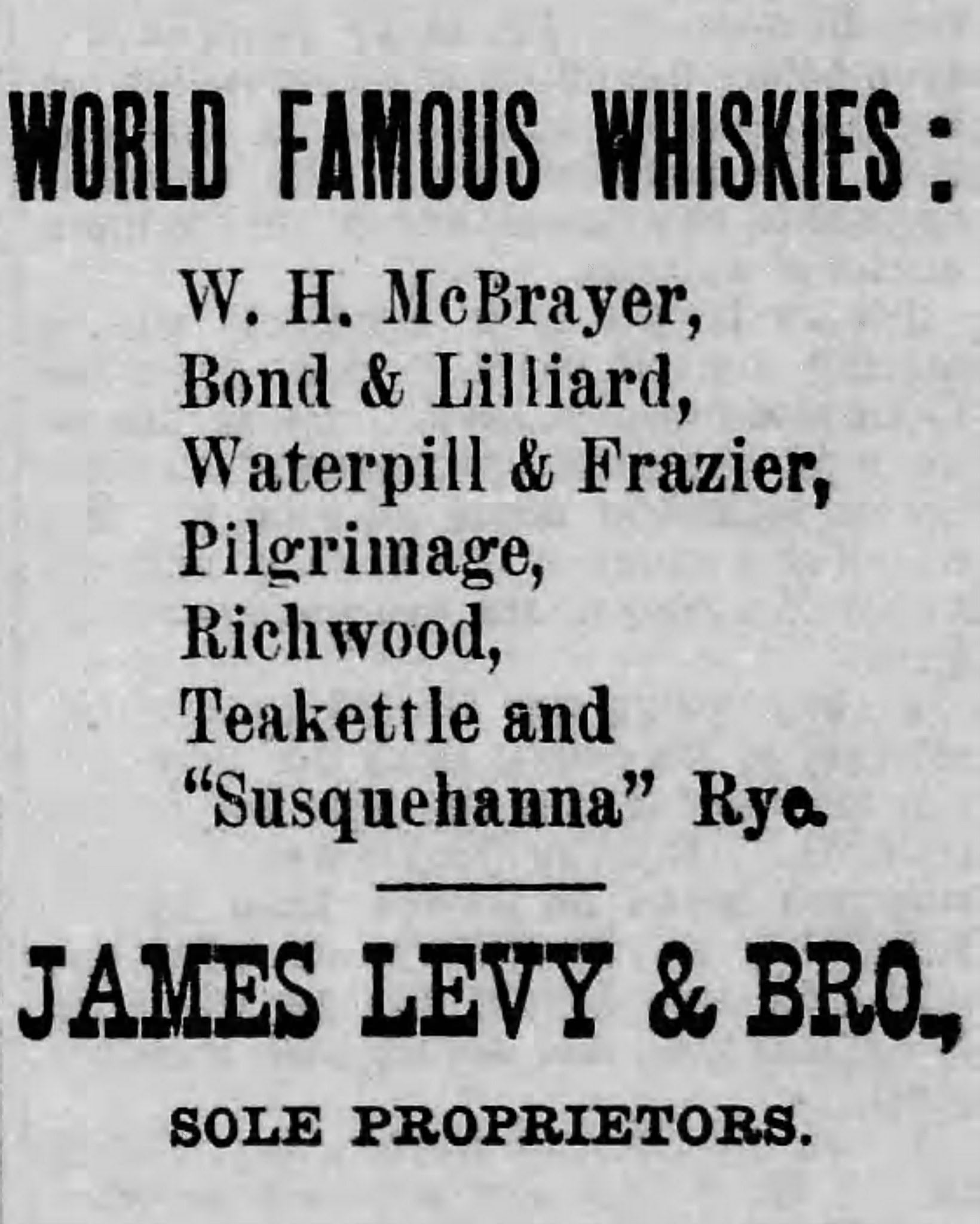
James Levy & Bro., though based in Cincinnati, was heavily invested in its Kentucky whiskeys, even going so far as to invest in roads and railroads in Trimble and Anderson Counties to ease the exportation of barrels and improve supply chain efficiency. By the late 1880s, James Levy had transformed Cincinnati into a thriving market for Kentucky whiskey. The 1888 Centennial Review of Cincinnati praised the business, saying, “Twenty years ago Louisville would have considered impossible recognition by the jobbing trade of any city outside of itself as a jobbing market for fine Kentucky whiskey; yet the firm of James Levy & Bro. has not only made Cincinnati recognized as such, but has plucked the laurels from Louisville…”
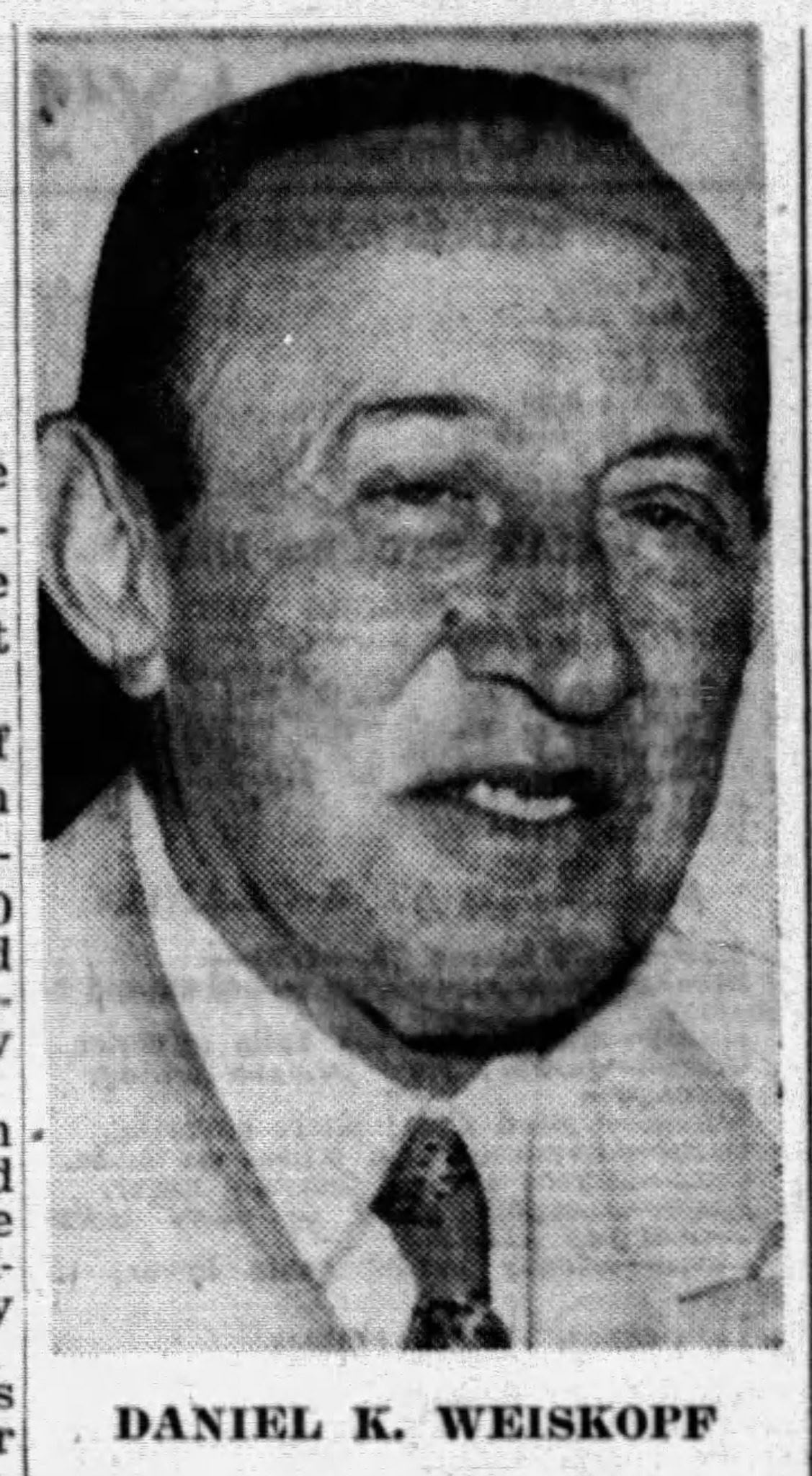
By the late-1890s, however, James Levy & Bro., along with the rest of the liquor industry, found their sources suddenly compromised when the Whiskey Trust, aka the American Spirits Manufacturing Company (ASMC), began buying up the distilleries in Kentucky. Many of the buyout negotiations were spearheaded by Cincinnati’s Daniel K. Weiskopf on behalf of the trust. (D.K. Weiskopf was son to Levi Weiskopf, a well-established liquor dealer in Cincinnati.) In 1899, the ASMC consolidated these purchases into a subsidiary known as the Kentucky Distilleries and Warehouse Company. James Levy & Bro. could no longer rely on the Whiskey Trust to supply fair pricing on the brands their company had been representing for decades. Their ownership of the Richwood Distillery became a huge advantage for the company. They were able to maintain a position of strength within the industry even as so many other liquor companies were fighting to remain competitive. George W. Harris, senior partner at James Levy & Bro., is quoted in 1899 in Louisville’s Courier Journal:
“I am immensely pleased with the position that the action of the agents of the combination has placed our concern in,” remarked Mr. Harris. “We will be the only Cincinnati whiskey house in the business with Kentucky Bourbon distilling properties in our possession, and with all the others having sold their Bourbon distilleries out to the combination, including A.Senior & Sons, Freiburg and Workum, Elias Block & Sons, and James Walsh & Co., it is easy to see that we will expect to enjoy an unusual advantage. To show our extreme satisfaction with the trend of affairs and our contempt for the case the combination proposes to file against us I might mention that we have decided to erect on the property of the Richwood distillery a sixty-thousand-barrel warehouse to accommodate our increased production, its having been decided to double the capacity of both the Richwood plant and the Pilgrimage house. This work will be done this summer so as to be ready for the fall season.”
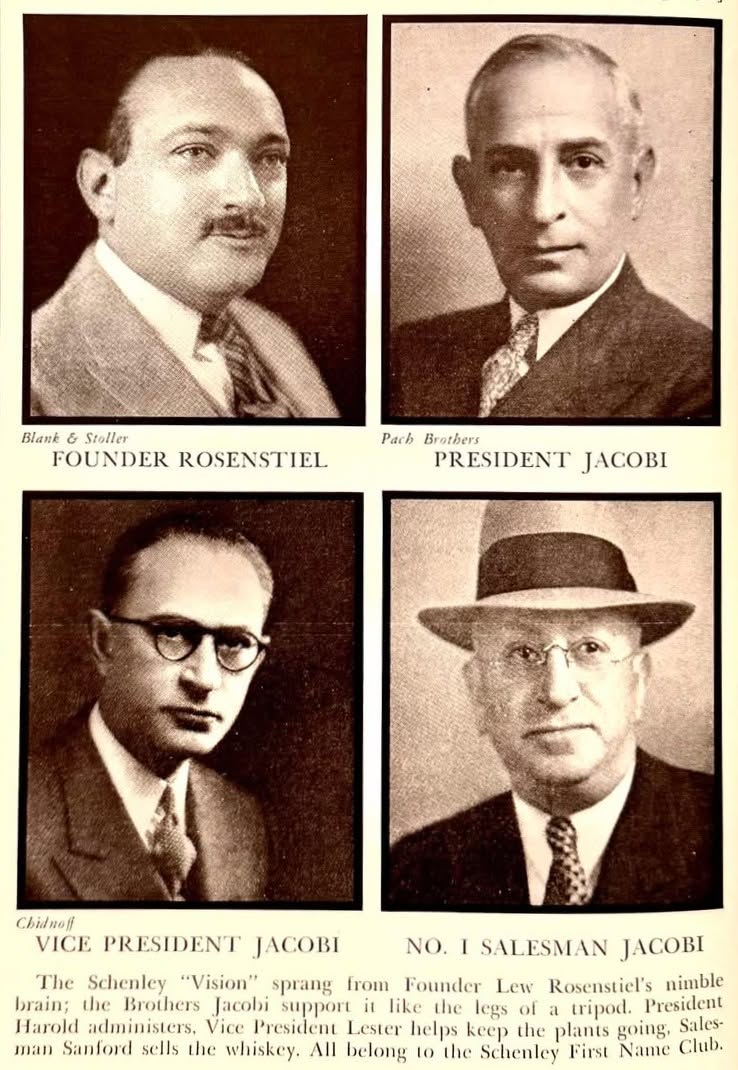
This tactic of owning distillery properties to control one’s own destiny would become the vision of the next generation of distillers. Mindsets were shifting in Cincinnati- The whiskey wholesaler would become the whiskey broker after the turn of the century. The ambitious men at the forefront of this dynamic shift in the industry were Daniel K. Weiskopf, Lester E. Jacobi, and Lewis S. Rosenstiel.
(You can read more about Daniel Weiskopf HERE )