If Park & Tilford had its own show on HBO, it would probably be called “Gilded Age Grocers”- where everyone smelled of French cologne, smoked Cuban cigars, drank imported liquors, and ate fancy, imported snacks on silver platters. The company’s owners did not start off as elite members of New York society, but Park & Tilford’s mercantile business grew right along with the city’s wealth and population, so they were primed for assimilation into the upper class. And even if they weren’t born with memberships to New York’s private clubs, they earned their fortunes and positions in the city…and married into it, too, which helped😊 Park & Tilford isn’t always mentioned as one of the big names in the pre-Prohibition American whiskey landscape, but they deserve more attention. They are mentioned here and there in whiskey history books, but there aren’t many places where one can read about their contributions to the whiskey industry. This may be due to their being a New York-based company or that they often get lumped into the category of companies that made post-Prohibition brand acquisitions, but there’s more to it than that. Let’s remedy this, shall we?
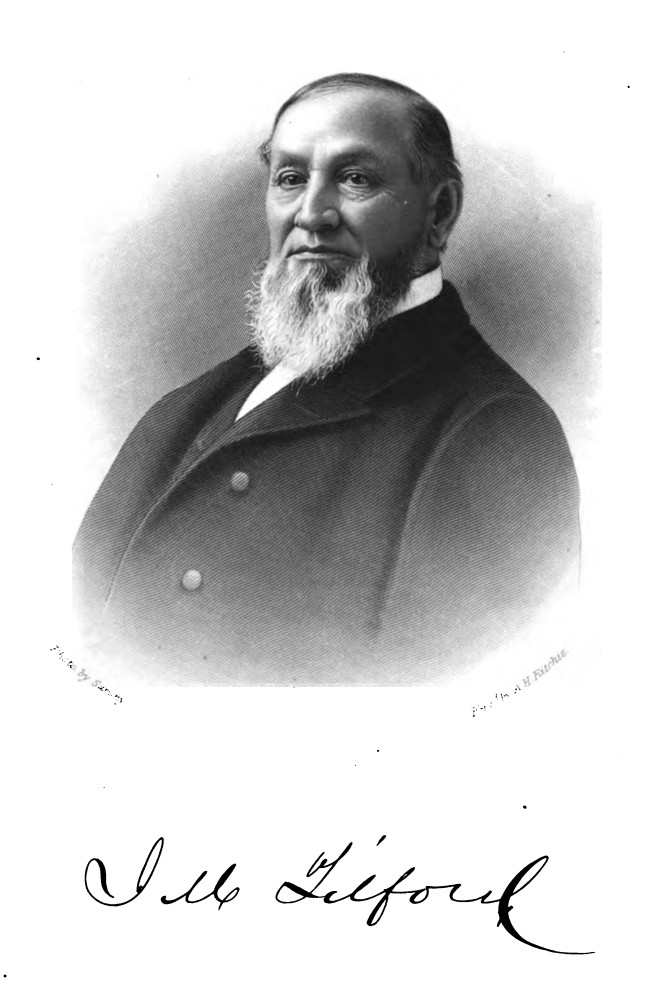
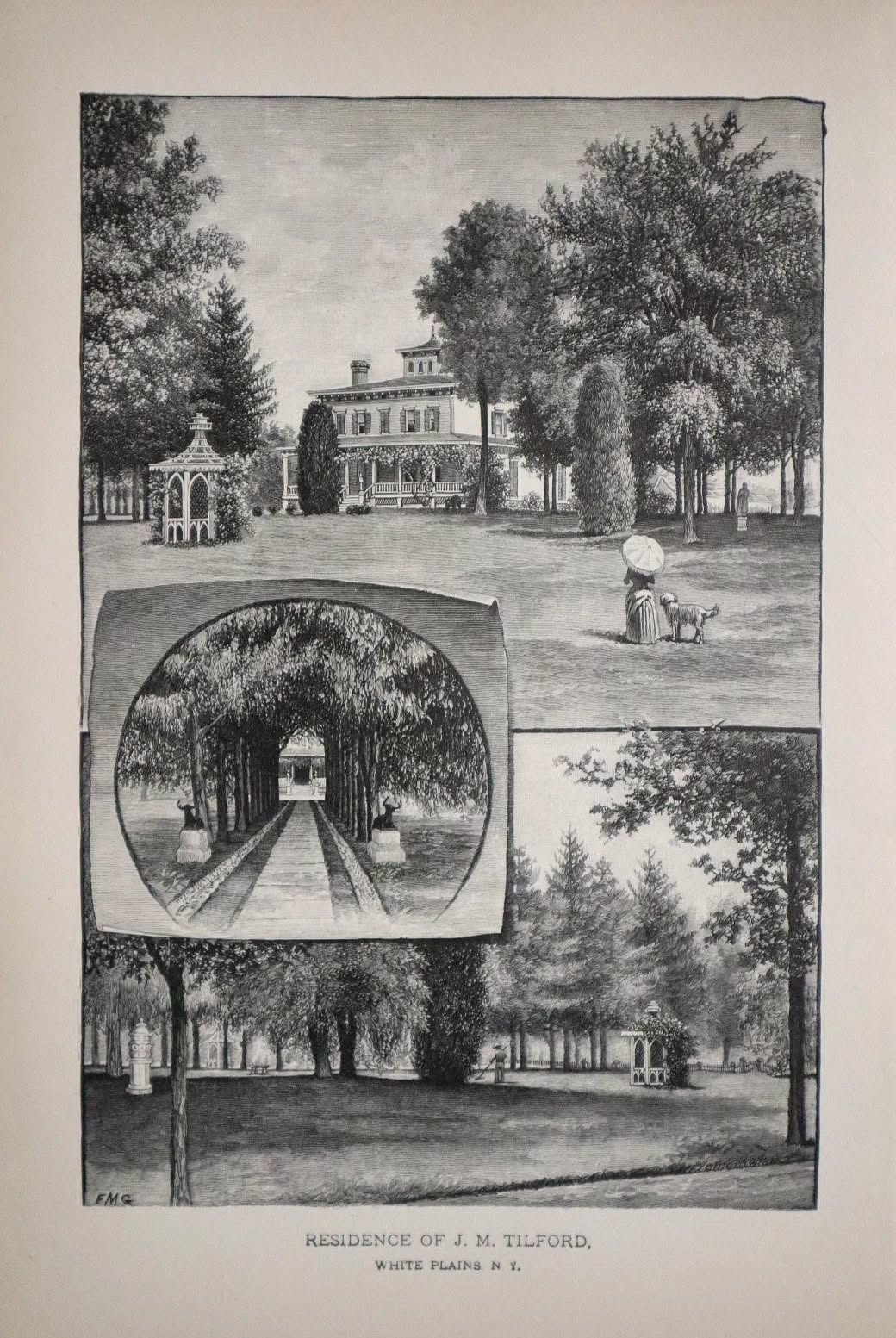
John Mason Tilford18451845
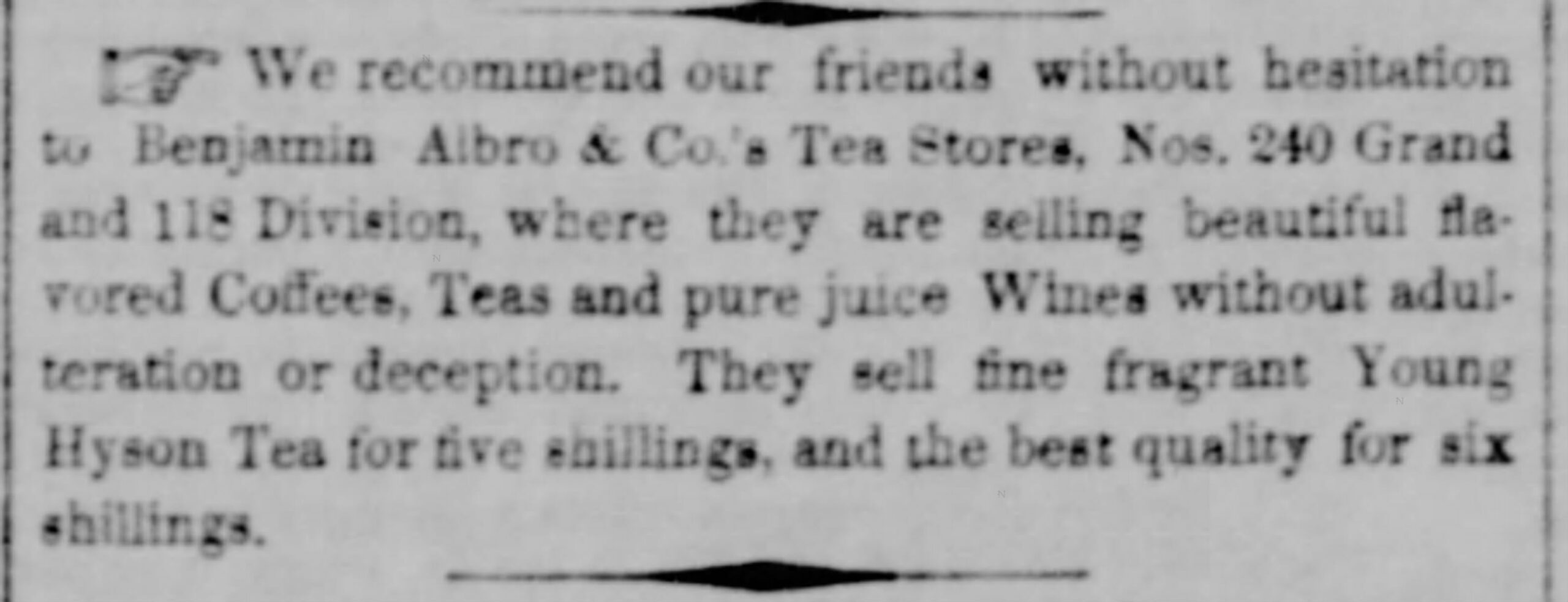
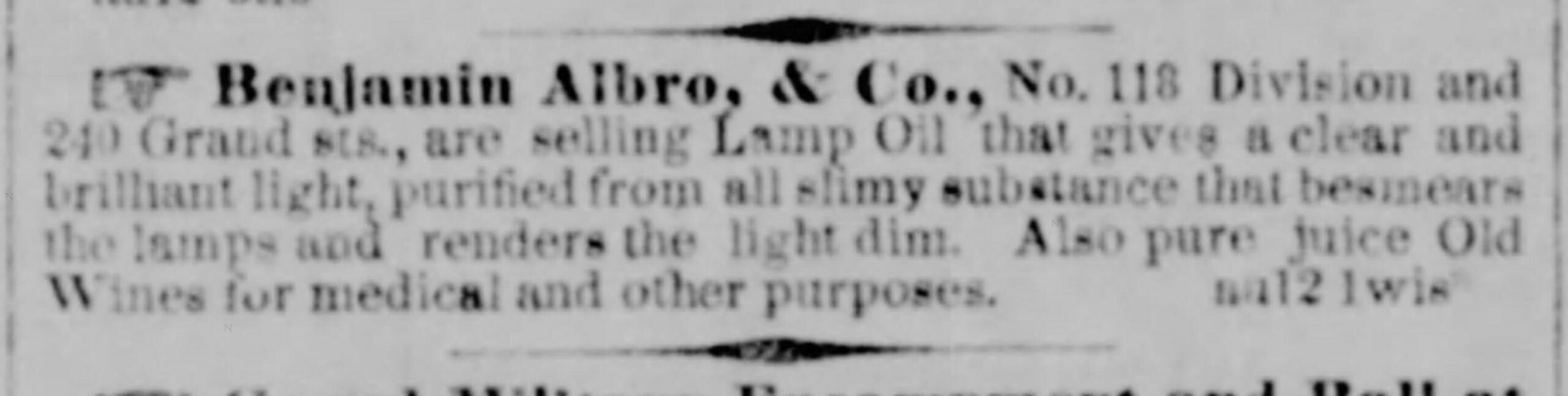
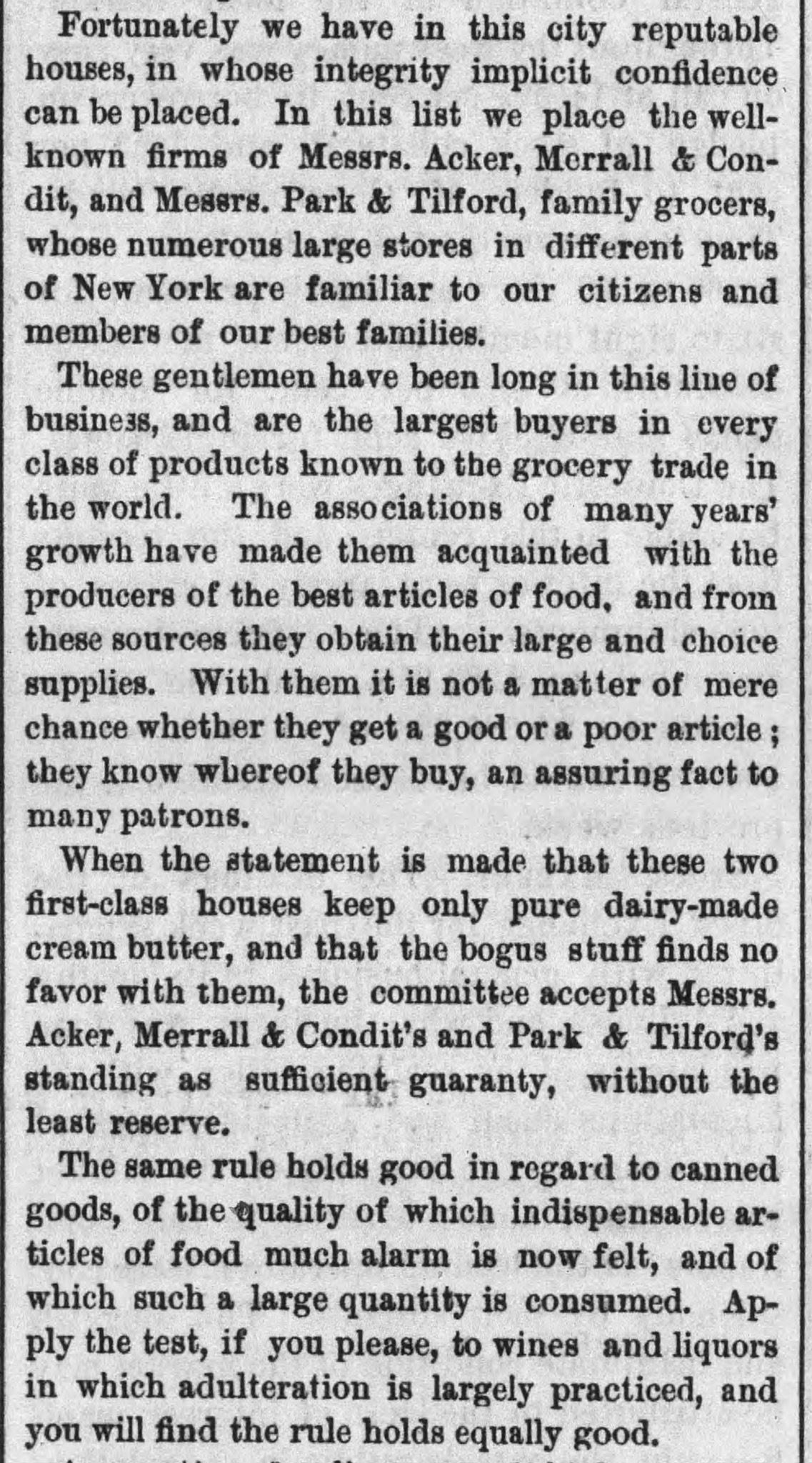
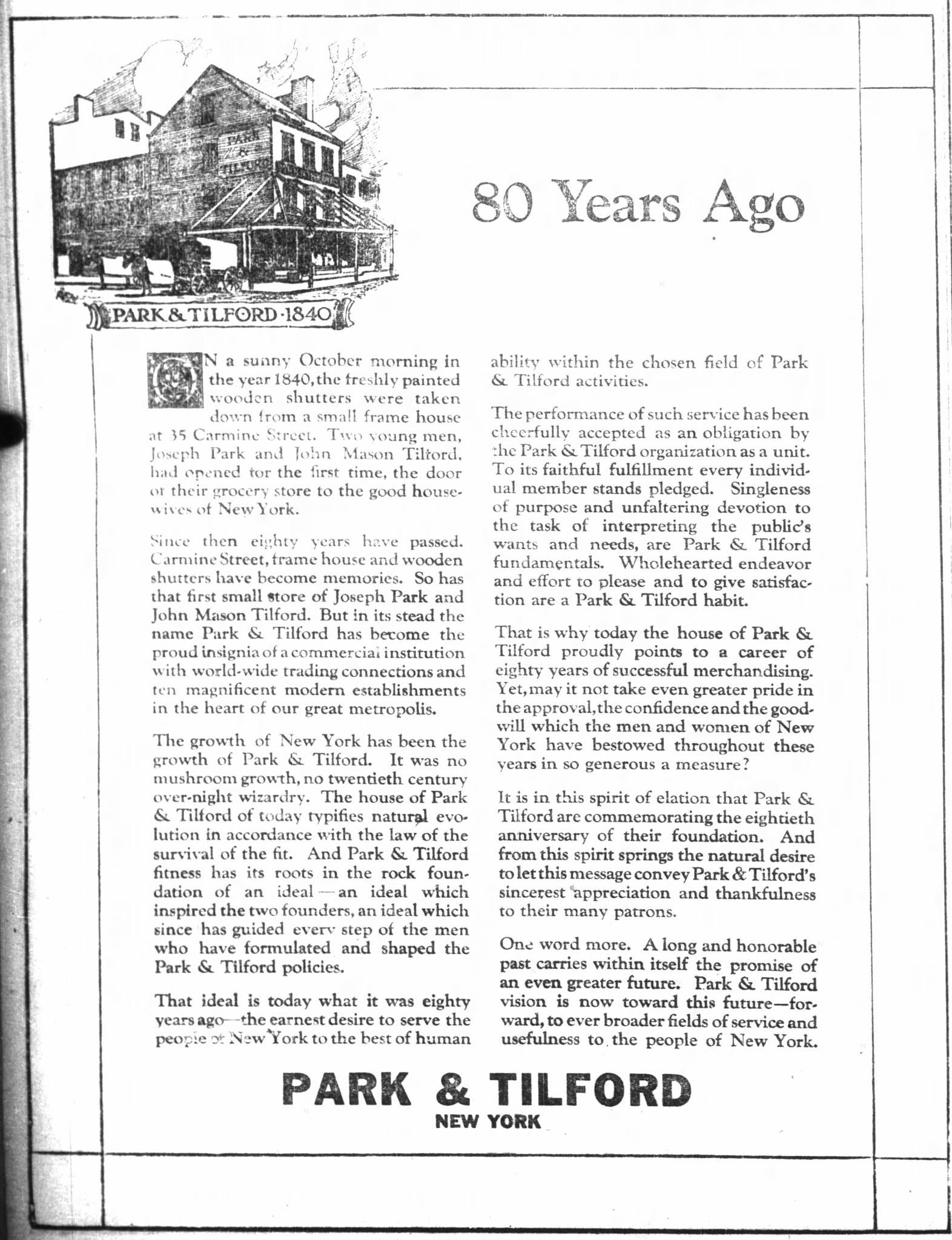
Park & Tilford, or “P&T” as 19th century New Yorkers referred to the company, was founded in 1840. The founders of the company, Joseph Park (born 1823) and John Mason Tilford (born 1815) had been fellow clerks in the grocery house of Benjamin Albro, a leading trade merchant in New York City during the early 1800s. Neither young man had any wealth to speak of. Joseph Park was originally from just outside of Rye, New York, and was the son of farmer. John Tilford was the son of minister from Argyle, NY, a town much further north above Albany. After gaining experience with one of the finest suppliers of export goods in the city, the two men struck out on their own and hung their first shingle at the southwest corner of 6th avenue and 9th street, an old-fashioned three-story shop with a wooden awning frame.
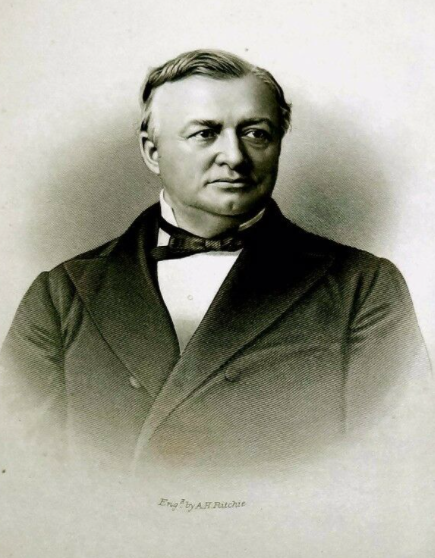
Joseph Park
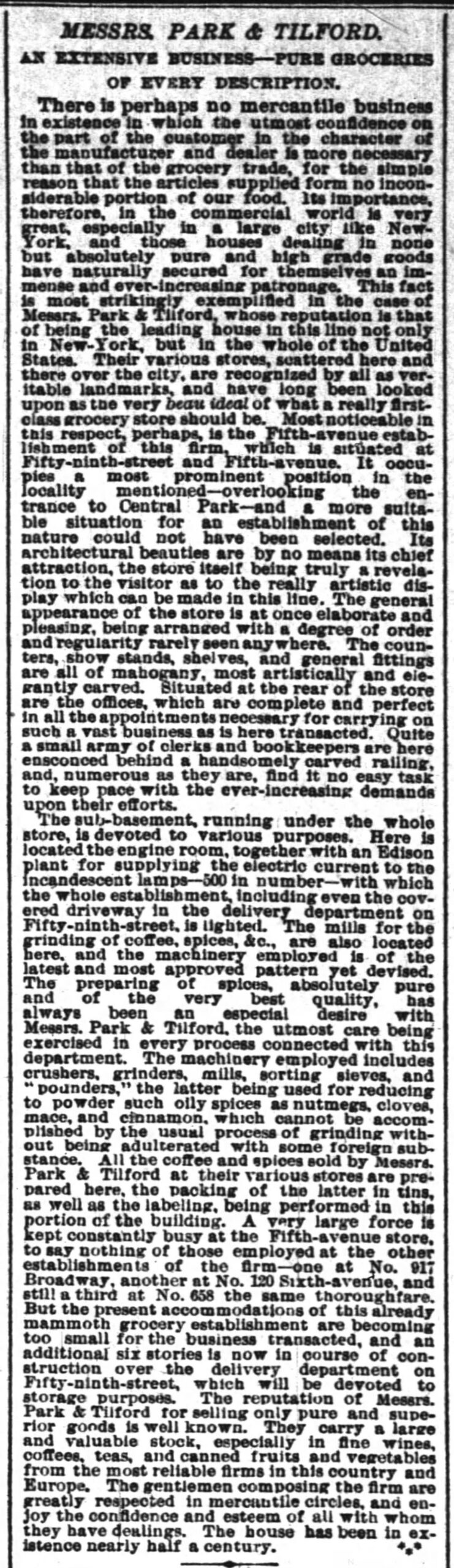
Park & Tilford built their reputation slowly, investing their income in the improvement of their stocks and in the expansion of their business. They knew that the relatively young, emerging metropolis loved imported goods, so they focused their attention on English products, cigars from Havana, Cuba, and delicacies, liquors, and perfumes from France. By the 1860s, Park & Tilford had established themselves so well that newly established businesses were using P&T’s Manhattan address in their ads to describe their own locations! And by the 1880s, when Joseph Park was in his 60s and John Tilford was nearing 70, Park & Tilford had four locations in New York City and another in Paris which served as their hub for exports into the U.S. They didn’t even need to advertise, relying instead on their own reputation for “Reliability” and on word of mouth. Both men brought their sons in as partners to run their satellite locations. They incorporated their firm into a stock company under the laws of New Jersey in 1890.
1886
Now, New York City’s fancy grocery concerns like Park & Tilford had a trick up their sleeves. Temperance forces were pushing for more regulations on how liquor was handled and sold during the 1880s. By 1887, the High License Law required that licenses to sell liquor to the public would be separated into categories. “Light wines”, beer and malt liquors, liquors- they would all be assessed and taxed differently (well, even more so). The intent of the bill was to put saloons and liquor dealers out of business, and to place preference upon those businesses selling for “off premises” consumption. The groceries had always existed in a kind of loophole within the liquor industry. Liquor was never their primary concern, but it was certainly a primary source of income for them! In February 1887, Miles Gibbons, Secretary of the Wine, Beer, and Liquor Dealers Association of New York State defended the liquor dealers saying, “(The) license for places selling liquor not to be drunk on the premises…was for the benefit of Park & Tilford and other large grocers who sell more whiskey and wine in an hour than the ordinary saloon-keeper does in a year.” Purposely flying under the radar by catering whiskey sales to the elite classes of New York certainly benefitted those Gilded Age grocers!
Part 2- The Founding Families
John M. Tilford passed away on January 7, 1891, after over half a century building one of the finest and well-known businesses in New York City. He died just a few months after Park & Tilford was incorporated under the laws of New Jersey (1890). While John Tilford had been a grocer, the director of several banks, and an ardent protector of his business interests, he had not been involved in any societies or clubs. His sons, however, were ready to prove their place in society.
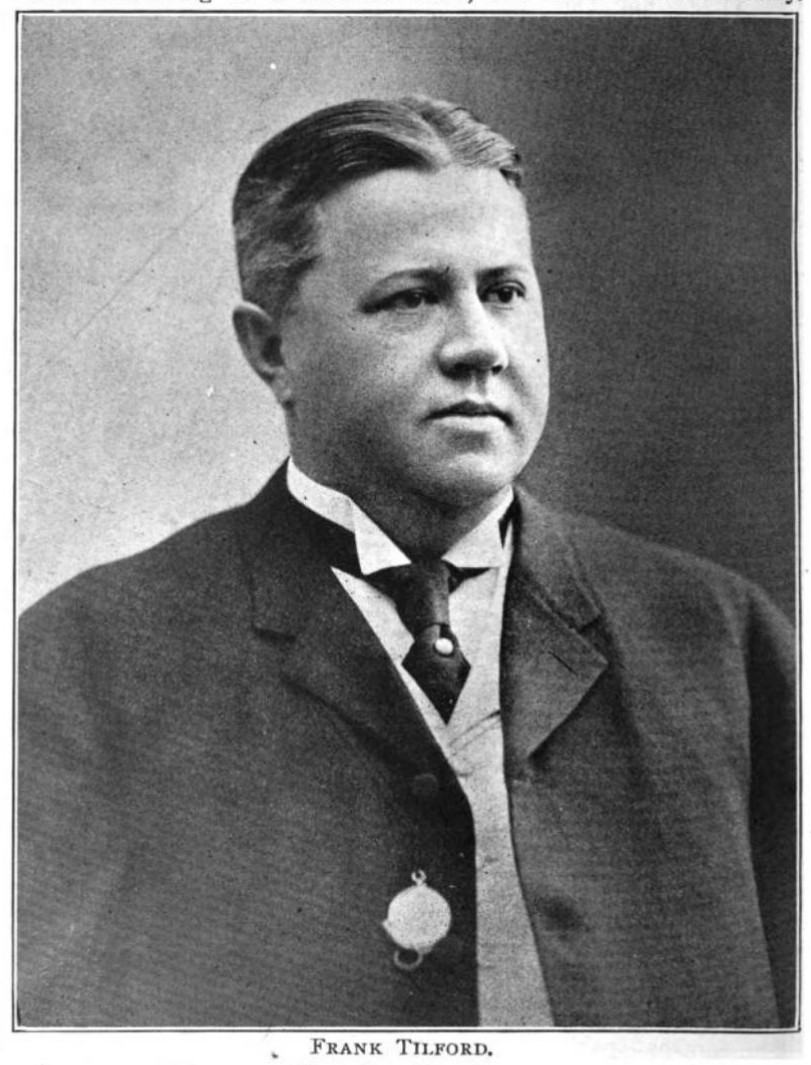
The year after their father’s death, his sons, Charles E. (born 1848) and Frank Tilford (born 1853) were listed among New York’s wealthiest men in the Tribune Monthly’s June Edition. The issue was called “American Millionaires: The Tribune’s List of Persons Reputed to Worth a Million Or More.” (The publication was meant to defend the wealthy status of America’s elite and support the tariffs that enabled an extension of the Gilded Age after President McKinley’s election.) Frank began to publicize his way into old money status. He had two daughters with his wife, Julia (Greer) Tilford. Julia’s father, James A. Greer, was a soldier who died in 1861 when she was just a toddler, but she was raised by her mother in New York. Her grandfather, George Greer, had been a successful merchant in New York City during the early 1800s and president of Greer, Turner & Co., a sugar refinery with its factory on Front Street. Marrying Julia meant marrying into old New York money, but still part of the merchant class. After his father’s death, Frank began to frequently proclaim that his mother, Jennie White, had family that came over on the Mayflower and described them as “tillers of the soil” (John Tilford was the son of a farmer!), that his father’s name could be traced back to the Norman conquest, and that “Tilford” meant “sword edge” because his ancestor had cut a barbarian king in half. (Nothing like a little heritage to hang your new money on, I suppose😉. The Gilded Age was full of men and women desperately trying to rationalize their wealth and lifestyles!) Frank lived at 245 W. 72nd Street, but in 1895 commissioned the plans for his own country estate in Cedarcrest, Long Island, which he named “Arcadia”. (Later called Mar-a-Vista)
New York Tribune. May 5, 1896.
Frank Tilford
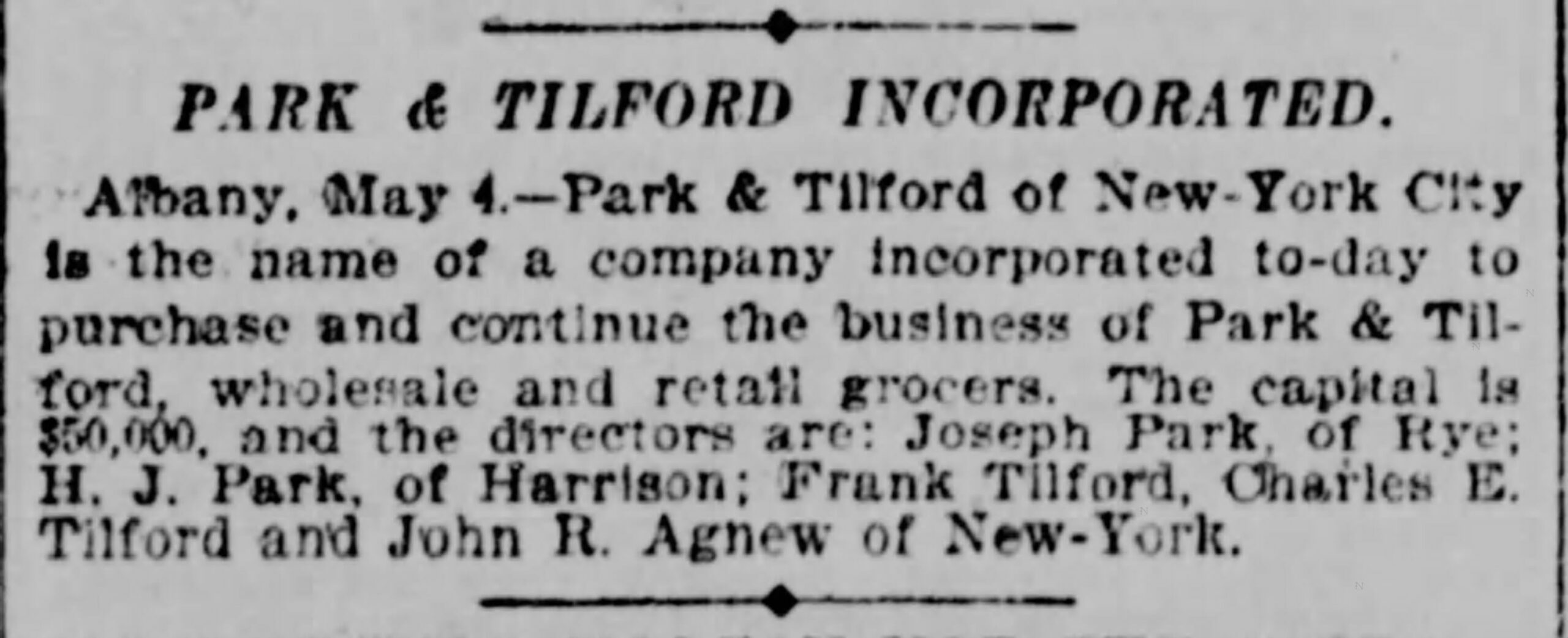
Charles E. Tilford, John Tilford’s eldest son, was less ostentatious than his younger brother, but no less involved in Park & Tilford’s business. When the company was incorporated again in 1896 with new directors in place, Charles was right there beside Hobart J. Park (son of Joseph Park) and his brother. The families were also invested in several New York banking concerns, held memberships at many elite clubs like the Union League of Manhattan and the American and New York Yacht Clubs, and maintained their presence within the Chamber of Commerce and the Produce Exchange. Charles was just as committed as his brother to maintaining his family’s new position in society, even if he was the more reserved of the two. He disowned both of his own children because they chose to marry outside of their class. His son, George E. Tilford, married an actress named Rita Selby, and his daughter, Etta, married a coffee broker named Edward K. Kirkland. When Charles died a millionaire in 1899, his will was specific in leaving his 75th street residence and the income from his estate to his wife, Corinne, while leaving each “child” $6,000 a year for life (considered a paltry number for the heirs of a millionaire). Meanwhile, the lion’s share of his wealth was donated to charities which included museums, hospitals, and animal shelters. George and Etta contested the will on the grounds that he was not legally allowed to leave more than half his estate to charities. Charles’ children may have married OUT of wealth, but they had no intention of leaving any of their father’s money to charity!
Suffice it to say, the Tilford brothers were keen on maintaining their status as gilded members of New York’s elite. Park & Tilford began to struggle a bit when Frank Tilford took the reins from his father and Joseph Park began to retire into the wings before the turn of the century. Frank’s desire to live according to his status in the mid-1890s likely took a toll on the business because the company was offered for sale on the London exchange in 1896. The sale never took place, and the company reorganized (see incorporation announcement below). Large grocers like Park & Tilford were tied to the wealth of New Yorkers, so the financial crisis of 1893 and the 1896 presidential election created a lot of tension and concern about the future of their industry. Once McKinley was elected, things calmed down for the upper classes, but things began to change again after the death of Joseph Park in 1903.
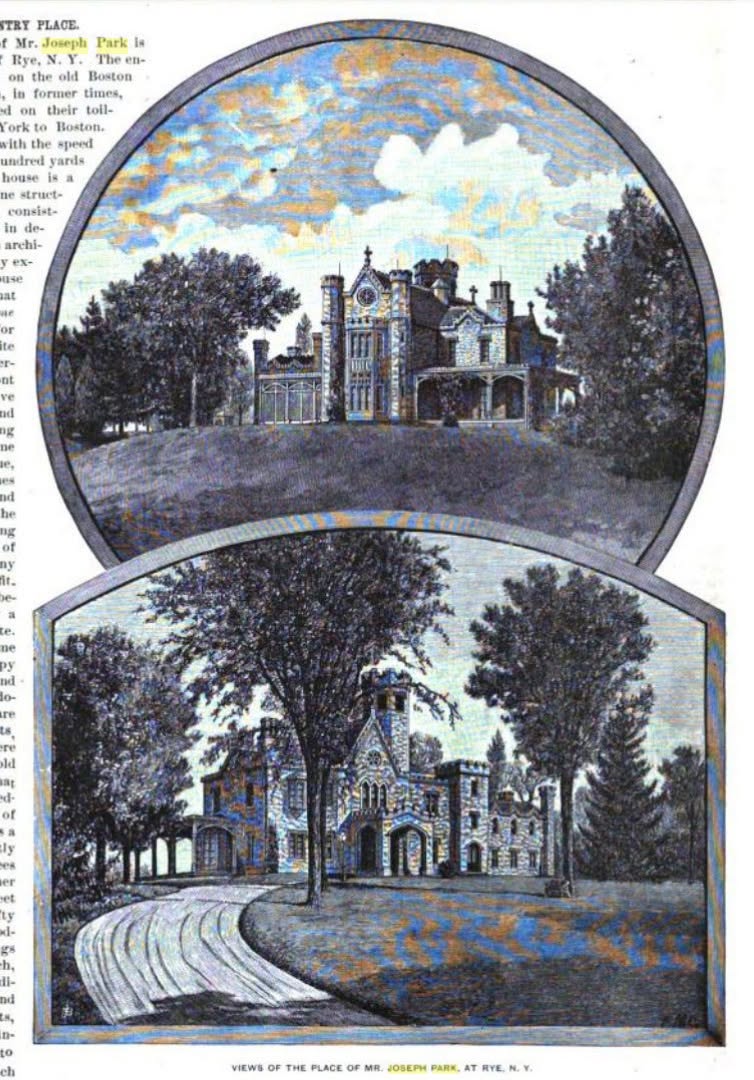
Whitby Castle in Rye, NY
Joseph Park had maintained his position of president of the company after John Tilford’s death in 1891. Frank Tilford was made vice-president in his father’s stead, but he had a slightly different vision for the firm. Joseph may have been in charge, but he slowly began to retire from his grocery business and place more of his time in banking. Between 1868 and 1886, Joseph Park had been building up his 160-acre estate on land in Rye, N.Y. which had once belonged to his father-in-law, Allan Carpenter. Joseph’s wife, Mary T. (Carpenter) Tilford, passed away in June 1883 at the age of 63. Her death may have encouraged Joseph to find a different residence several years later. In 1886, Joseph became the owner of Whitby Castle, which had famously belonged to the Chapman heirs. (It’s possible that the Chapmans lost their banking fortune during the crash.) When he died, he left Whitby Castle to his eldest son, George Carpenter Park (born 1852) and his original estate in Rye, N.Y. to Hobart Joseph Park (born 1855). George and Hobart had remained with their father’s company for several years after their father’s death, but in 1906, Hobart sold his share of the interest in Park & Tilford to Frank Tilford. The Park brothers turned the focus of their attention, instead, toward real estate and philanthropic work. Frank Tilford incorporated the company under the laws of New York after taking over the company. (replacing their previous incorporation since 1890 through the laws of New Jersey).
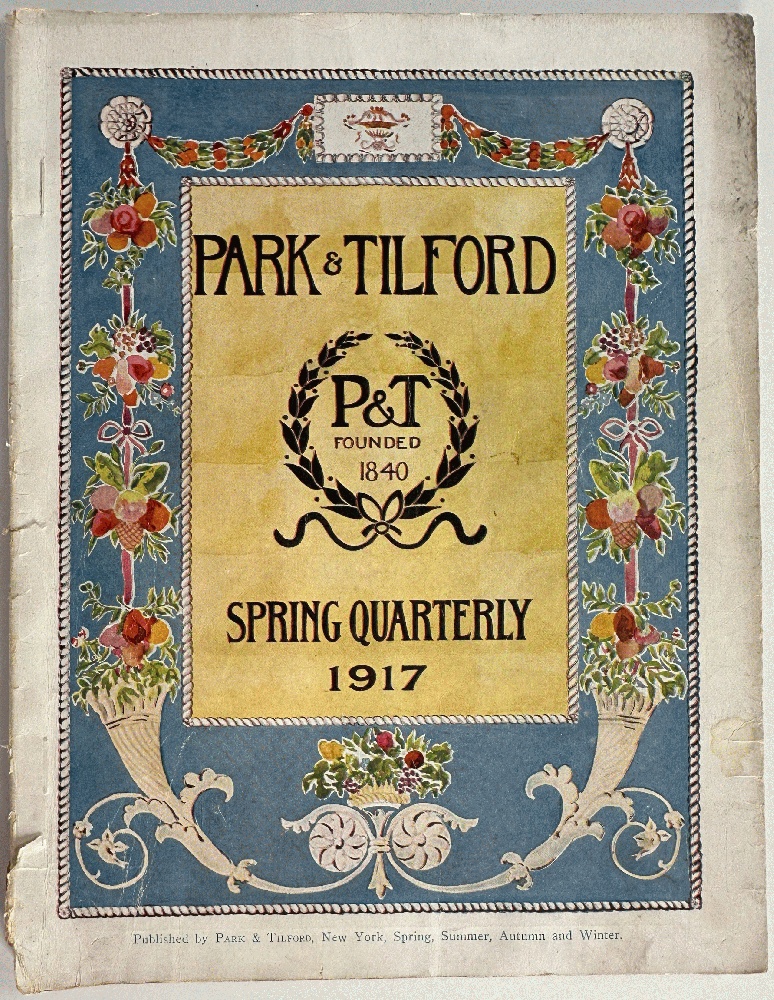
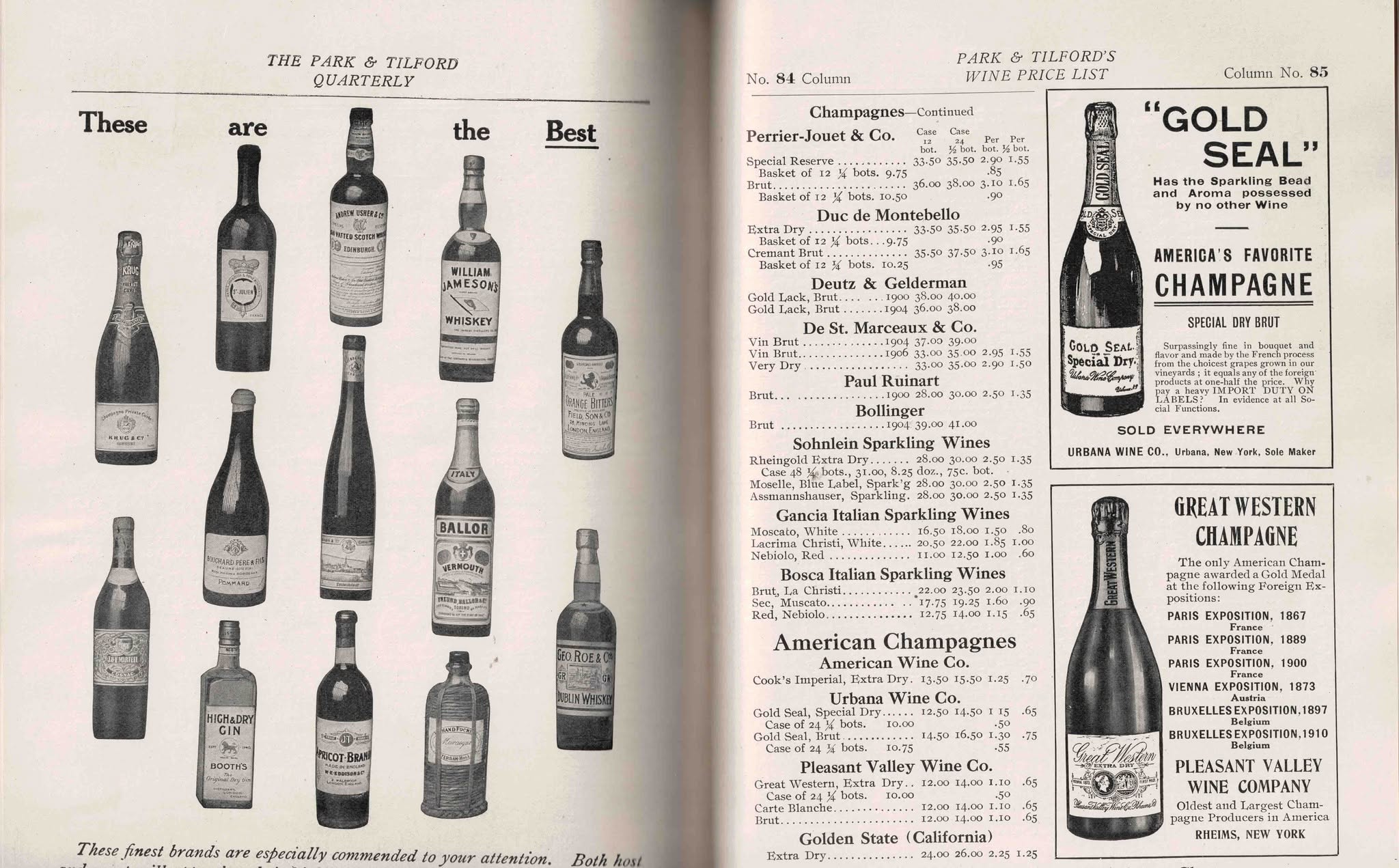
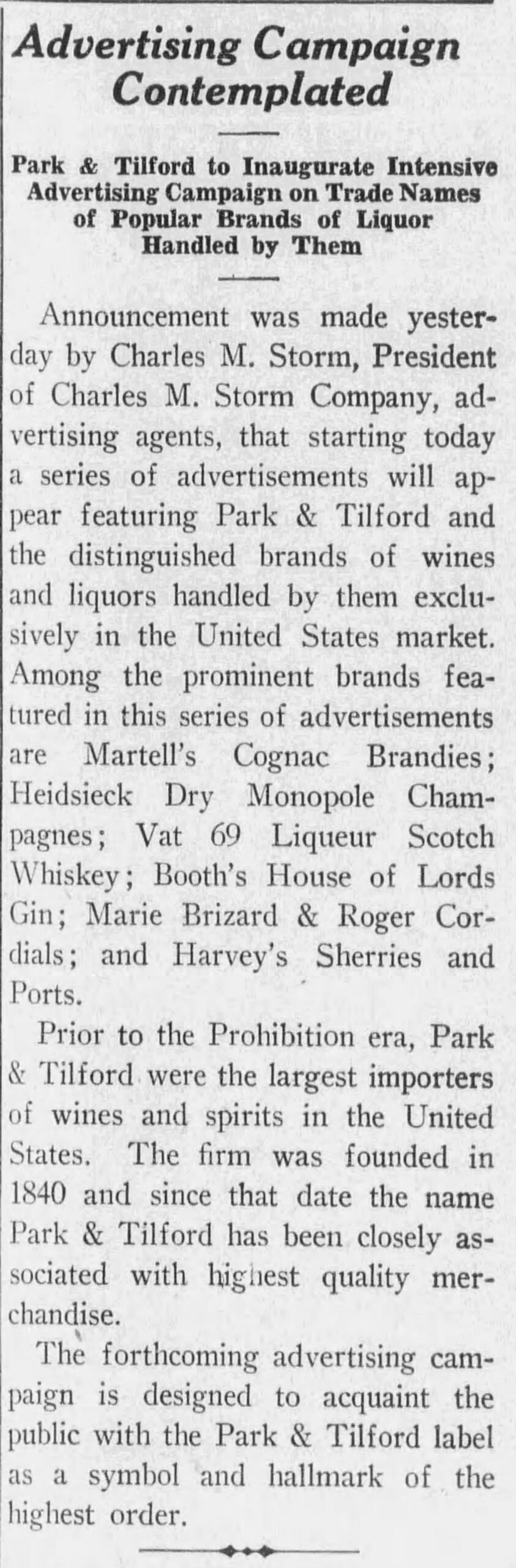
Remember when I said that Park & Tilford had no need to advertise? The company’s founders believed advertising to be beneath them, so they maintained a policy against it. In its 67th year, however, Park & Tilford launched its first coordinated advertising campaign under the direction of Frank Tilford. On June 26, 1907, the “Printers’ Ink Journal for Advertisers” published a 5-page article describing the company’s new policy of reaching a wider, more national audience. (Frank Tilford’s huge photographic portrait took up most of the article’s second page and a sketch of his family’s bona fides followed on the third page!) The Food & Drug Act was figuring prominently in the newspapers at the time, and Park & Tilford was keen to stress their ambivalence toward the bill because they would never have dreamed of allowing any tainted or lesser items to be sold in their stores in the first place! Their liquors, wines, and food stuffs were, as always, above board and of the highest quality. The company also began to publish their “Park & Tilford Quarterly”. The catalog was published seasonally to aid their expansion and encourage shipping of their products through the mail.
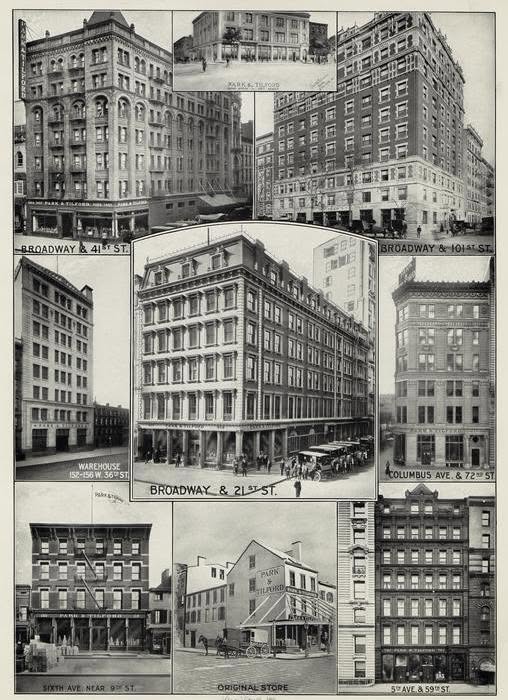
By 1909, Park & Tilford boasted 11 locations, 9 of which were in New York City with two additional export hubs in Havana and Paris. Frank Tilford had no intention of slowing down…even as the curtains were closing on the Gilded Age’s excesses in New York.
Park & Tilford’s 9 locations in NY
Part 3- Prohibition & New Ownership
1912
In yesterday’s post, we left Frank Tilford in 1909 amid expansion for Park & Tilford’s business. Tilford built his newest store at Lenox Ave in Harlem (corner of 126th St.) to create more access to his products for the city’s growing suburban population. The company continued to stand tall on its reputation with New York’s wealthy citizens, but by the 19 teens, the P&T, through its vigorous advertising campaigns, had reached the average, middle class resident too. As WWI drew closer, P&T’s
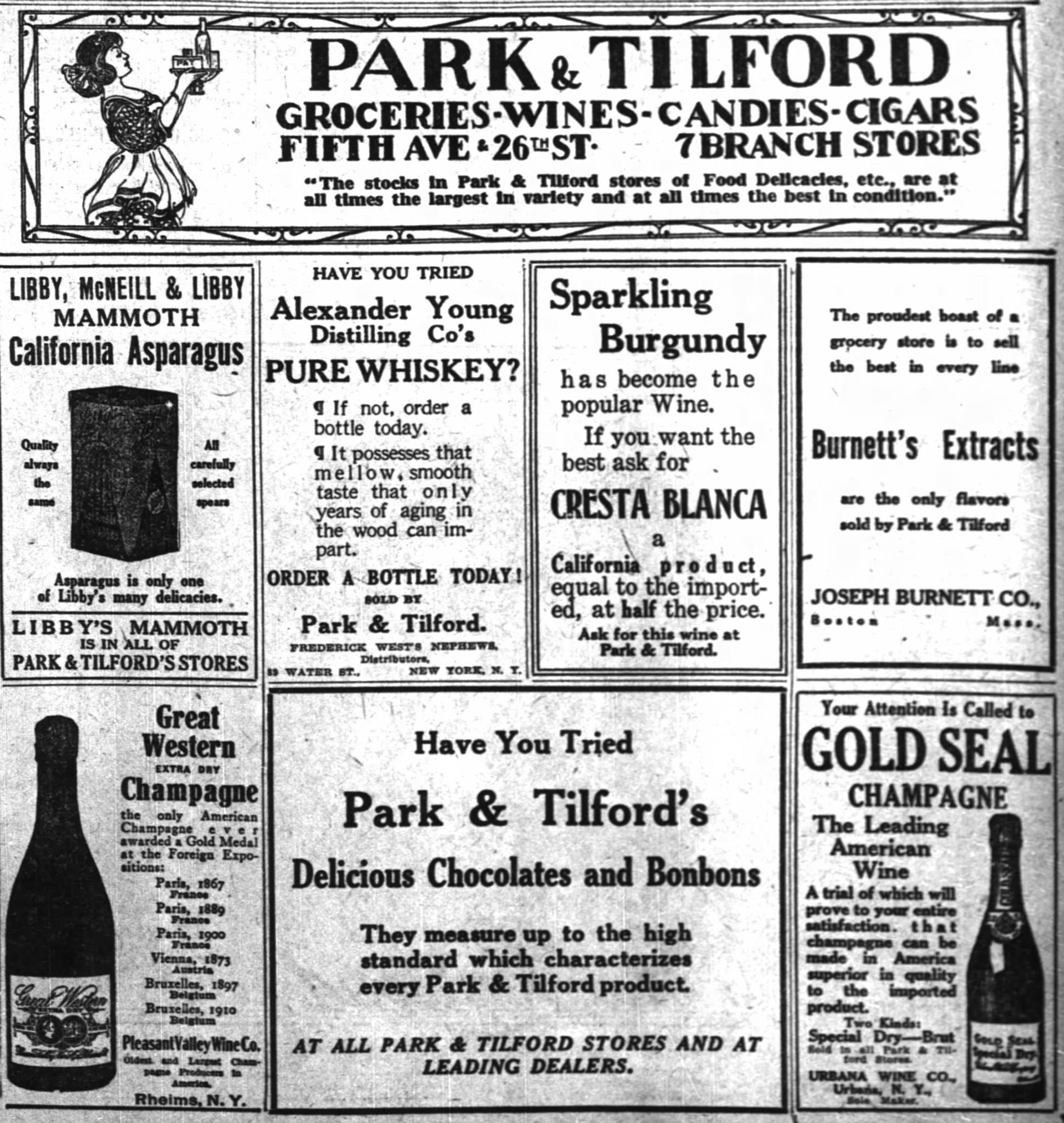
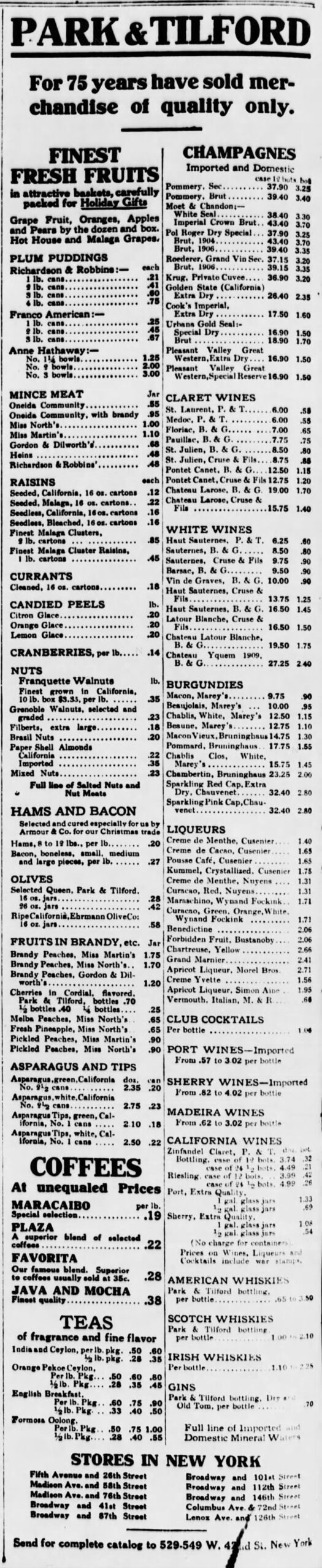
1915. Note the addition of wines and spirits in the ad.
advertising began to lean more heavily into liquor sales. Instead of a casual mention of alcohol in its ads, nearly half of their ad space in the New York Times was committed to promoting their private bottled stocks and that of the companies whose distribution they handled out of New York. The dynamic cultural shift that came with the changing priorities of New York’s population during those early years of the new century had come to Park & Tilford as well.
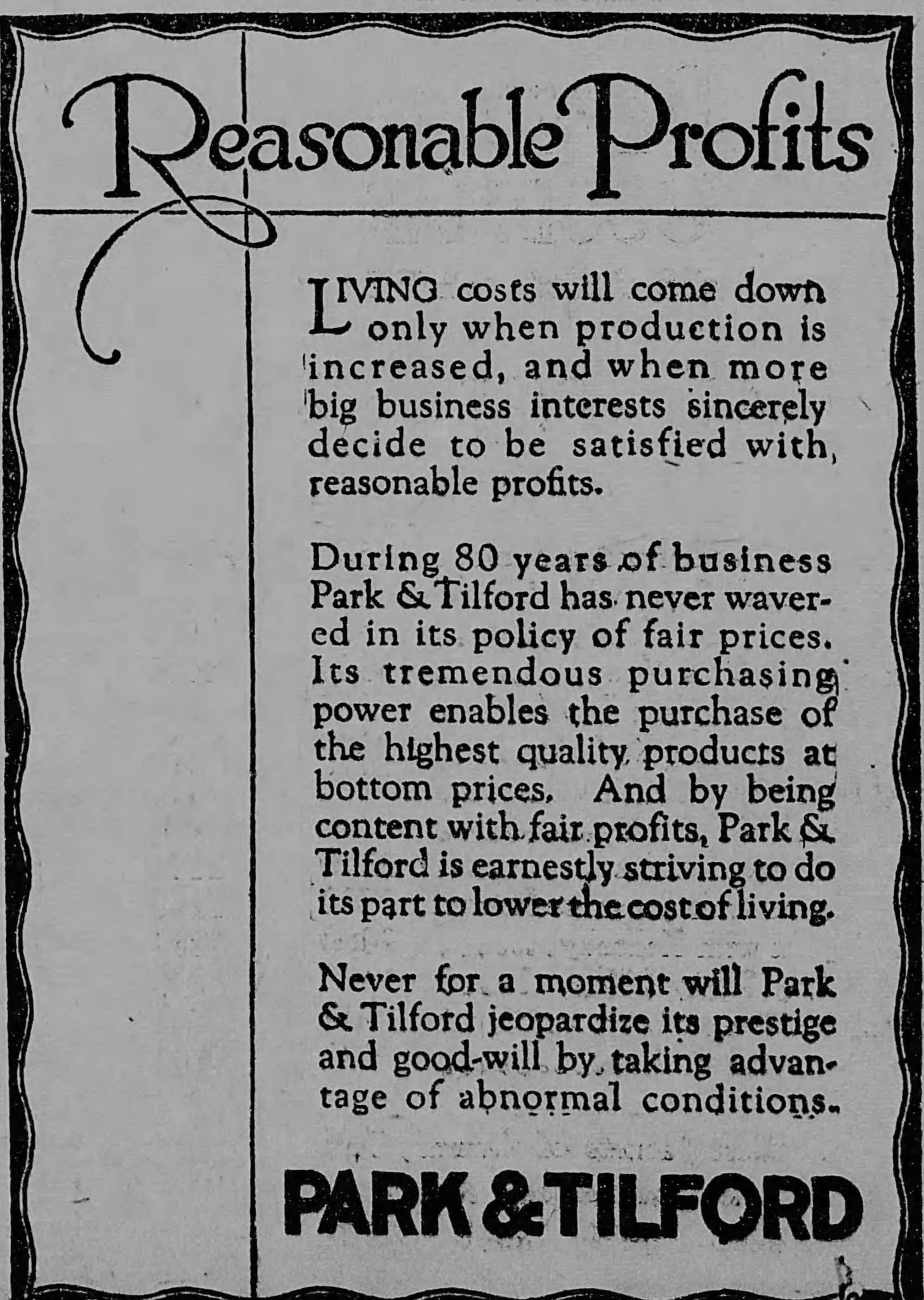
WWII brought an unpredictable marketplace to New York’s grocers. The war didn’t just create issues with the importation of goods and alcohol sales; it also affected public sentiment about high end products and high prices. Park & Tilford stressed in their ads that their prices were the lowest to be found and that their many years in the business gave them the purchasing power to maintain those low prices. Frank Tilford abandoned his campaign to promote his own wealth and status and began to place ads that promoted his thrift instead. He proudly proclaimed when profit percentages from certain days of the business week would be donated toward the war effort. He, and other wealthy men in the city, were making large donations to hospitals and charities. The days of the high-end grocer were coming to an end…no matter what Frank Tilford wished he could do to slow its demise.
1920
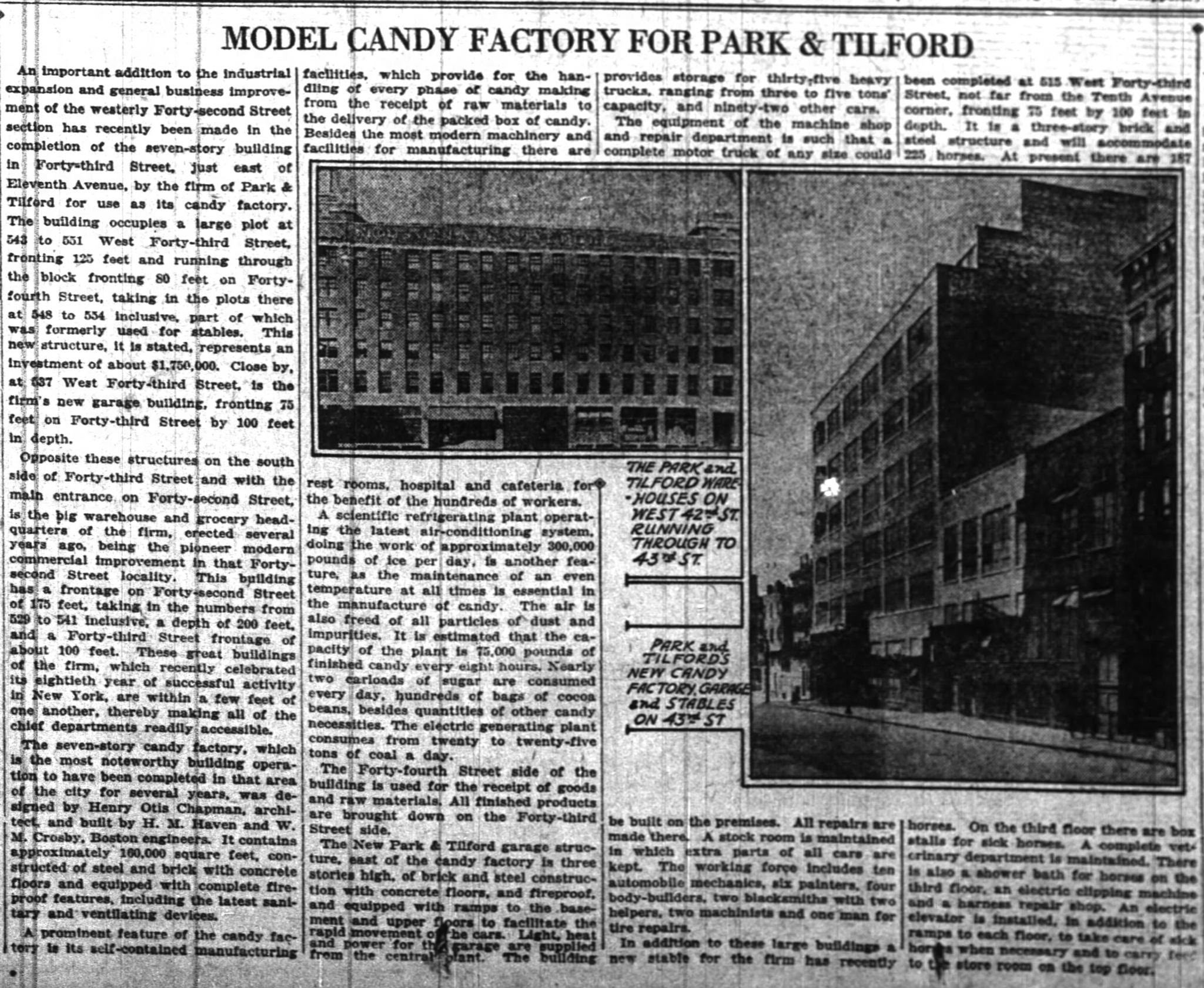
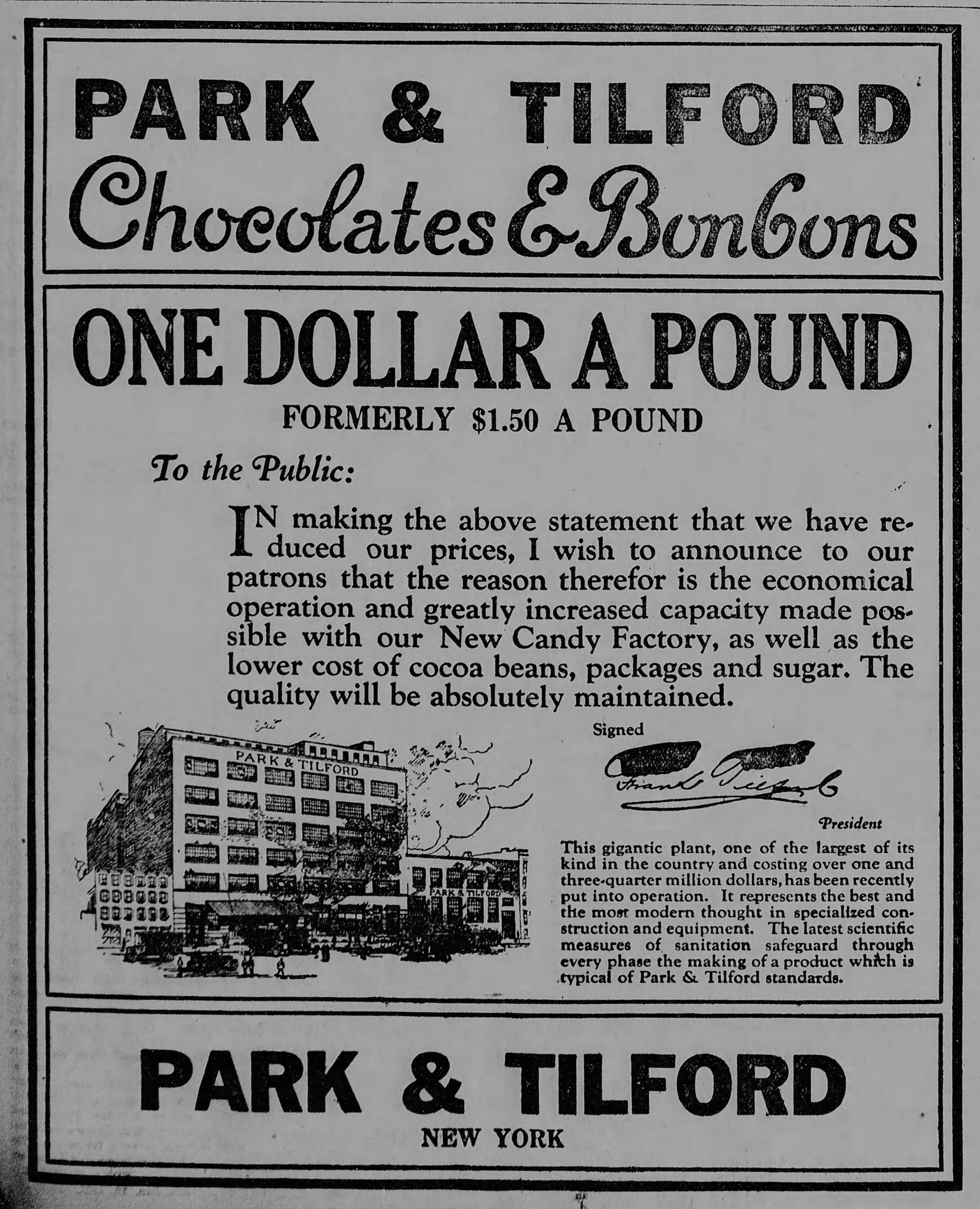
When Prohibition arrived, Park & Tilford took a big hit. Losing their alcohol revenue was a crushing blow, but as a grocery store chain, there were other, albeit less lucrative, options for the business to pursue. In 1921, Frank Tilford supervised the construction of a seven-story candy factory- because who doesn’t want to replace their whiskey with a few bon bons, right? Tilford spent over a million dollars building his huge new factory, but two years later, the investment left him in a financial hole.
19211921
1920
Here, I feel it’s important to mention that while Park & Tilford had been forced out of the liquor distribution business by Prohibition, its distribution network remained very much intact! P&T, even if it was a New York-based business, was still one of America’s largest grocery businesses, and it retained the ability to cast a very wide net. During Prohibition, those businessmen with the understanding that distribution was key to the success of their businesses were the ones to come out on top. Men like Seton Porter of National Distillers understood the importance of distribution all too well. His company had been involved in securing America’s largest liquor distributors since the turn of the century. Lewis Rosenstiel of Cincinnati had already been focused on building his own distribution network out of Cincinnati years before the Volstead Act took effect. And when it came to Park & Tilford, the man who saw the potential behind the 83-year-old company’s nation-wide reach was David A. Schulte.
1923
David A. Schulte was the cigar magnate of New York City in the early 1900s. He was praised for his tireless work ethic and lauded for his refusal to take vacations. Schulte had, under the guidance of his mentor, turned a few tobacco shops near the Brooklyn Bridge into great chain of hundreds of “Schulte Cigar Stores” over the course of 40 years. Of course, Park & Tilford had been running an extensive cigar trade decades before Schulte was even born. They helped to establish the tobacco trade between the U.S. and Havana, Cuba, where P&T maintained an export house. David Schulte’s cigar empire would have been in direct competition with Park & Tilford while securing business contracts in Cuba over the years, so it was in Schulte’s interest to acquire their business- cigars, candy, groceries and all! Frank Tilford was vulnerable during those first years of Prohibition, and David Schulte immediately stepped in to “help”.
In August 1923, Frank Tilford was quoted by the Wall Steet Journal:
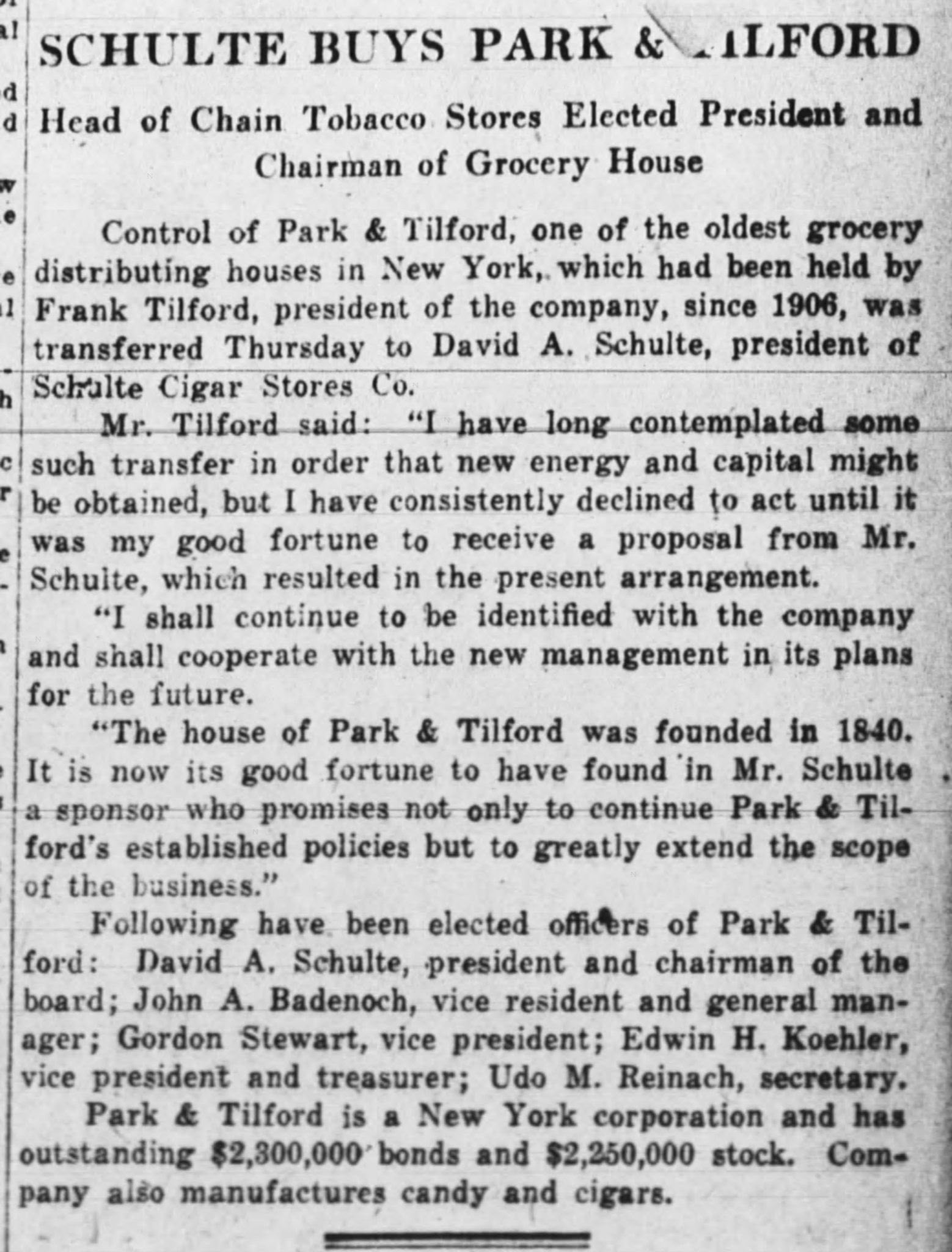
“I have long contemplated some such transfer in order that new energy and capital might be obtained, but I have consistently declined to act until it was good fortune to receive a proposal from Mr. Schulte, which resulted in the present arrangement.”
(…emphasis on good “fortune” )
David A. Schulte purchased a controlling interest in Park & Tilford by supplying Frank Tilford with two million dollars to cover his debt. Tilford owned about 90% of the outstanding $2,250,000 stock of Park & Tilford before the buyout, but he would have to settle for his new position of “chairman of the advisory board” after handing his company over to Schulte.
Park & Tilford’s new officers were: Charles Schulte as President and chairman of the board; John A. Badenoch, vice president; Edwin H. Kohler, vice president and treasurer; Udo M. Reinach, secretary. Almost immediately, with all those freshly invested dollars behind it, Park & Tilford’s sales increased. Candy sales were up, debt was down, new foreign contracts were signed, and the company advertised the hiring of 100 new positions. Business was good in 1923…but Frank Tilford was not.
Frank Tilford retired to his residence in Palm Beach, Florida a few month after the sale to nurse his health, but he did not improve. Frank passed away on March 6, 1924, less than 5 months after the sale of his father’s company.
Part 4- David A. Schulte
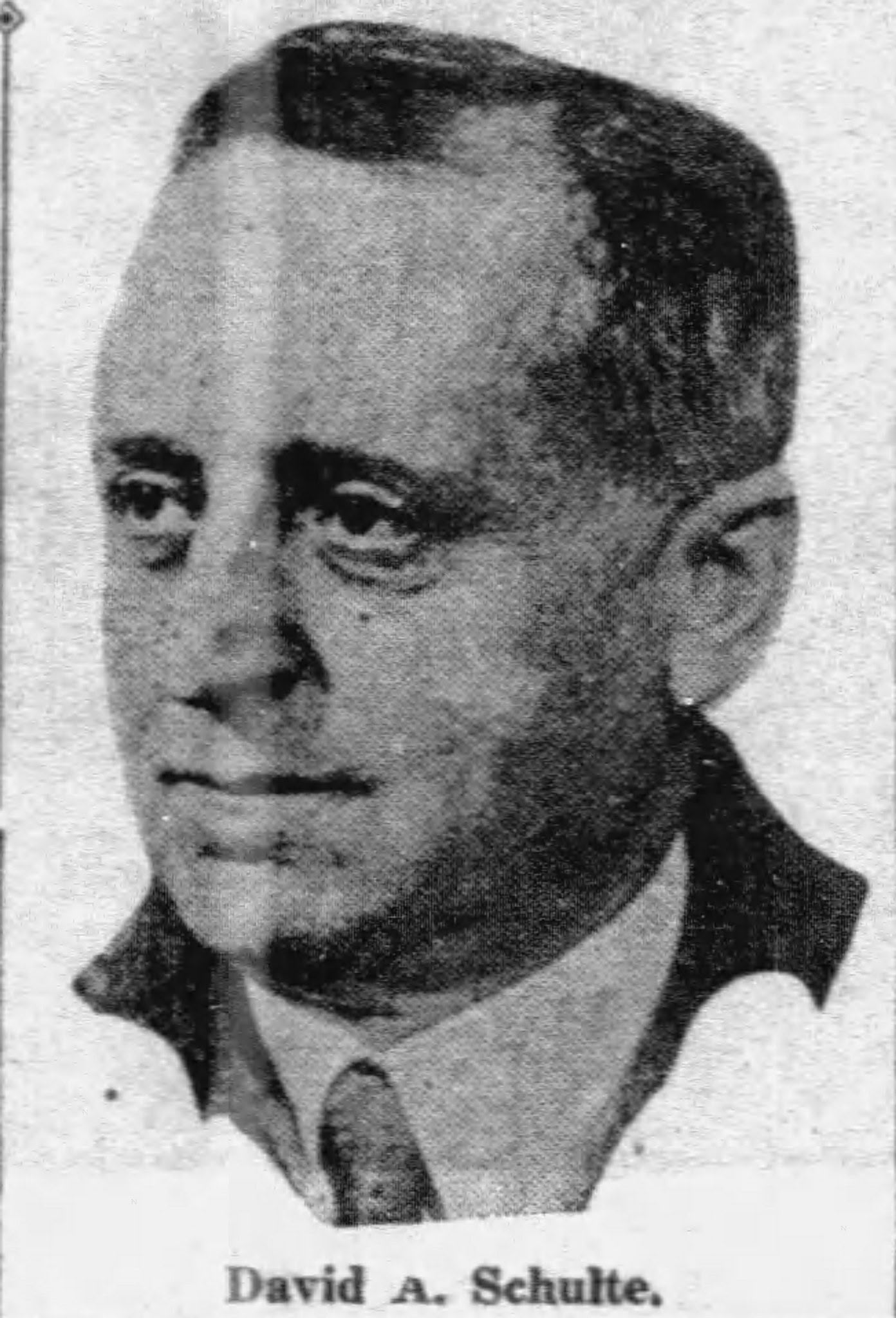
David A. Schulte
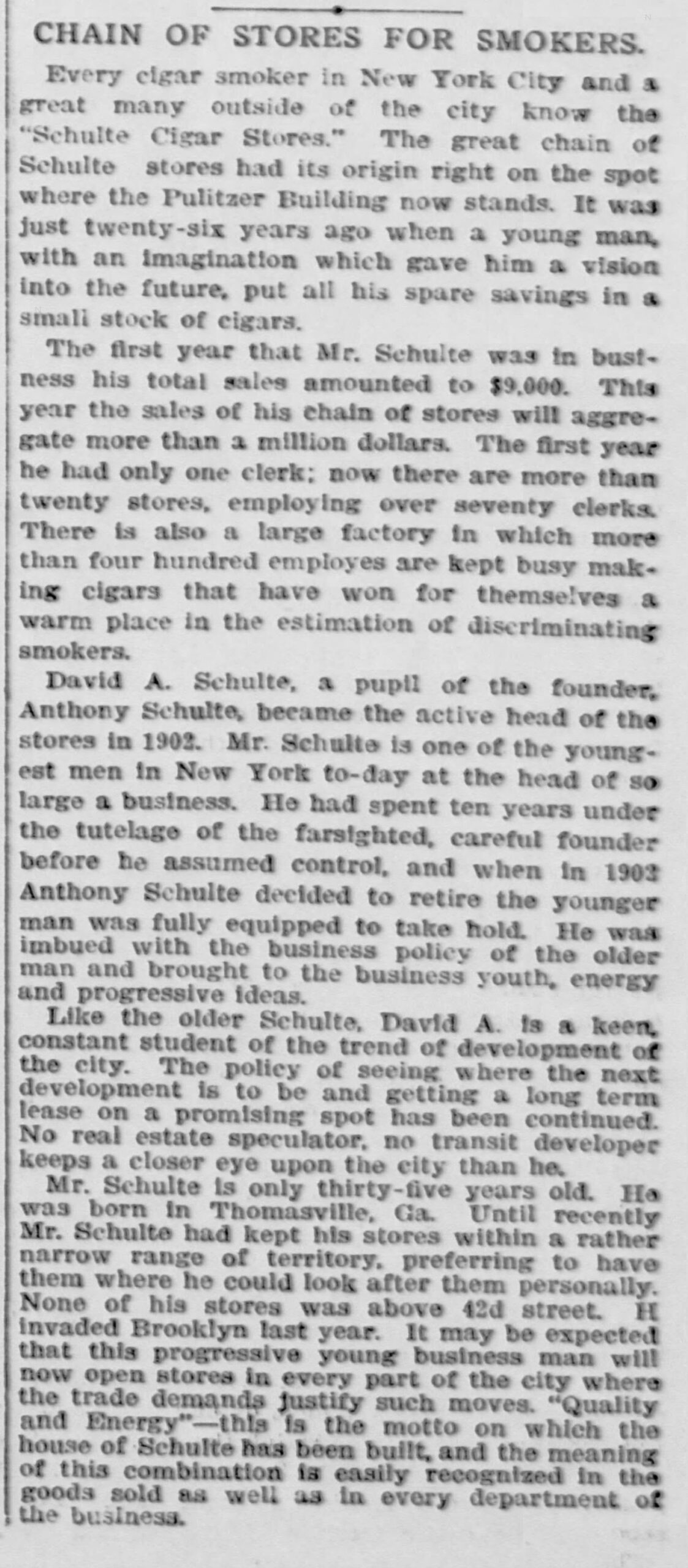
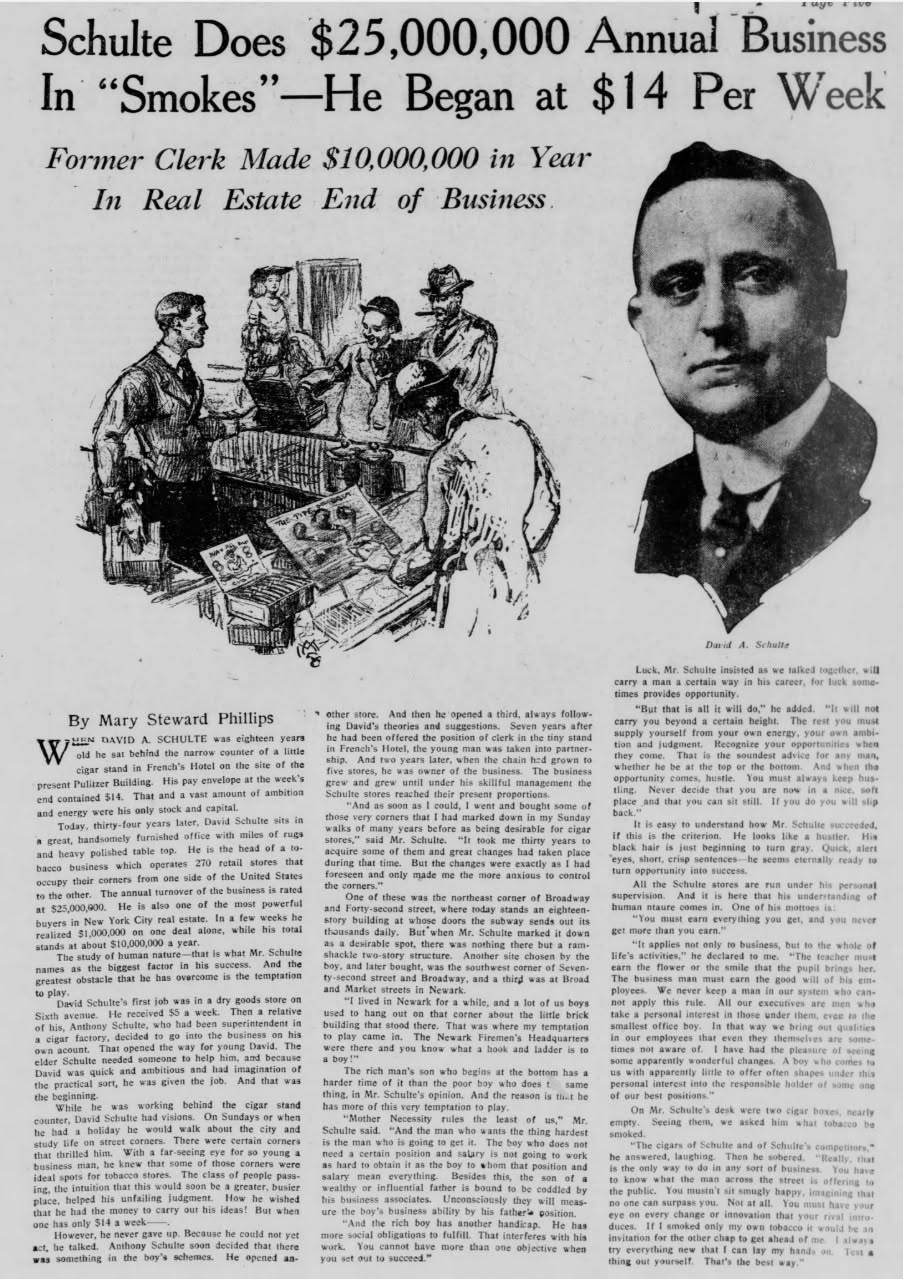
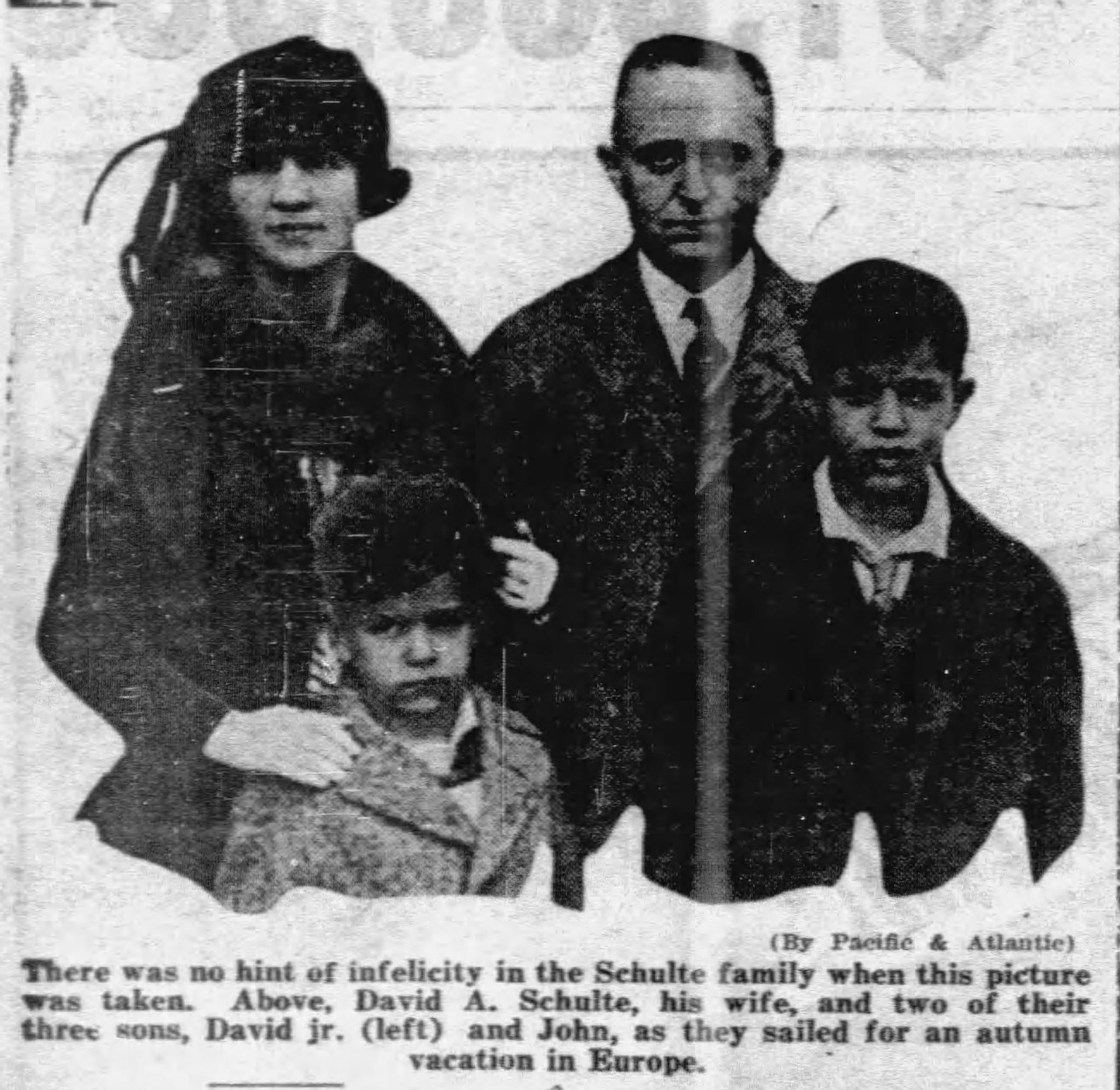
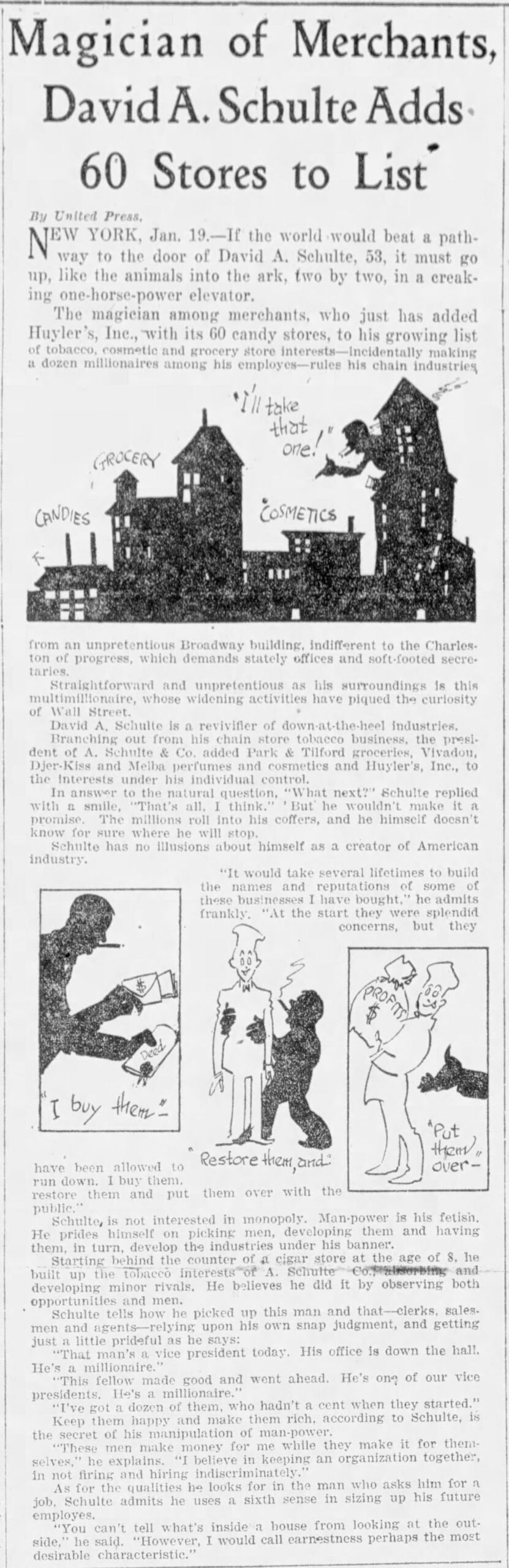
I know I often write about figures in American whiskey history that don’t get enough attention, BUT this one’s a doozy. David A. Schulte wasn’t a liquor dealer. He wasn’t a distiller. Schulte was originally a cigar shop owner- and not just ANY cigar shop owner! In New York City, during the early 1900s, he was THE cigar shop owner. By the mid-1920’s, Schulte wasn’t just a millionaire. It was estimated that he was worth over $100 million dollars (nearly $2 billion today). He owned the largest tobacco-selling corporation in the world. In the spring of 1926, he went and bought France’s tobacco monopoly…for $75 million- IN CASH! This man was dubbed by his peers, “The Magician of Merchants”. During Prohibition, was buying up everything foreign and domestic- “Five cent to a Dollar” stores, candy stores, chocolatiers, perfume companies, cigar companies, vast amounts of real estate, and anything else that could earn him a profit. Schulte’s organization was in the business of creating huge chains of stores, something that wasn’t commonplace outside of the grocery industry- at least not by the 1920s. The Cincinnati Post quoted him in 1927:
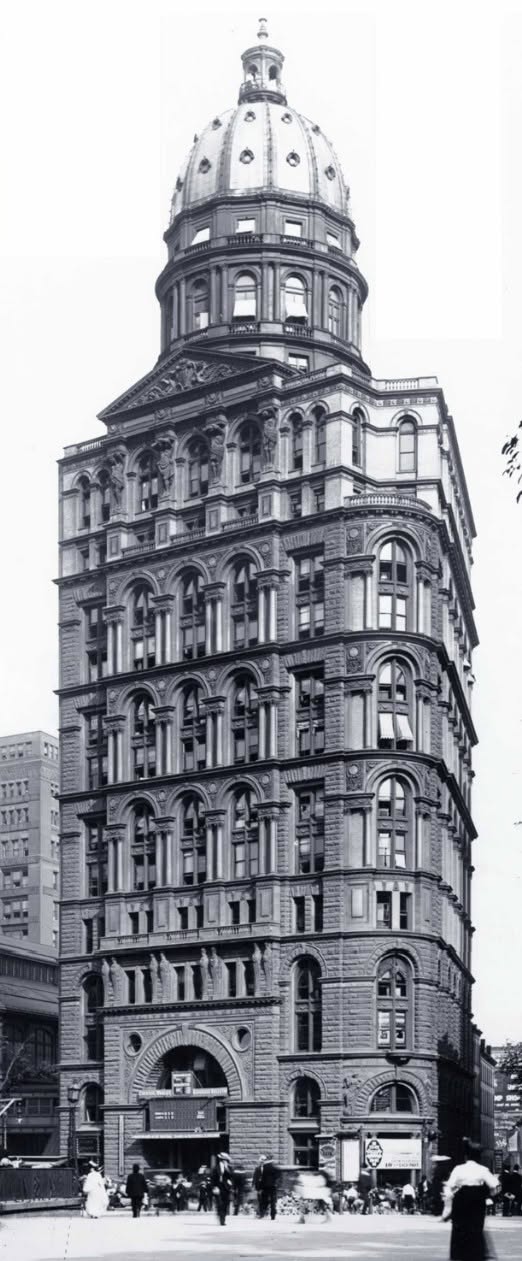
The Pulitzer Building, where David A. Goldberg first worked with Anthony Schulte.
“It would take several lifetimes to build the names and reputations of some of these businesses I have bought…At the start they were splendid concerns, but they have been allowed to run down. I buy them. I restore them and put them over with the public.”
And when asked about the millionaires he was creating through his acquisitions Schulte said, “These men make money for me while they make it for themselves.”
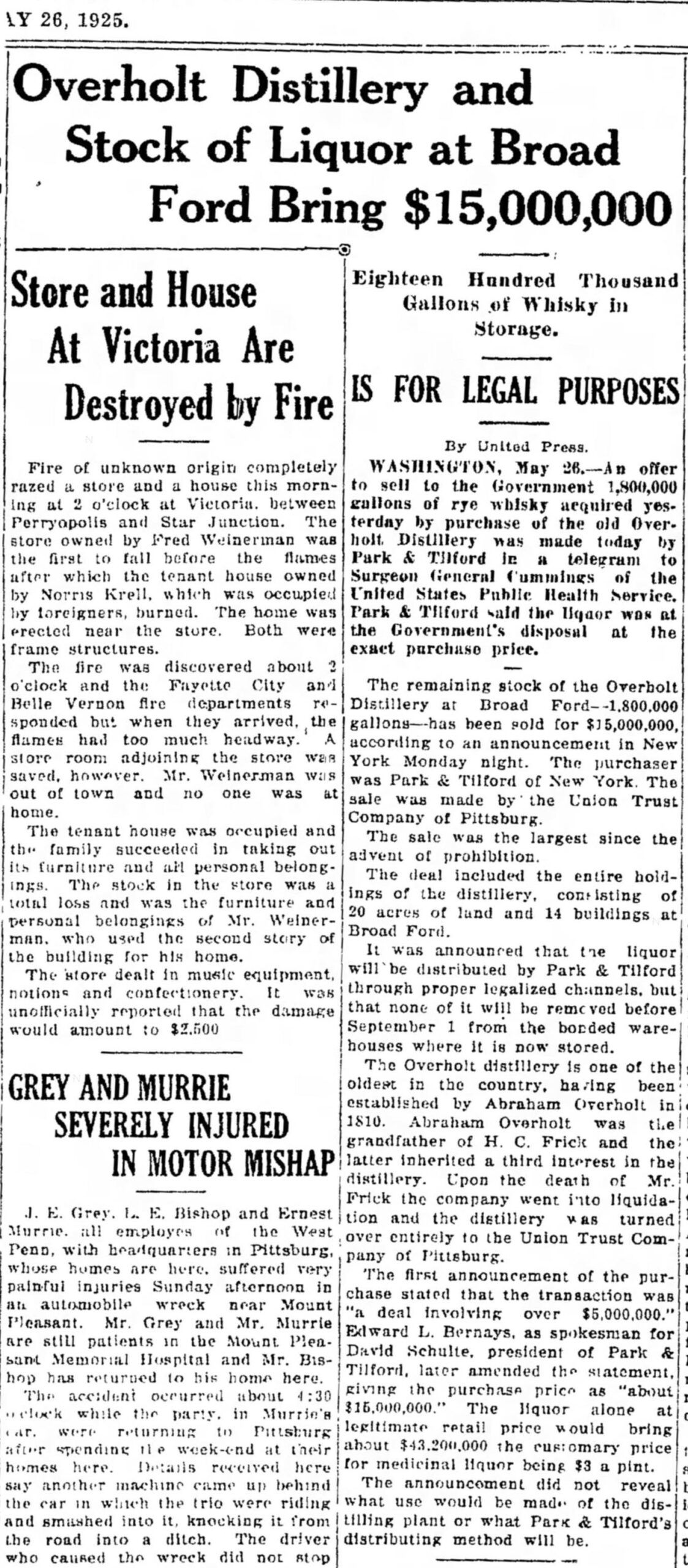
It was really only a matter of time before David Schulte got involved in the liquor business. Prohibition provided the perfect opportunity for a man like him- a man buying up companies that were down on their luck. His purchase of Park & Tilford in 1923 provided him with a large distribution chain, a necessity for anyone thinking of investing in legal liquor sales during Prohibition. In May 1925, he’d make the largest legitimate purchase of liquor in the United States since Prohibition was enacted. But before we get into that, let’s look at who David Schulte was and where he came from. Maybe it doesn’t need to be said (rags to riches stories are not unique for New York), but this cigar-smoking, American business icon/tycoon didn’t start off as a multi-millionaire. He didn’t even start off as a Schulte!!
David A. Schulte was born David Albert Goldberg on March 7, 1873, in Thomasville, Georgia. His father, Louis Goldberg, was from Poland and came to the U.S. during the 1850s. Louis and his young wife, Bertha (Davis) Goldberg, were married in Thomasville where Louis ran his dry goods business. David’s mother passed away in 1875 before David was two years old. His father remarried soon thereafter to Julie Grossman (born 1857) in February 1876. The Goldberg family left Georgia during the 1880s, first moving to Riverhead, Long Island for a time and then settling in Newark, New Jersey (about 10 miles away from Manhattan- across the Hudson River and through Jersey City, for anyone not familiar with the area). David’s older sister, Rose (21), was soon married in 1888 to a man from Manhattan named Anthony Schulte.
Anthony Schulte was born and raised in Detroit, Michigan. When he was just 14, he took work with one of the largest cigar manufacturers in Key West, Florida and proceeded to work his way from the bottom right up through the ranks of that business. In 1882, he moved to New York City to establish his own store in the French Hotel near City Hall- the site upon which the Pulitzer Building would be built in 1890. After marrying Rose Goldberg, he took David, his 15-year-old brother-in-law, under his wing. David started running errands, sweeping, and clerking when business was brisk. Like Anthony, he would learn the cigar business from the bottom up. And learn, he did. When Schulte opened his second store, David was made clerk for that shop. As another 2 stores were added, David took on more responsibilities. By the turn of the century, Schulte owned 8 stores, and David had become Anthony’s most trusted employee.
1909
Anthony Schulte died in 1904, leaving everything to his wife and 4 daughters. David Goldberg was made executor of his mentor’s will and took over the business in Schulte’s stead. He even chose to legally assume his employer’s surname. The knowledge and ambition that had been instilled in him as a young man was now free to burst onto New York’s marketplace, and David A. Goldberg, now David A. Schulte, would spend the next 20 years expanding his brother-in-law’s business into his own, private empire. By the early 1920s, David Schulte had nearly 300 cigar stores, not just in New York, but all over the country. He had become a multimillionaire and a force to be reckoned with.
As we discussed yesterday, David A. Schulte bought out Frank Tilford’s ownership of Park & Tilford in 1923. He owned the company and all the purchasing and distribution power that came with it. He bought London’s famous Dunhill brand of cigars the same year and brought it to New York with its own high-end store on 5th Avenue. Schulte was investing in real estate and buying up companies faster than the newspapers could keep up with their stories about his acquisitions.
1925
192619251927
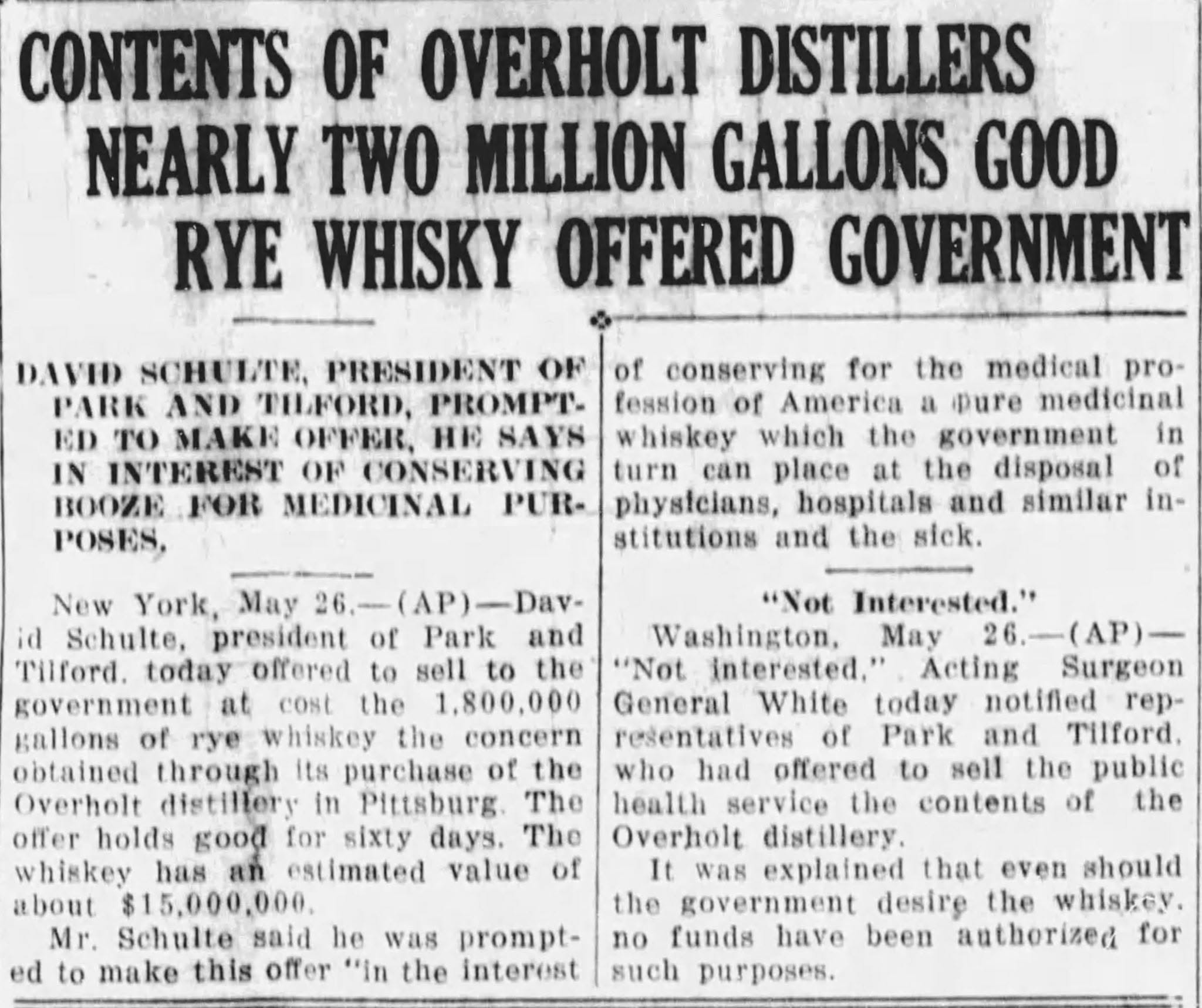
In 1925, David Schulte made the largest single purchase of liquor since the advent of Prohibition. 1,800,000 gallons of rye whiskey, 14 buildings, and 20 acres of land were purchased for $15 million from Pittsburgh’s Union Trust Company, making him the new owner of the Overholt Distillery and all its rye whiskey stocks. At retail, all that whiskey was worth about $43,200,000 (over $800 million today). The distillery, which had belonged to Andrew Mellon, had been held in trust since Mellon joined Warren G. Harding’s cabinet as Secretary of the Treasury. (Mellon was likely still invested, though he repeatedly insisted when questioned by the press that he had divested all interest in the company.) Schulte intended to use his powerful distribution network to sell all that legally purchased whiskey to America’s licensed physicians, hospitals and pharmacists. He even made a very public gesture immediately after his purchase by offering to sell all of the whiskey he acquired directly to the federal government for their own use! This gesture was, of course, rejected, but it’s worth pointing out that Mellon could not have accepted the offer anyway without tremendous political blow back and Schulte was likely keen to prove just how legal his large purchase of liquor had been. Perhaps unsurprisingly, by 1928, Park & Tilford was on record as doing the largest business in its history. While liquidating Schulte’s massive stocks of rye whiskey, the company was showing profits of over $660,000 in the first six months of that year.
19271930
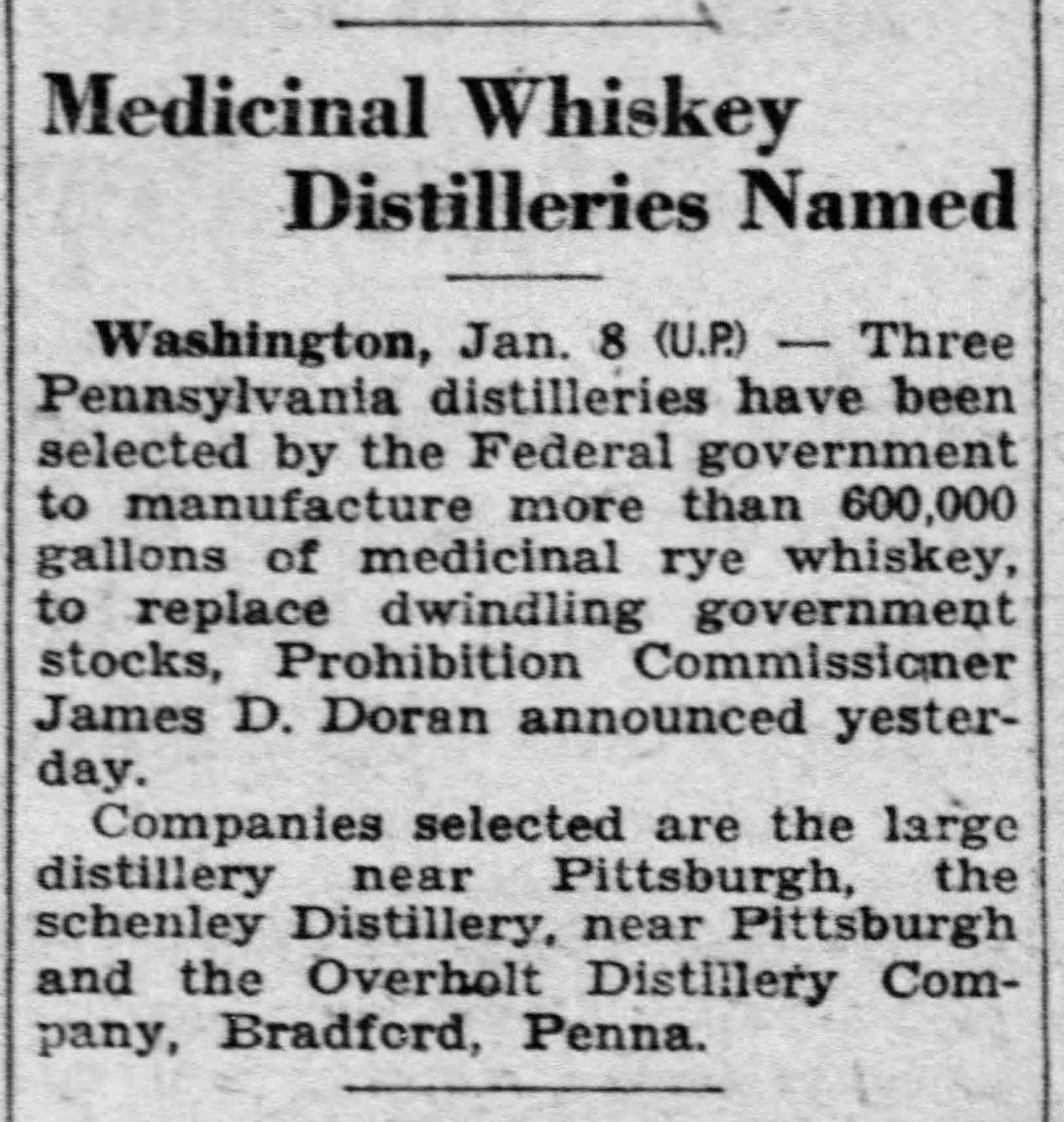
In January 1930, the U.S. Treasury Department issued licenses to three of Pennsylvania’s rye whiskey distilleries to begin the production of medicinal whiskey. They were Overholt Distillery (Broad Ford, Pa), Large Distillery (Large, Pa), and Schenley Distillery (Schenley/Aladdin, Pa), all Western Pennsylvania distilleries. In the end, only Overholt at Broad Ford was permitted to distill whiskey that year. Overholt belonged to David Schulte, Schenley belonged to Lew Rosenstiel…so who owned Large Distillery? To be clear, the Large Distillery was one of two distilleries in the country that had been operational between January 17, 1920 (the enactment of Prohibition) and November 23, 1921 (enactment of the Willis Campbell Act) under a special license to manufacture medicinal whiskey. All its distilling equipment had been maintained and kept in good condition during the years of Prohibition by the company’s owner, Frederick Renziehausen. In May 1930, Fred Renziehausen’s death put Large Distillery up for grabs…even though its warehouses had been pillaged for years! By August 1930, while Renziehausen’s estate was being settled, “a New York concern representing the Overholt Company” was able to gain ownership of the Large Distillery. The distillery and all of its remaining rye whiskey stocks were sold by the Fidelity Trust Company of Pittsburgh (executor of Renziehausen’s estate) for $2 -2.5 million, though the exact amount of the sale was never disclosed. The transition of ownership was kept private, but when the end of Prohibition drew near in 1933, it was clear that the sale of Large had been to David Schulte’s organization.
October 1933
Schulte sold the Large and Overholt Distilleries to National Distillers in June 1933. I know that most folks like to say that National Distillers was the owner of Overholt and Large during Prohibition and that National Distillers was one of the 6 companies given licenses to distill medicinal whiskey during Prohibition, but those folks always neglect to mention David Schulte and Park & Tilford. This is mostly due to American whiskey history’s focus on bourbon and its utter neglect of rye whiskey producers and owners, but that’s another story. National Distillers did come to own Large and Overholt during Prohibition, but not until June of 1933. Before that, it was Mr. David A. Shulte and his massive empire that held the lion’s share of Pennsylvania’s whiskey stocks.
David Schulte and Lewis Rosenstiel, neither of whom were Pennsylvanians, yet both of whom owned Pennsylvania’s famed rye whiskey stocks AND understood the importance of legal distribution networks for liquor (at least in the eyes of the public!)- THEY were the titans of rye whiskey during Prohibition! Schulte’s name gets completely left out of whiskey histories describing Prohibition because he was never associated with Kentucky bourbon! I mean, it’s true, isn’t it? Can you think of another reason? Park & Tilford, however, does get a mention here and there because the company DID buy Kentucky brands and distilleries AFTER Prohibition.
Part 5- The Finale: Post-Prohibition.
Yeah, this one’s a bit long (I know, they’re all long😉), but there was a lot to learn and a shocking lack of info out there about Park & Tilford! I enjoyed the research and found that a lot of it paralleled what we’re going through today in the whiskey industry. Anyway, enjoy! We left off with David A. Schulte in June 1933…
Prohibition was nearing its end, so Park & Tilford and the newly incorporated Schulte Retail Stores Corporation, were geared up to sell liquor, and lots of it. P&T chartered newly painted ships loaded with liquor from Europe to arrive on the east coast and in San Franciso just in time for Repeal on December 5th. David Schulte sold the Overholt and Large Distilleries to Seton Porter of National Distillers in June 1933, but part of the sale involved David Schulte absorbing 102,000 shares of National Distillers’ common stock, so the sale left Schulte just as invested in selling that rye whiskey as Seton Porter! They both stood to mutually benefit from collaboration once the laws restricting the sale of liquor were lifted.
In New York, the city’s Police Commissioner (1930-1933), Edward Mulrooney, who had been appointed the chairman of NYC’s newly established Alcoholic Beverage Control Board, explained to the “Daily News” how Park & Tilford would be given the green light to sell alcohol. Hundreds of applications from hotels, clubs, and restaurants were flooding Mulrooney’s office every hour during those weeks leading up to Repeal, but certain businesses were given preferential treatment. The chairman explained that he could not estimate how many applicants would be approved by December 5th, but he didn’t mind adding the following statement:
“Hotels of known reputation, such as the Astor and Waldorf Astoria and grocers like Charles & Co. and Park & Tilford will receive their permits without being subjected to investigation,” Mulrooney said. “Fleischmann’s Distillery at Tarrytown will likewise be licensed immediately because of its reputable standing,” he added.
Times may have been changing, but apparently the wheels of bureaucracy could still be greased.
Meanwhile, David A. Schulte never ceased the expansion of his empire. His quest to control the cigar market in America was still underway, and he continued to invest in retail businesses, candy store properties, and in major real estate ventures. The Shulte Retail Store Corporation, which had been incorporated in April 1933, and D.A. Schulte, Inc., with its 1200 employees in 325 stores, were the sweethearts of the stock exchange, but Schulte was itching to launch liquor sales again! To be clear, Park & Tilford did not own any distilleries at this point. The company, with all its political and business connections, was a retail behemoth with a very large distribution network, but it was representing other companies and buying whiskey in bulk to blend and bottle under its own “Park & Tilford” brands. David Schulte intended to pick up right where he had left off before Prohibition. Schulte may have been in business for over 40 years, but he was very much a creature of habit. His offices in New York were dingy and Dickensian in their old-fashioned accommodation and equipment and could only be reached by riding in a creaky, old bird-cage elevator. He may have made about $35 million-a-year out of those dusty offices where he smoked 12 cigars-a-day, but he had a stubborn way of doing things. Those ways may have been progressive in some aspects (He did give his workers a hefty 20% raise in 1934 and he WAS pro-Union), but his old-school methods of manipulating the stock market like a Gilded Age tycoon would land him in trouble by the late 1930s.
1938
In 1938, around the same time he purchased his sprawling new estate at Telegraph Hill in Holmdel, New Jersey*, David A. Schulte got caught up in an insider trading scandal with many other big businessmen on Wall Street. As Schulte sold off stocks in his company, several of his subsidiaries (all under his name) would quickly buy them up to create the illusion of active trading. While he wasn’t alone, his market manipulations were soon seized upon by the newly created Securities and Exchange Commission. (Congress passed the Securities Exchange Act of 1934 to create the SEC in the wake of the stock market crash of 1929 to help restore confidence in capital markets.) The SEC enjoined Schulte for his violations of the Securities Exchange Act in February 1939, and he was forced to consent to an injunction halting the buying and selling of his own properties. His stock values suffered after the injunction. Perhaps out of habit, Schulte began buying again- this time, he would focus on buying distilleries. Owning distillery properties secured his supply of liquor during a very competitive race by the nation’s largest liquor companies to scoop up every available and operational plant in the country.
By the end of the 1930s, the bulk of Park & Tilford’s revenue was obtained through the distribution of liquor and wine. David Sculte purchased the Bonnie Bros. Distillery in Louisville, KY in late 1938 and had begun production of whiskey by 1939. In September 1940, Park & Tilford acquired the Hamburger Distillery in Brownsville, Pennsylvania. The distillery, which had been operated by its original owner, Albert M. Hanauer, since Repeal, filed for bankruptcy in 1939, so Schulte wasted little time taking advantage of the opportunity. Hamburger Distillery’s rye whiskey brands, with Bridgeport Pure Rye among them, were quite valuable, and the company’s old stocks of rye were highly prized on the market. By 1941, Park & Tilford scooped up two additional distilleries- The Woodford County Distillery in Midway, KY and the Krogman Distillery in Tell City, Indiana. The following year, they added the Owings Mill Distillery, aka the Gwynnbrook Distillery/Hunter Baltimore Rye Distillery, to their collective. With Hamburger Distillery’s 15,000 gallons a day, Woodford and Krogman’s 3,500 gallons each, and the output of the Bonnie Bros. and Owings Mills plants, Park & Tilford’s distilleries were manufacturing 37,000 gallons daily! Their old and new whiskey stocks kept the company flush with 8,550,000 gallons of whiskey in storage.
As the second world war threatened upheaval in the whiskey industry, Park & Tilford shifted production to industrial alcohol. Throughout 1943, most of Park & Tilford’s advertisements stressed the company’s commitment to the war effort. The whiskey industry’s focus was shifting toward scientific advancements in distilling- synthetic products, chemicals, rubber, and the like. Park & Tilford’s scientists at Hamburger’s Distillery had discovered a means to extract diastase from grain using sodium sulfite. The company’s president, Frank G. Handren, claimed that the elimination of barley malt from the alcohol production process would save the government 10 cents on every gallon of alcohol produced.
“Since the protein byproduct can be sold very cheaply,” Handren said, “it offers limitless nutritive possibilities. It can be used to enrich white flour for bread and cereals, thus making up for the protein loss resulting from the milling process. It can be used also as a supplement to livestock feed, now critically short, thus enriching the feed for hogs and cattle which, in turn, will result in more and richer meats for human consumption.
“The process bids fair to revolutionize the alcohol industry, reducing its main product, alcohol, to the level of a byproduct.”
That’s right, folks! Your favorite whiskeys, said Park & Tilford, were now simply a BYPRODUCT of the distillation process! There were so many better ways to profit from owning a distillery than by making silly old whiskey! Plus your corn flakes box can boldly claim “Now with more protein!” Talk of “preserving heritage and tradition” in distilling would have to take a back seat to progress.
Science was the key to success in the 1940s, and Park & Tilford were prepared to reap its profitable rewards. Of course, by the mid-1940s, the “Big Four” (National Distillers, Schenley, Seagram’s, and Hiram Walker) had been busy buying up distilleries and investing heavily in scientific advancements and expansion, as well. The consolidation of the whiskey industry was in the hands of the few, and the U.S. government was investigating this whirlwind of acquisitions and increased production with concern. David Schulte, with no desire to be left behind, made plans to double the capacities at all four of his distilleries. At the same time, he also decided to take a step back, allowing his 38-year-old son, Arthur D. Schulte, to become president of Park and Tilford, Inc. David Schulte, now 73, would stay active as chairman of the board. Frank G. Hendren remained president of Park & Tilford’s subsidiaries.
The sales for Park & Tilford’s subsidiaries, it should be said, were at an all-time high in 1946. They were showing $56,206,987 in profits from 1945, which had been a $5 million increase over those from 1944…but enough was never enough for the Schultes. To shine a spotlight on his companies and boost its engagement on the stock market, Mr. Schulte offered whiskey dividends to Park & Tilford’s stockholders, allowing the purchase of six cases of “reserve” whiskey for every stock they held. This strategy caused wild fluctuations in the market and made the company quite a bit of money. The SEC was none too happy about these new manipulative tactics, and in August 1946, it suspended Park & Tilford’s ability to participate in any security underwriting for 20 days.
By 1949, the competition in the whiskey market was stiffening. The government recently lifted their war time restrictions, and a flood of whiskey was entering the market. Arthur D. Schulte, now 42, commented on the state of the market;
“We are all jockeying for position on that market now. How? More advertising, new brands, revision of distribution setups…We merely are leveling off to a normal economic plateau. The general prosperity is keyed to the heavy industries, and they are in good shape,” he said. “In 1947, the Federal and State taxes on distilled spirits amounted to $2,750,000,000, the biggest single source of revenue outside of income taxes.”
And so, with the whiskey industry riding high, companies decided to ramp up production and drown themselves in more advertising, more brands, and a flood of whiskey. (Sound familiar?) In July 1949, Park & Tilford joined the “smaller” producers in a push to allowing the use of used cooperage. The largest producers were cornering the market by buying up America’s cooperages and were insisting upon the continued use of brand new, charred oak barrels, but the lack of available barrel stocks were limiting the ability of “smaller” companies to compete (Park & Tilford were not exactly small, but were dwarfed in comparison with National Distillers and Schenley!). With competition shrinking and whiskey production soaring, the industry was about to face a tough decade. And just as this was all taking place, David A. Schulte passed away at home in his mansion on Telegraph Hill in Holmdel, New Jersey.
Jan 3, 1955
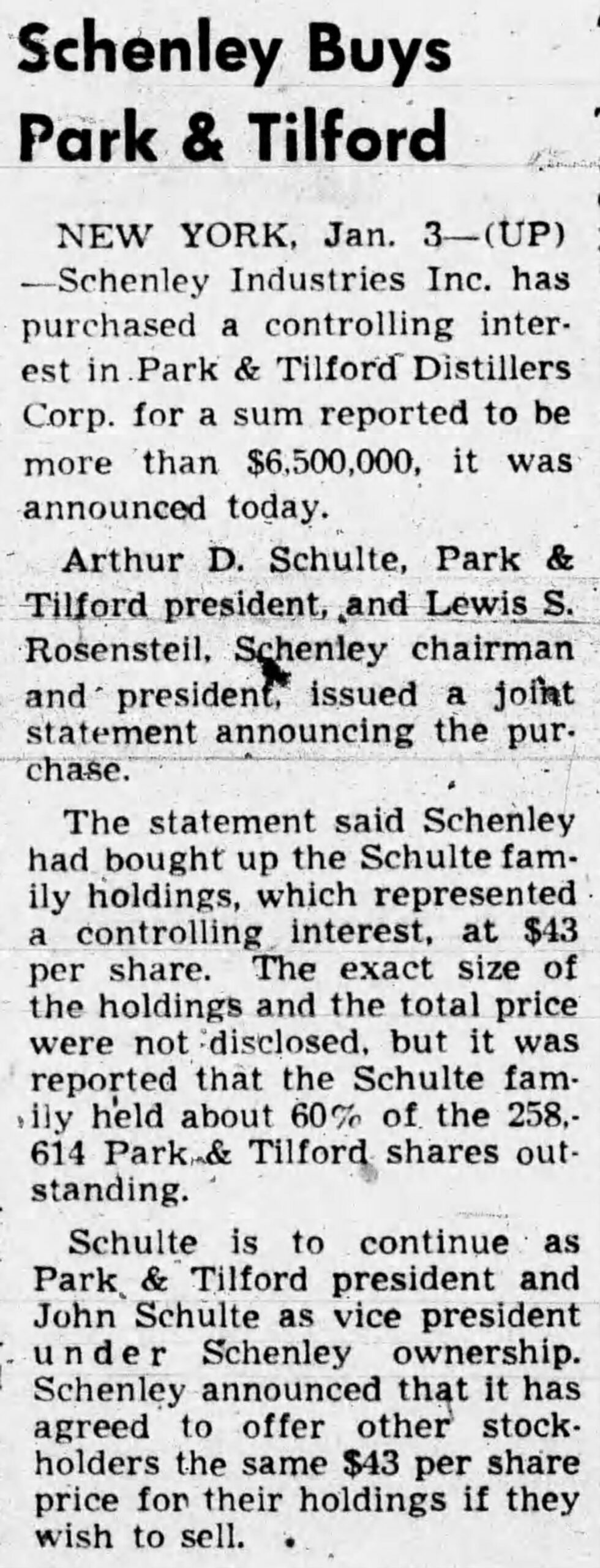
We all know what happened to the market going forward. It took less than 20 years (1933-1950) for the market to consolidate itself and overproduce itself into a glut. Distillers like Park & Tilford decided to focus on science and industrial alcohol production, using those advances to turn the industry’s whiskey production techniques upside down. “Green whiskey” and blended whiskeys with little known brand names were overwhelming the market in many U.S. states. Park & Tilford would not survive the changes they helped to set in motion. Arthur Schulte sold controlling interest in Park & Tilford to Schenley in 1954 with a compete buyout in 1958.
*Telegraph Hill is the second highest point in Monmouth County and overlooks the Raritan River. It was an outlook during the Revolutionary War used to keep an eye on British ships. The site became an estate composed of 165 acres of farmland, the mansion on the site becoming the home of David Schulte in 1938. The estate was broken into parcels and housing developments in the 1960s and 70s. Bell Labs was built on the site in the early 60s, where numerous Nobel Prize winning discoveries were made. It is also famous for being the place where Bruce Springsteen recorded his album “The River” between July 1976 and July 1981.

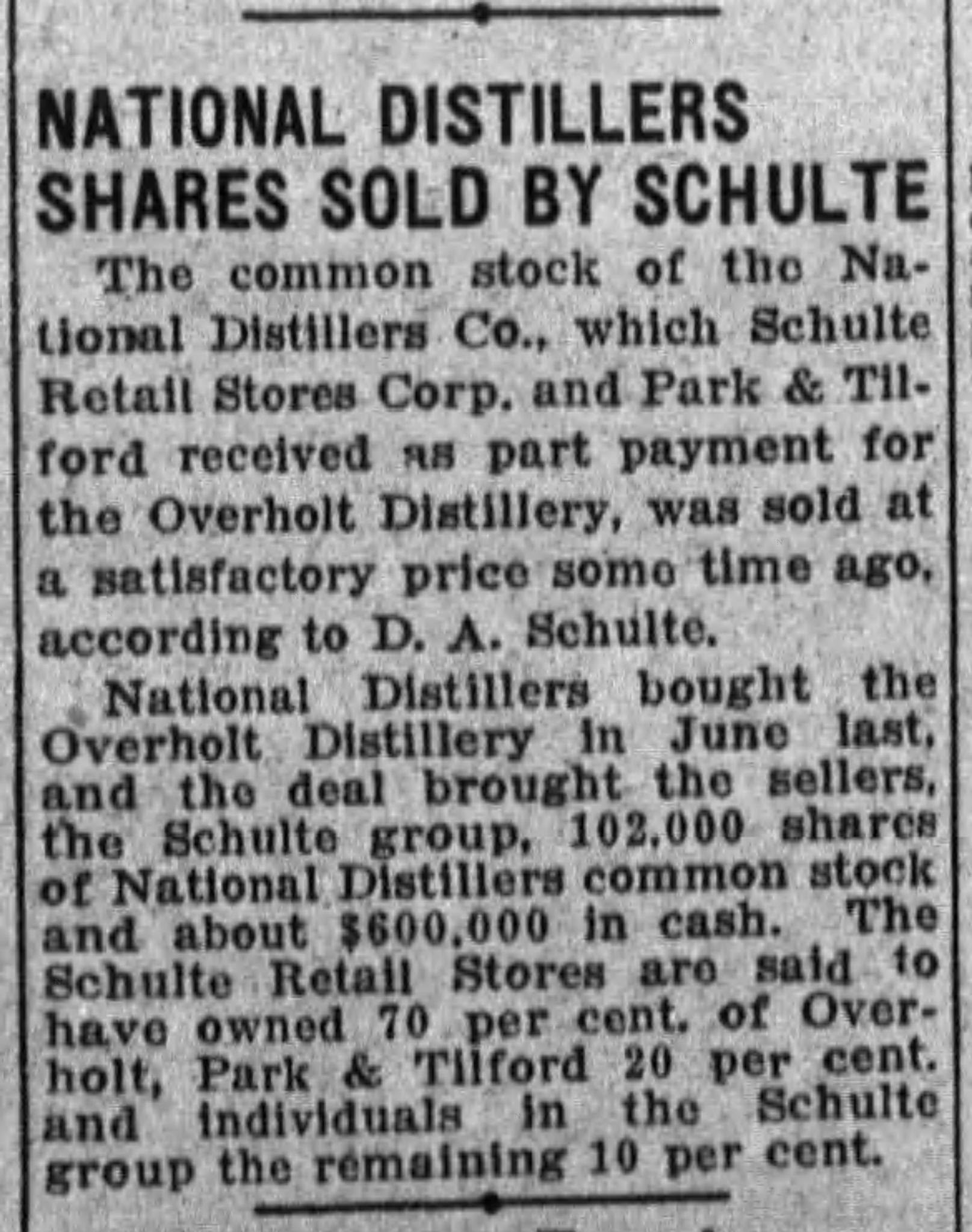
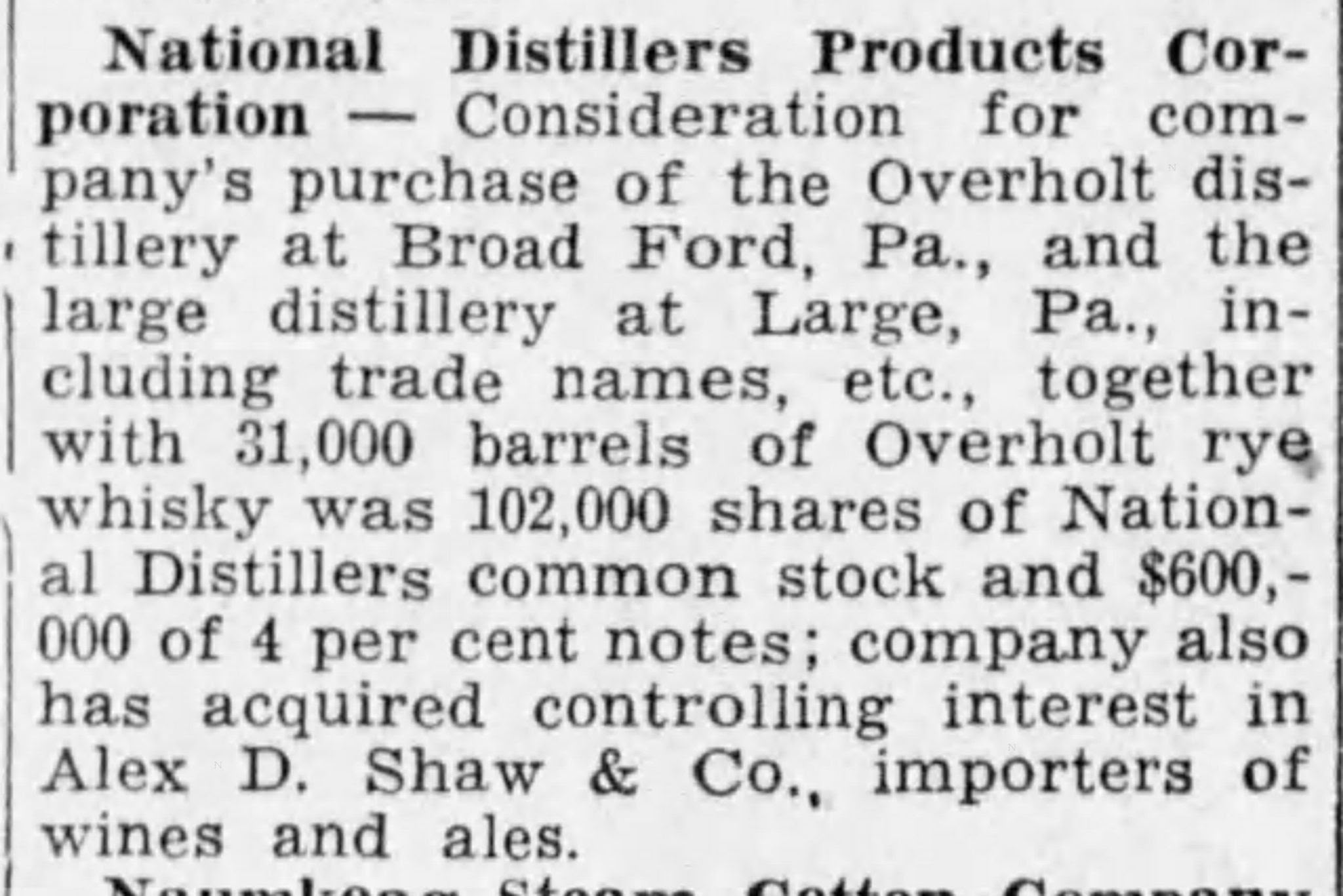 Schulte sold the Large and Overholt Distilleries to National Distillers in June 1933. I know that most folks like to say that National Distillers was the owner of Overholt and Large during Prohibition and that National Distillers was one of the 6 companies given licenses to distill medicinal whiskey during Prohibition, but those folks always neglect to mention David Schulte and Park & Tilford. This is mostly due to American whiskey history’s focus on bourbon and its utter neglect of rye whiskey producers and owners, but that’s another story. National Distillers did come to own Large and Overholt during Prohibition, but not until June of 1933. Before that, it was Mr. David A. Shulte and his massive empire that held the lion’s share of Pennsylvania’s whiskey stocks.
 Yeah, this one’s a bit long (I know, they’re all long😉), but there was a lot to learn and a shocking lack of info out there about Park & Tilford! I enjoyed the research and found that a lot of it paralleled what we’re going through today in the whiskey industry. Anyway, enjoy! We left off with David A. Schulte in June 1933…
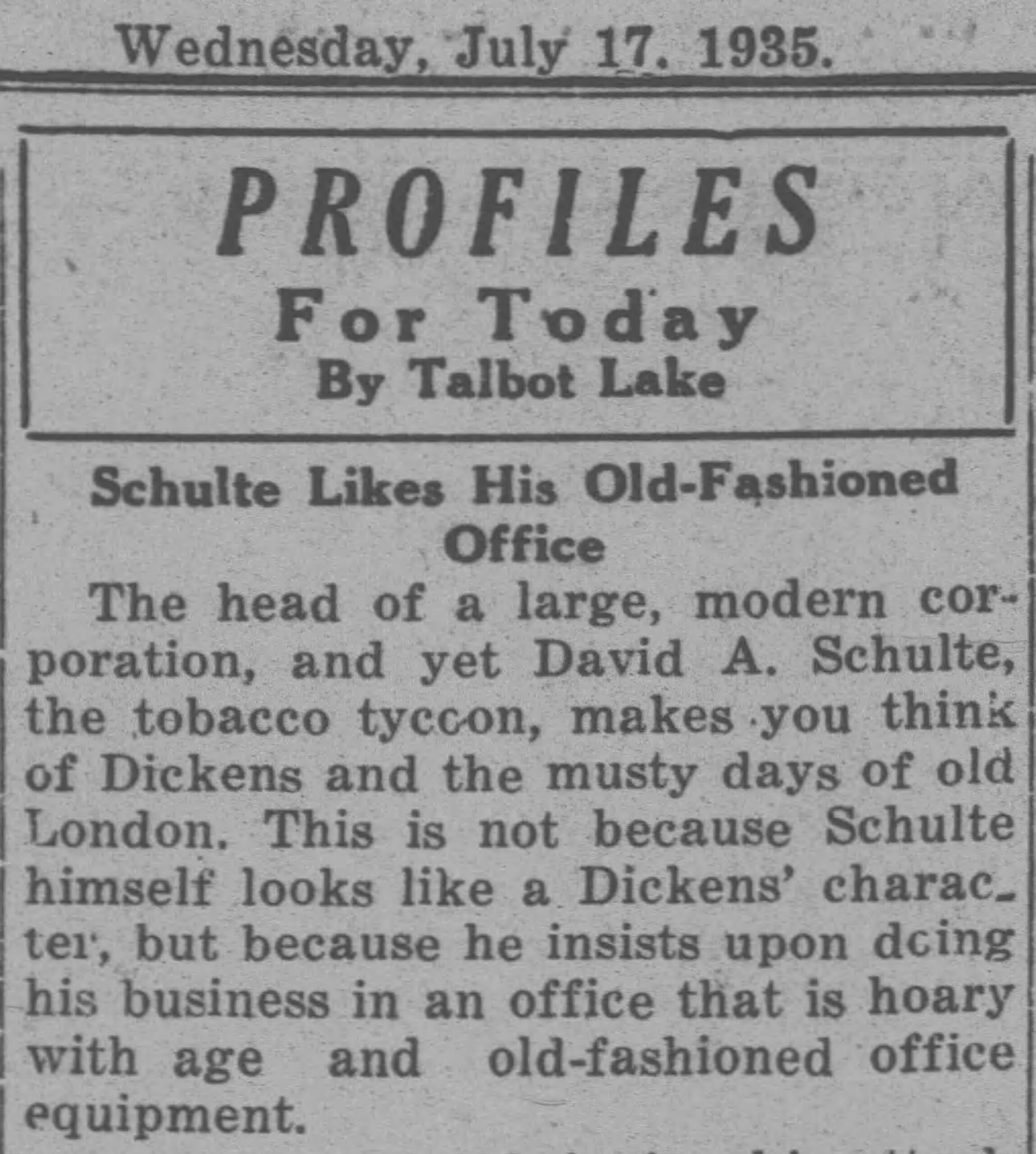 His offices in New York were dingy and Dickensian in their old-fashioned accommodation and equipment and could only be reached by riding in a creaky, old bird-cage elevator. He may have made about $35 million-a-year out of those dusty offices where he smoked 12 cigars-a-day, but he had a stubborn way of doing things. Those ways may have been progressive in some aspects (He did give his workers a hefty 20% raise in 1934 and he WAS pro-Union), but his old-school methods of manipulating the stock market like a Gilded Age tycoon would land him in trouble by the late 1930s.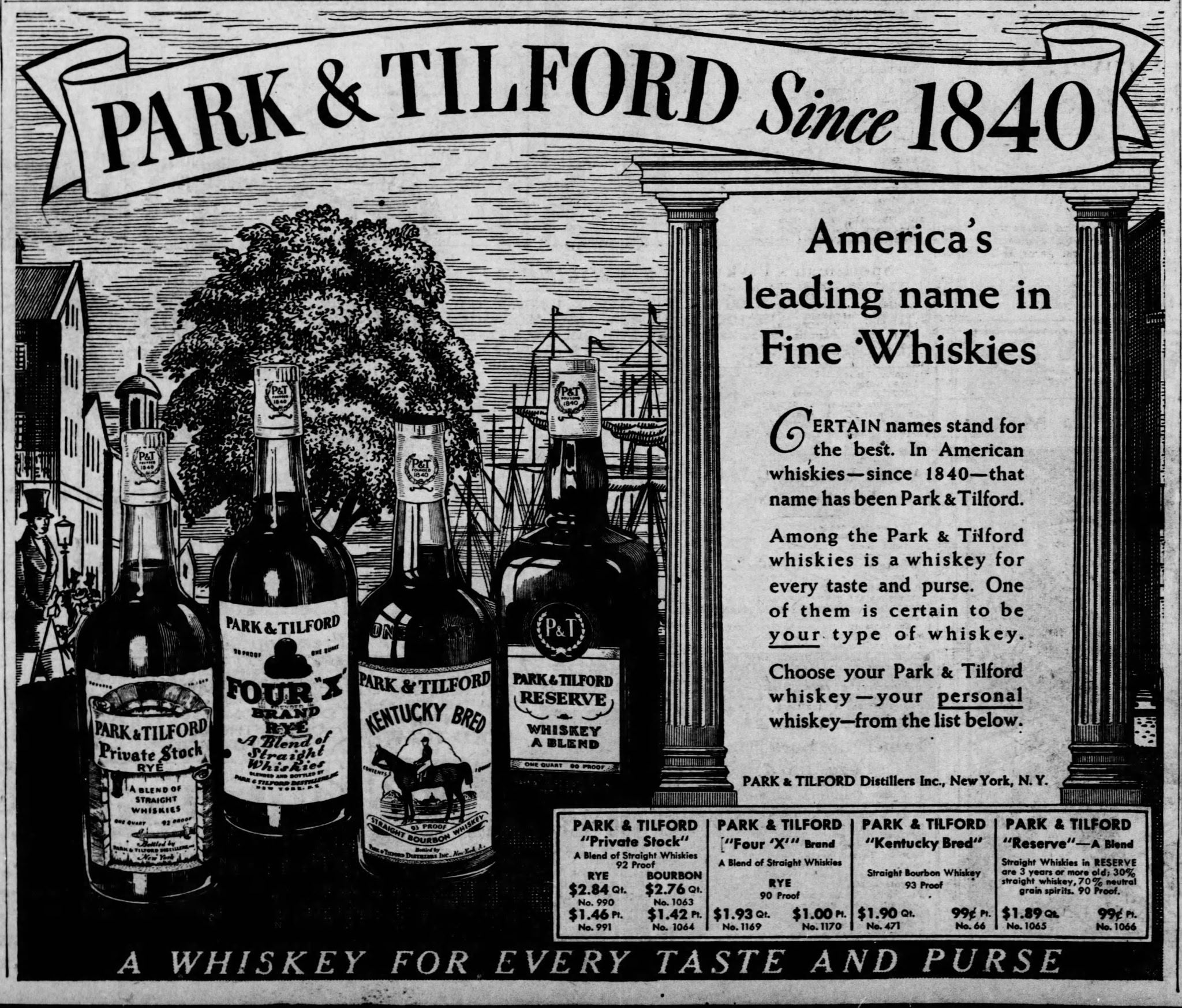
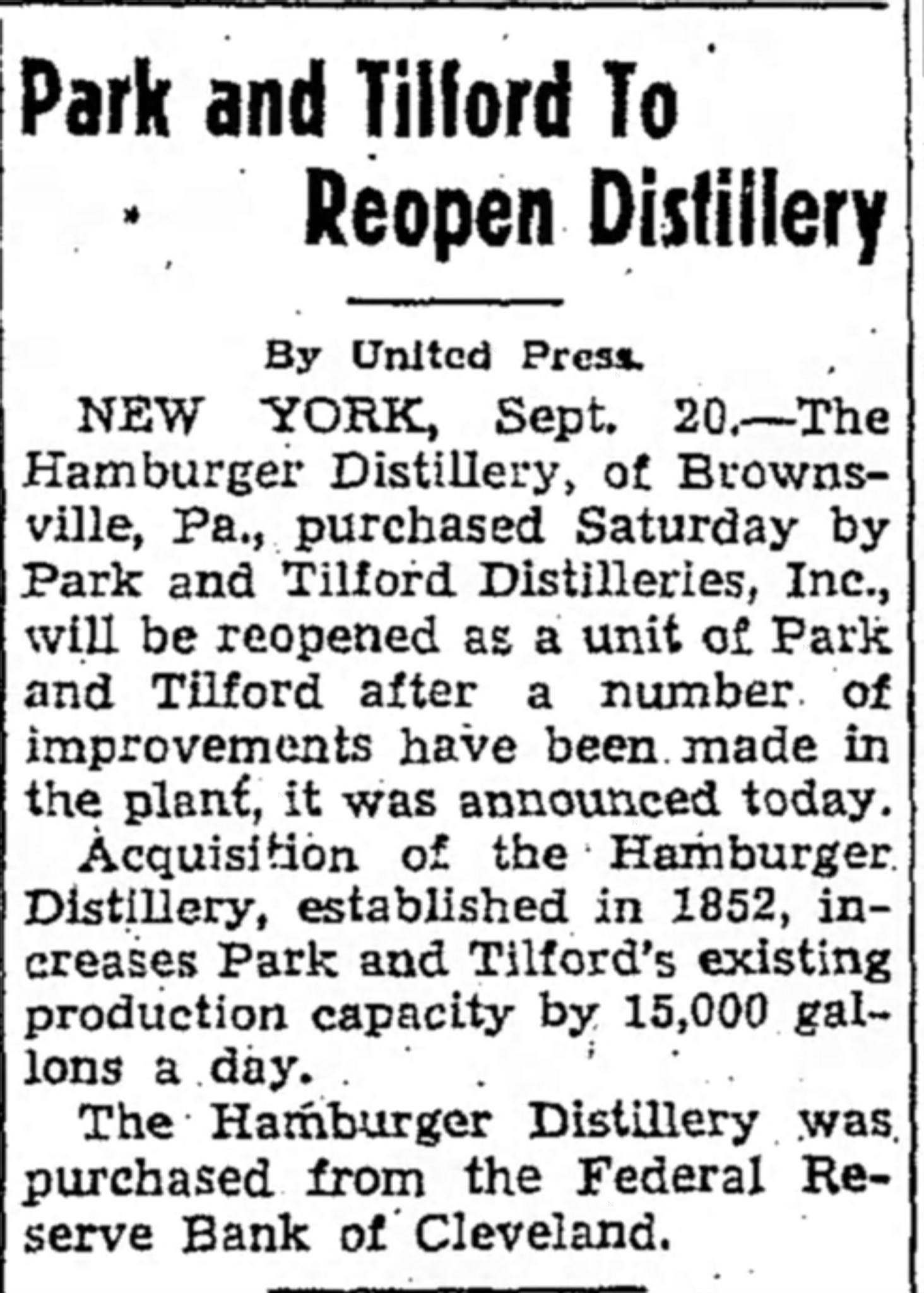 Hamburger Distillery’s rye whiskey brands, with Bridgeport Pure Rye among them, were quite valuable, and the company’s old stocks of rye were highly prized on the market. By 1941, Park & Tilford scooped up two additional distilleries- The Woodford County Distillery in Midway, KY and the Krogman Distillery in Tell City, Indiana.
 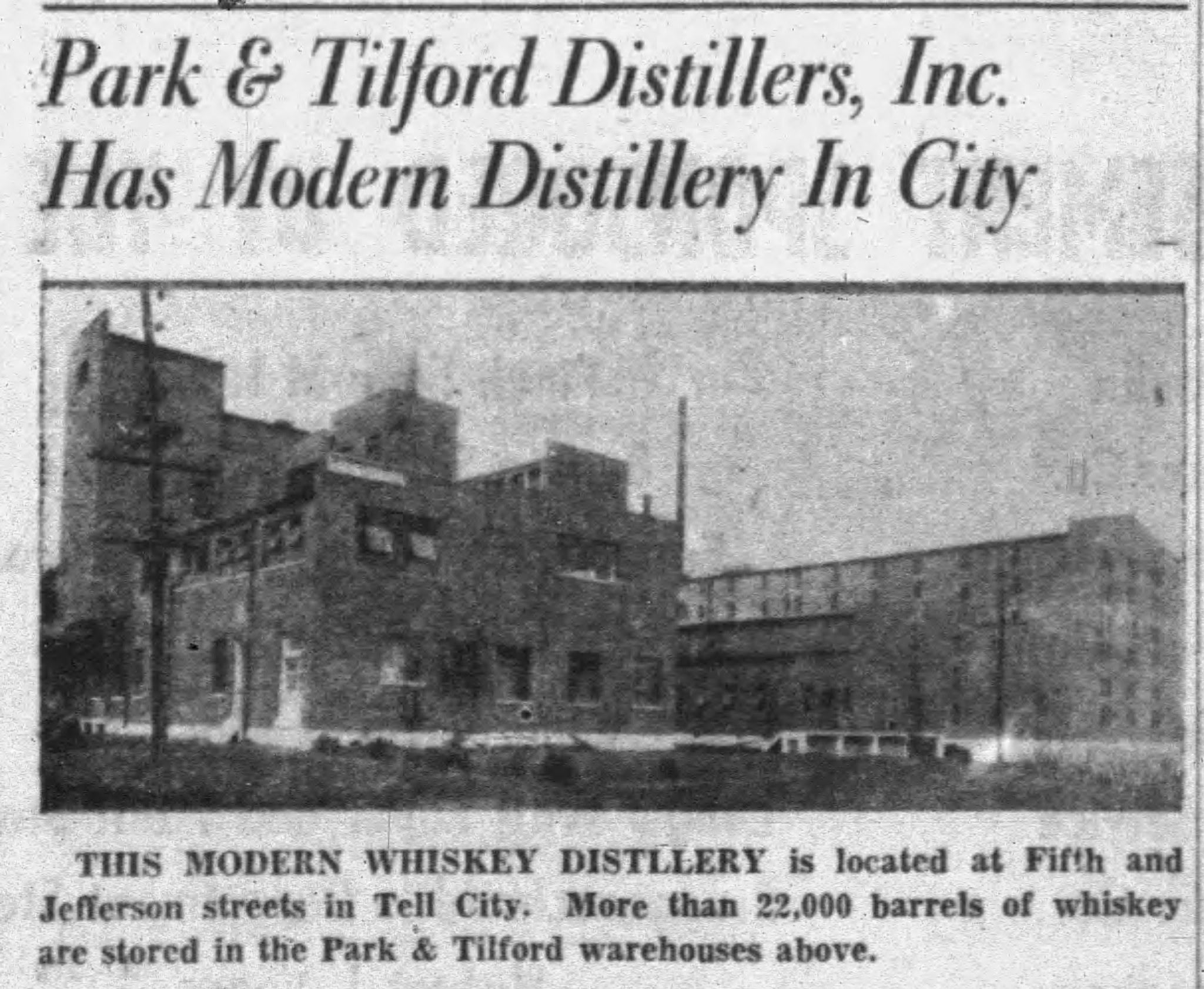 The following year, they added the Owings Mill Distillery, aka the Gwynnbrook Distillery/Hunter Baltimore Rye Distillery, to their collective. With Hamburger Distillery’s 15,000 gallons a day, Woodford and Krogman’s 3,500 gallons each, and the output of the Bonnie Bros. and Owings Mills plants, Park & Tilford’s distilleries were manufacturing 37,000 gallons daily! Their old and new whiskey stocks kept the company flush with 8,550,000 gallons of whiskey in storage.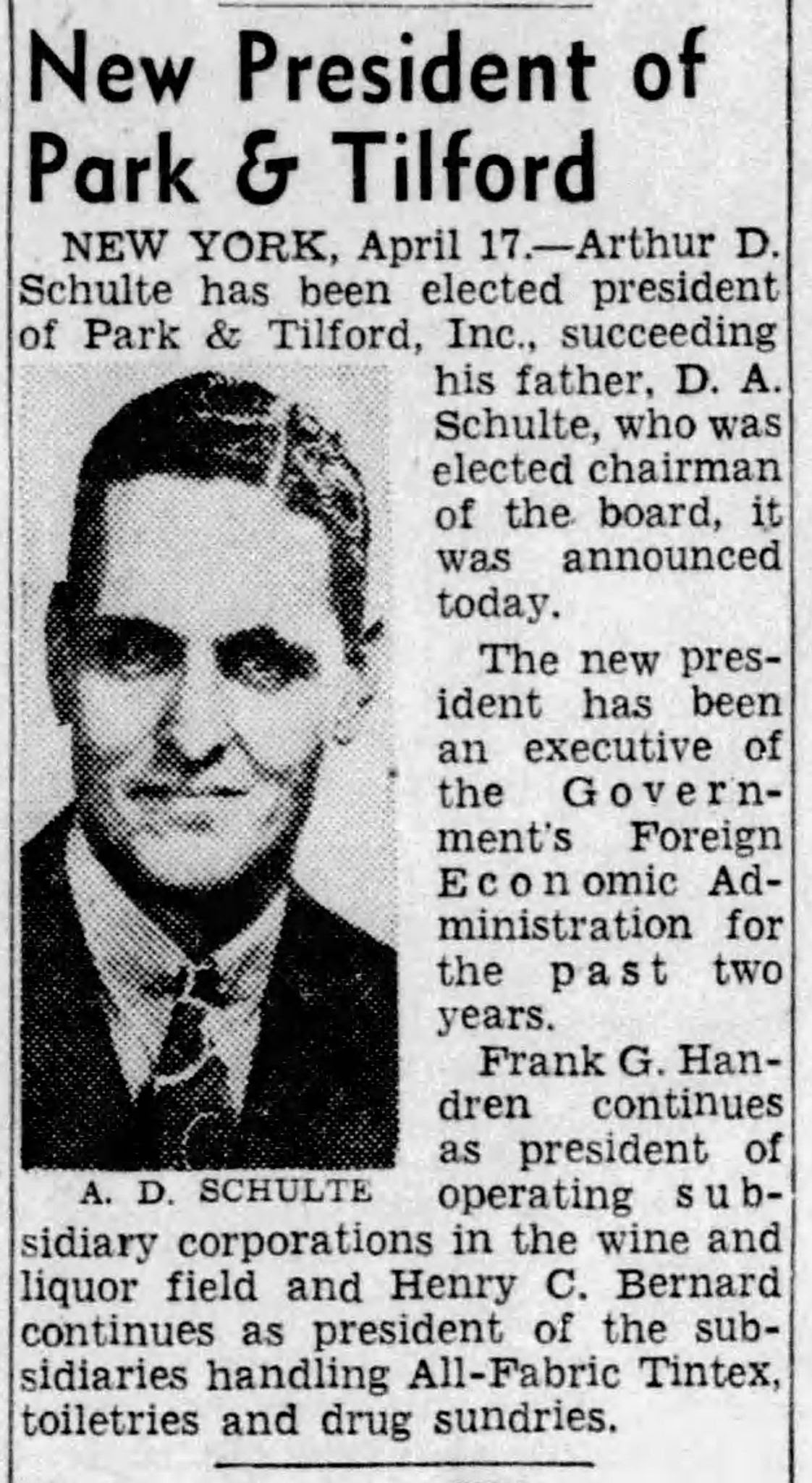
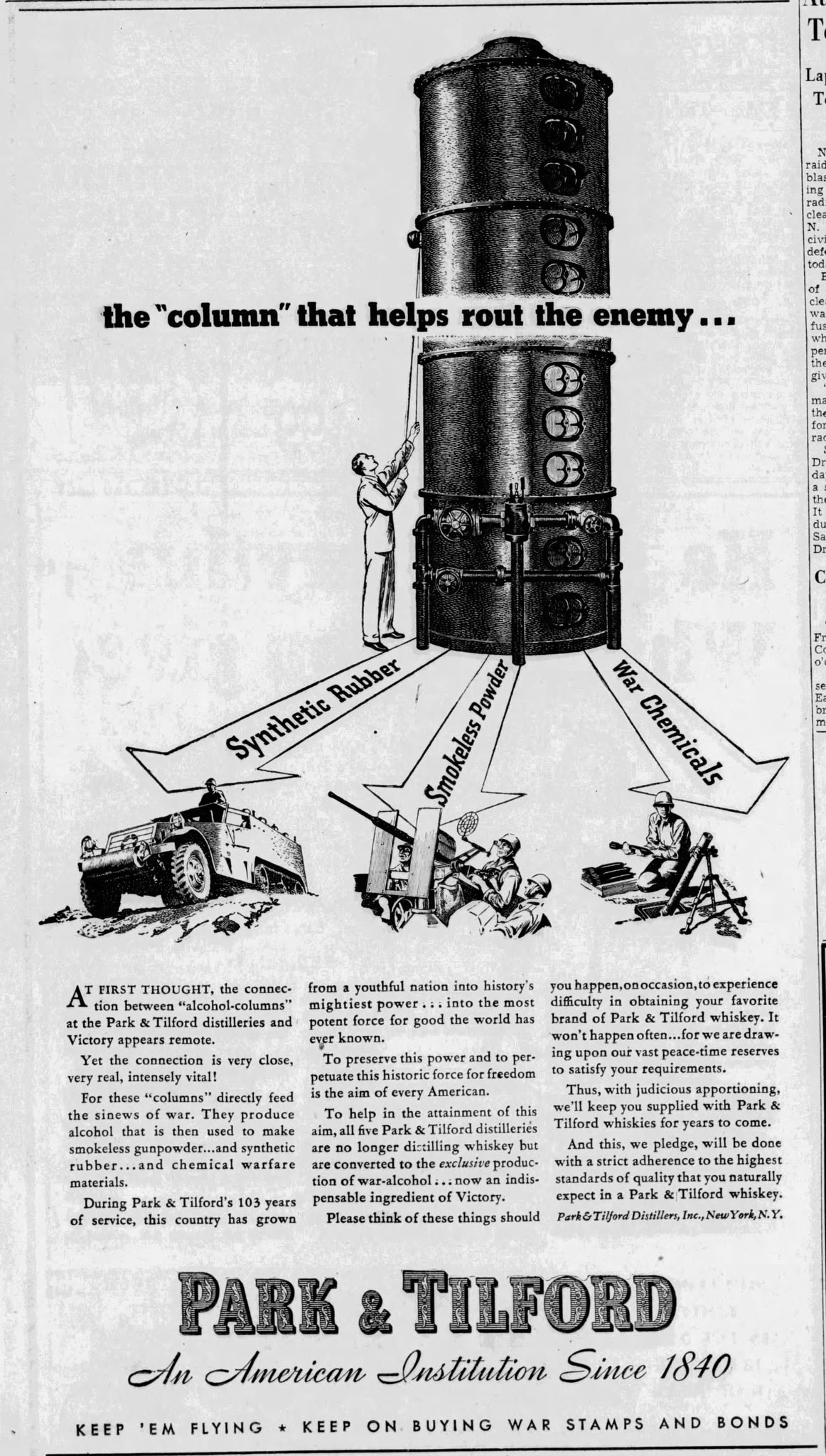
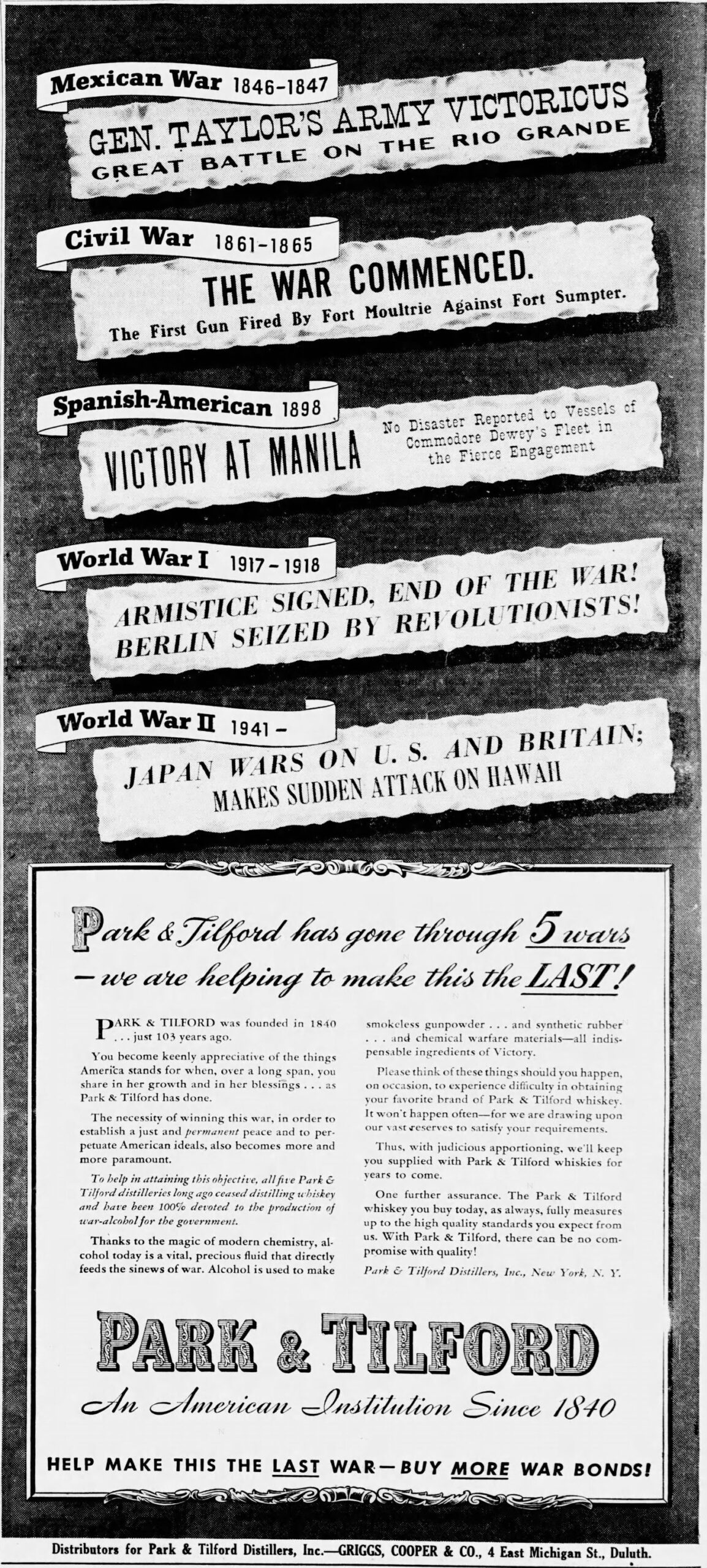 Science was the key to success in the 1940s, and Park & Tilford were prepared to reap its profitable rewards. Of course, by the mid-1940s, the “Big Four” (National Distillers, Schenley, Seagram’s, and Hiram Walker) had been busy buying up distilleries and investing heavily in scientific advancements and expansion, as well. The consolidation of the whiskey industry was in the hands of the few, and the U.S. government was investigating this whirlwind of acquisitions and increased production with concern. David Schulte, with no desire to be left behind, made plans to double the capacities at all four of his distilleries. At the same time, he also decided to take a step back, allowing his 38-year-old son, Arthur D. Schulte, to become president of Park and Tilford, Inc. David Schulte, now 73, would stay active as chairman of the board. Frank G. Hendren remained president of Park & Tilford’s subsidiaries.
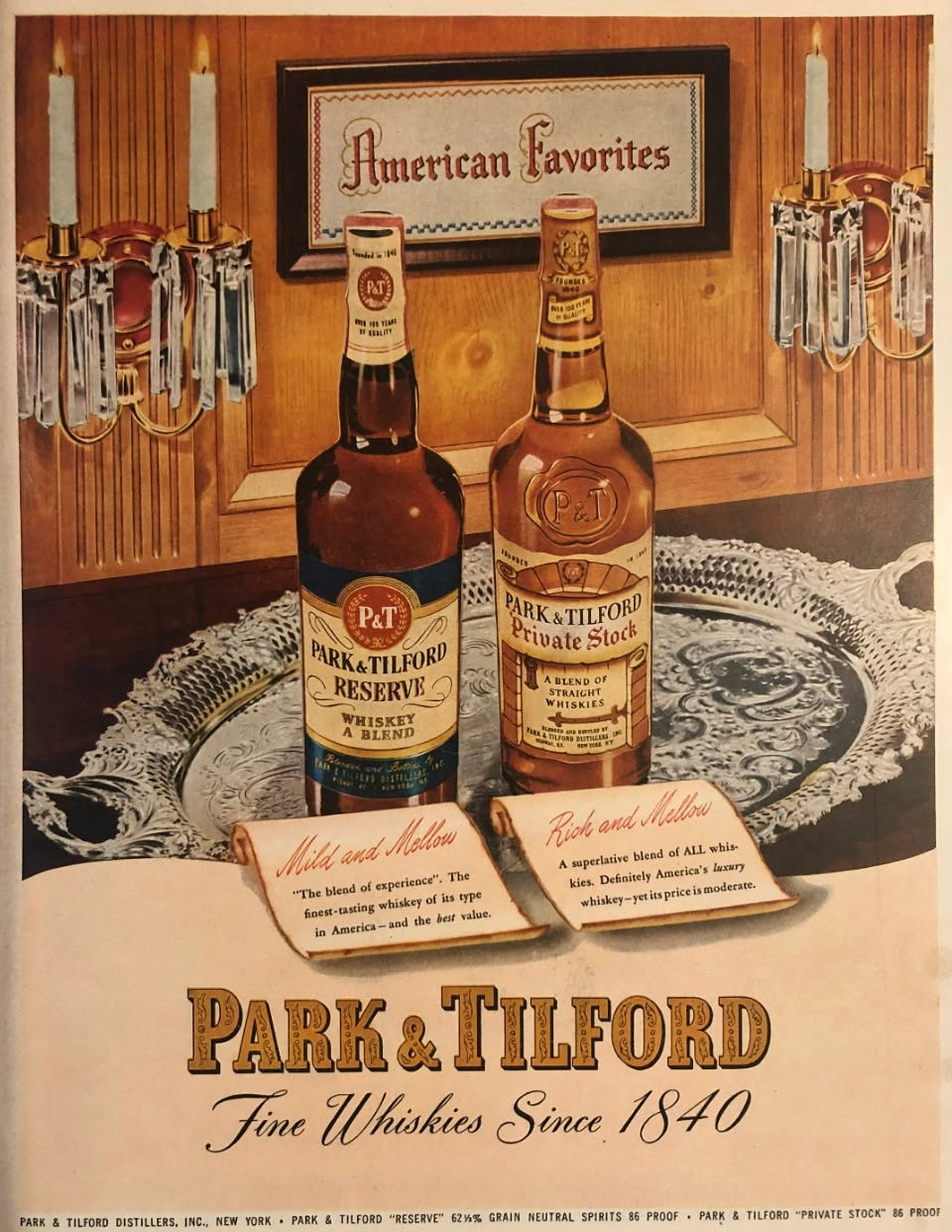 By 1949, the competition in the whiskey market was stiffening. The government recently lifted their war time restrictions, and a flood of whiskey was entering the market. Arthur D. Schulte, now 42, commented on the state of the market;