

One of the glossed over elements necessary in the production of traditional Pennsylvania rye was the nearly universal use of heated warehouses. The steam-heating of warehouses is mentioned occasionally, but it is often compared to the use of cycle heating in Kentucky- which is not accurate. Cycle heating, employed by distilleries like Buffalo Trace and KY’s Michter’s Distillery, is a modern adaption of the older tradition of year-round, consistent steam heating of bonded warehouses. This practice, by the way, did not disappear with Repeal. It was employed into the 1950s and 60s. The excuse most often given for why steam heating in warehouses was abandoned is that it was cost saving measure. This excuse falls short for me, especially after asking engineers about the costs involved and hearing, “No, it’s pretty easy to heat a warehouse with steam and the expense is not really an issue.” The reason, it seems, has more to do with the structures of modern rickhouses. Most bonded warehouses today are made of concrete and steel with lighter weight metal siding that do not insulate heat very well.
Warehouses in Pennsylvania were large, masonry structures- made of locally made brick or stone. They were heated by steam, and lots of it. Most warehouses were kept at about 80 degrees- not ambient room temperature as some “heated warehouses” are today. They were HOT. And the hotter they were, the drier the air inside.
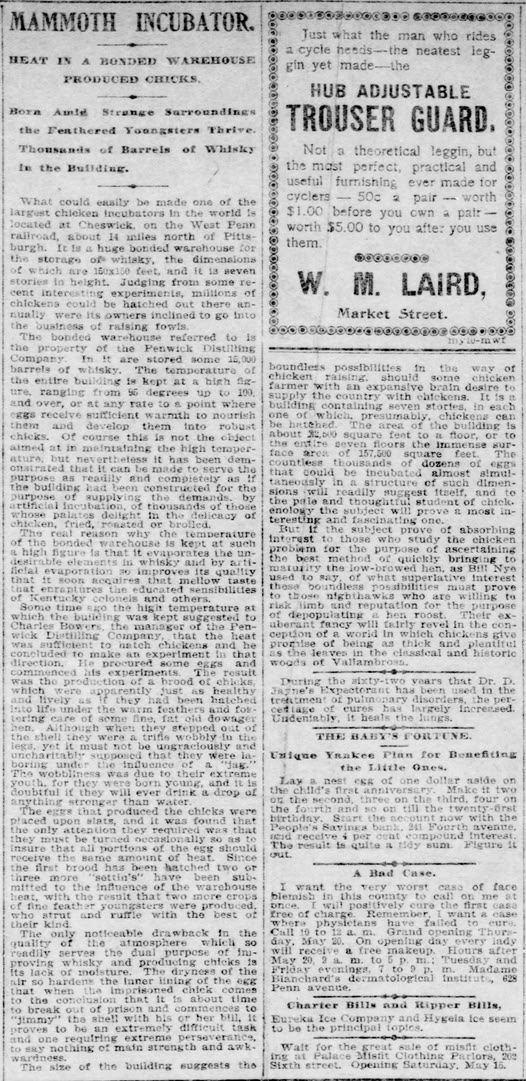
One particular distillery in Cheswick, Pennsylvania maintained their rye whiskey warehouses at temperatures of over 95 degrees. Yeah, that’s right. Near 100 degrees! And guess what else you can do in a building that’s kept at 100 degrees? You can incubate chicken eggs! And they DID! And this was no insignificant distillery. This was the Penwick Distilling Company- 14 miles north of Pittsburgh. They manufactured Penwick Pure Malt and Pure Rye Whiskeys. Many liquor firms (rectifiers) sought out their spirits for bottling and blending purposes, too- popular brands that bottled Penwick rye whiskeys were St. Ledger Pure Rye Whiskey (a Pittsburgh brand) and Daniel Brady Rye Whiskey (a Chicago brand).
Penwick Distillery did not survive Prohibition, but its name was changed to East Penn Distilling Co. after 1919, which some collectors of Prohibition whiskeys may recognize. The distillery’s brands were absorbed by the American Medicinal Spirits Co. before Repeal, which later fell under the name National Distillers.
Another interesting thing to note here is that Kentucky was quite familiar with the use of heated warehouses. In fact, many swore by them! Like Pennsylvania and Maryland, many Kentucky distilleries owned large brick warehouses that were fully heated year-round, so it’s an odd thing (at least to me) that no one maintained the practice. (To be clear, the owner of the Penwick Distilling Company, Elias Block, was ALSO owner of the Darling Distillery in Kentucky.) While folks may explain how expensive it would be to use steam heat in a modern bourbon warehouse, that seems an odd excuse for such a lucrative Kentucky industry. I think the reality has less to do with avoiding the added expense of heating warehouses and more to do with an aversion to change. Distilleries may like to claim that they’ve been doing things the same way they’ve always done them, but that’s patently false. While they HAVE been doing things the same way for a long time, they’ve changed their production methods a great deal over time. There is plenty of proof showing that heated warehouses vastly altered aging spirits. One only needs to taste the difference by comparing a modern whiskey to one that was distilled and matured 50 years ago.