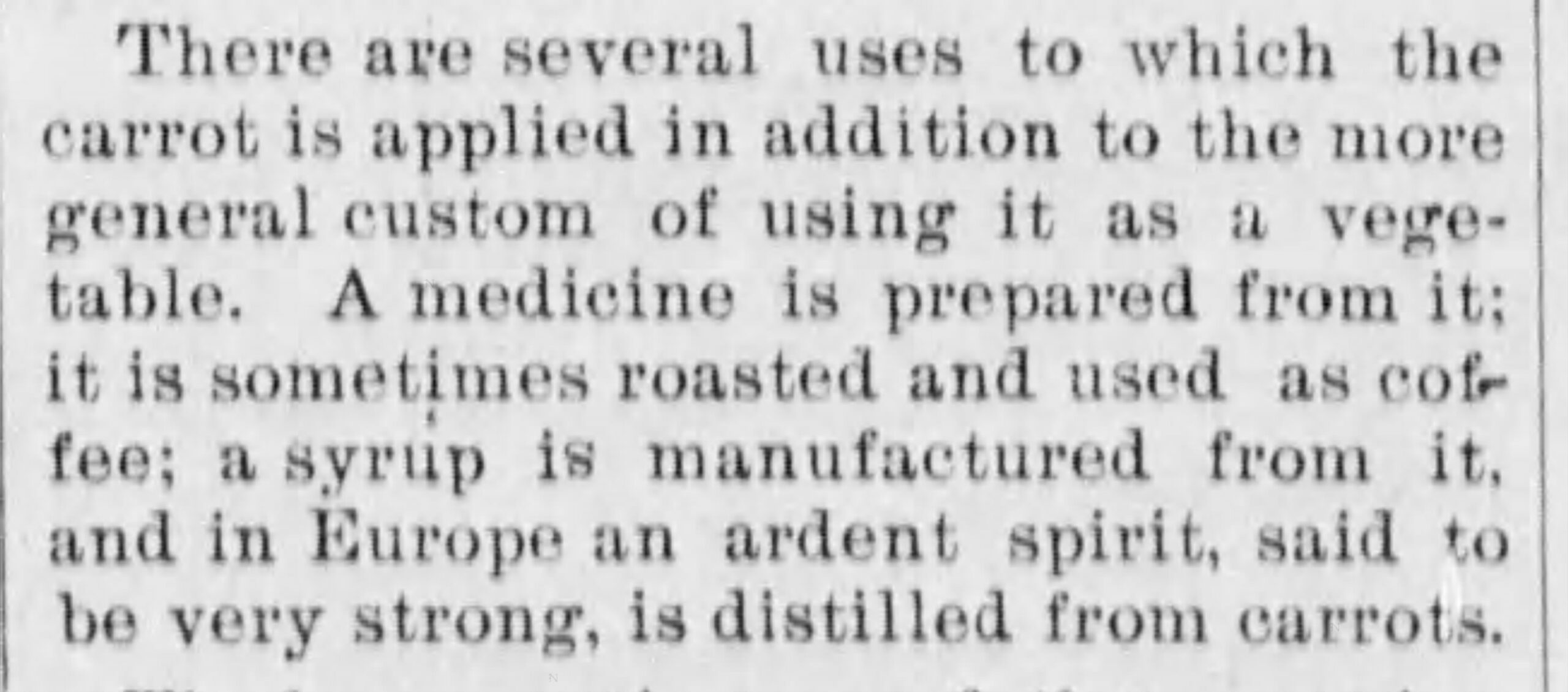
The ingenuity of pre-prohibition distillers never ceases to amaze me. Carrot spirits? I’ve seen potato whiskey, but carrot whiskey? Who knew?
The idea of supplementing your mash with a sweet vegetable isn’t really so far-fetched, though. A few years ago, I had the unique pleasure to sit and talk with Marc Meltonville, the famous food historian, at Mount Vernon’s distillery in Virginia. We discussed the various possibilities for supplemental mash adjuncts, which seemed endless! Marc explained that yeasts may be bred for particular performance outcomes when it comes to flavor, but they are more particular about their environment than they are about what they consume. Yeasts want to eat sugar, so you can throw anything in the mash you like- You just have to be wary about how the yeast will consume those sugars and what effect those yeasts will have on the final flavors present in your distillate. Certain yeast strains work best on grapes, others on rye or wheat or blueberries or apples. Some work best in acidic environments, some for long fermentations, others for short- but each may be employed to produce a preferred flavor profile in a whiskey. Distillers perfect their yeast strains after years of experimentation, honing in on desirable flavors, but that doesn’t mean that those same yeasts won’t have a go at whatever you throw at them! The trick is finding a yeast that will perform best under ideal circumstances- circumstances that a distiller specifically cultivates for the yeast of their choosing. It’s curious to find examples of distillers making spirits out of vegetables like carrots, but it becomes less odd when you remember that corn can be a considered a grain, a fruit, OR a vegetable, depending on how it’s harvested or how it’s used after harvest! Distillers, much like their yeast strains, have always understood that their objective is to convert sugar into alcohol, so they haven’t always been as particular as they are now about “mashbills”.
Pre-Prohibition distillers weren’t limited by modern legal standards of identity, but they WERE bound by industry-imposed standards. More importantly, they were bound by consumer expectations, so there were certainly industry standards which dictated what WAS and what WAS NOT permissible. But when it came to neutral grain spirits (aka “cologne spirits” or base spirits for rectified products), the market was far more open to interpretation! The use of carrots may have not have been embraced for whiskey production in the U.S., but it was entertained as an interesting concept!- No less interesting than beet sugar or molasses or potatoes or any other potential sugar source for yeast! So…why not experiment at least, right? Just the idea of carrots being a consideration for distillers is interesting…at the very least. When life gives you carrots, why not cook them, ferment them, and distill them into spirit?
Here is a recipe for carrot spirits, pulled from the “Encyclopædia of Chemistry, Theoretical, Practical, and Analytical, as Applied to the Arts and Manufacturers: Acetic acid-gas” which was published in 1877.
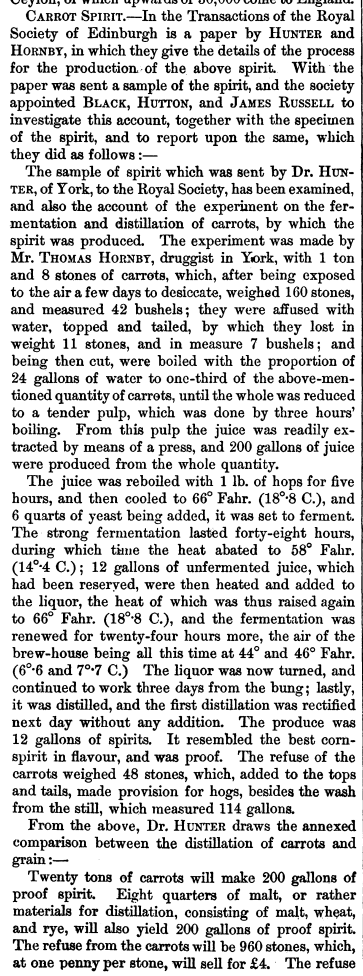
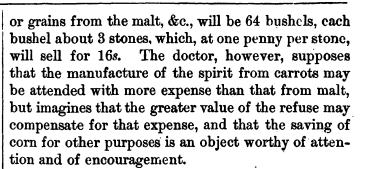
Carrot spirits were an 1870s experiment in Edinburgh, not the United States, but it shows a genuine scientific interest in using other surplus agricultural products for distillation purposes (likely for rectifiers in need of inexpensive, flavorful high wines). It considers the all-important recycling of stillage. Early distillers were very conscious of the value of their spent mash because it was a large part of their revenue. Raising animals and selling them for meat was either as profitable (or nearly as profitable) for their business as the sale of their distilled spirits, so the quality of their spent mash was always a consideration. With both rye and corn-based American whiskeys, nutritional supplements for the animals were common, so finding a way to avoid paying for feed supplements while still making quality products would have, at the very least, been a worthy experiment. This experiment definitely grabbed my attention! I wonder what modern distillers would do with this recipe today?
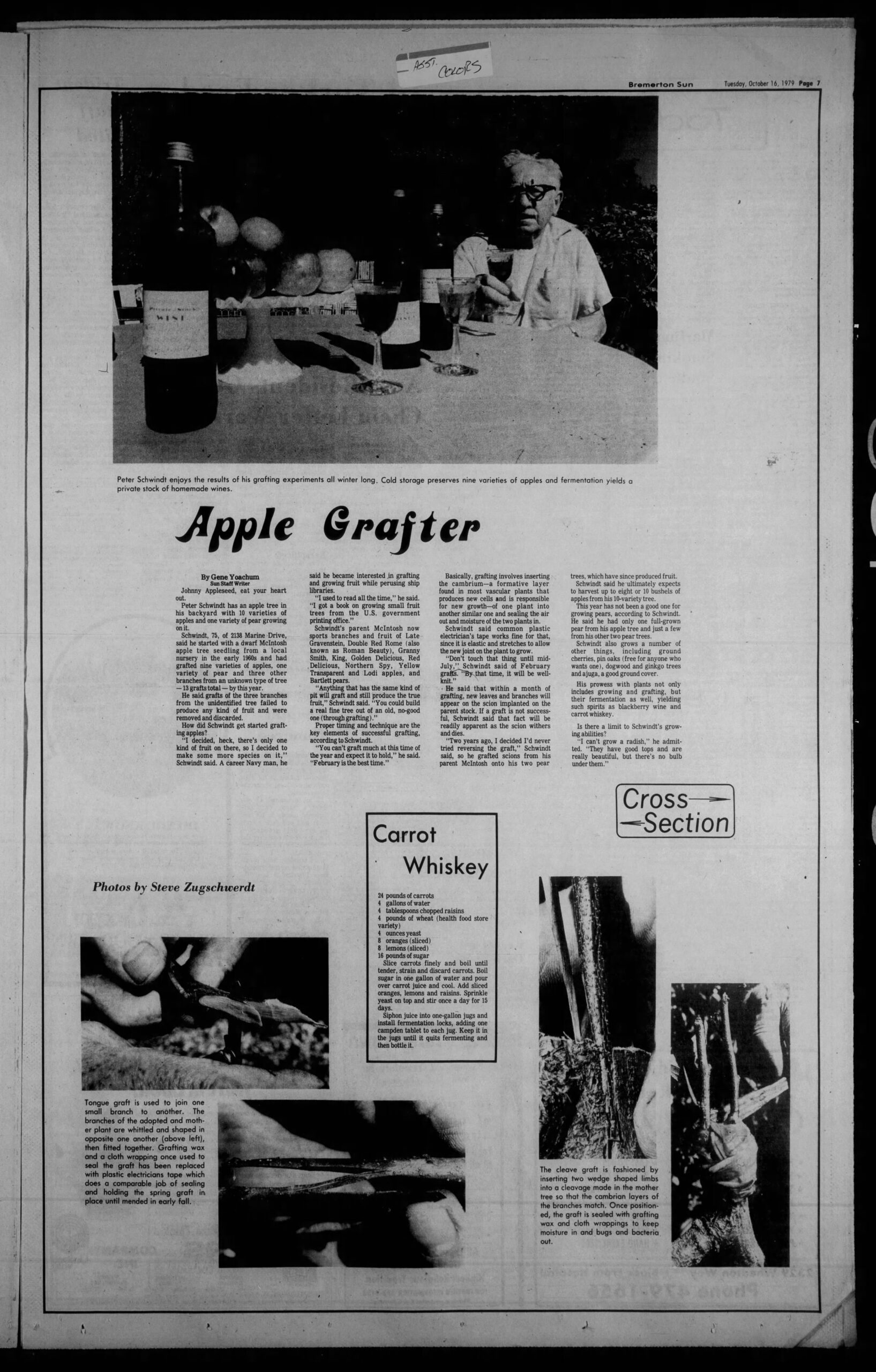
Here is another recipe from an article in The Kitsap Sun of Bremerton, Washington in 1979- This recipe describes more of a “carrot wine” than a “carrot whiskey”, but it doesn’t make seeing those words in a modern newspaper any less interesting!