
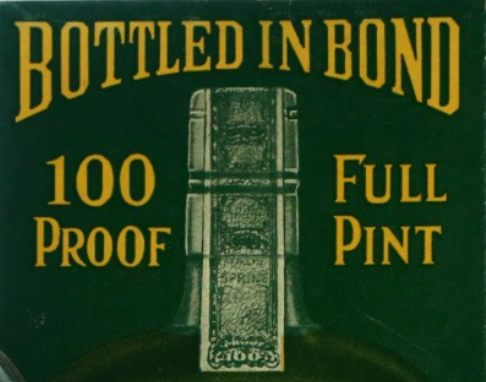
Let’s clear up a few things about the Bottled in Bond Act of 1897. I know the “BIB Act” has been written about an ENDLESS number of times, but there are some big cracks in its backstory that deserve some attention and explanation. Let’s begin by saying that the Bottled-in-Bond Act was a supplemental piece of legislation being tacked on to bills that had already been passed through Congress. When you read the language of the 1897 act, two things stand out that make this very clear:
1. Nowhere in the BIB Act is it mentioned that WHISKEY MUST BE AGED FOR 4 YEARS. Yes, that’s right! It is never mentioned! And why might that be? Because Section 50 of the Act of August 28, 1894 (otherwise known as the Wilson-Gorman Tariff Bill) makes it very clear -numerous times!- that distillers must order a regauge of barreled spirits before those spirits reached 4 years of age (otherwise known as an extension to the bonding period). The Wilson-Gorman Bill was basically a means for the government’s Office of Internal Revenue to ensure that an appropriate/presumed amount of spirit had been lost due to evaporation and that the spirits hadn’t been tampered with in any way before a tax could be levied what remained in the barrel. In 1895, that legislation was modified to say that distillers could go ahead and leave that regauged whiskey in the barrel for an additional 4 years before that barrel was taxed (an 8 year bonding period). Of course, a second regauge would have to take place then, as well. So the “Bottled-in-Bond Act” of 1897 did not NEED to mention anything about the spirits being “4-years-old” because that fact was already implied. Or, at least, the initial gauging period ended the day before the whiskey turned 4 years old. It was the distiller’s obligation to report when the whiskey was going to be four years old so that the government gauger would know to re-gauge that whiskey after it was four years old.
2. Nowhere are the words “charred barrels” mentioned. In fact, barrels aren’t mentioned at all. They are implied, however. Since 1889, distilleries had been prohibited from refilling casks or packages previously used at the same distillery. So brand new barrels are implied, and though charring was not legally enforced, it was commonplace throughout the industry. What is of concern with the BIB Act are cisterns and bottles. This act is all about regulating the end of the bonding period and the bottling of the product. The act was quite purposefully making the vatting of products from multiple distilleries less favorable. It was beneficial to pure/straight whiskey manufacturers, but not so great for liquor firms and blending houses. This is a very interesting transitional moment in the distillery industry. Bottling by a distillery (on the distillery’s premises) was not normally done, but the BIB Act would change that in a big way because it would elevate bottled-in-bond products and give distillers bottling their own product an advantage they didn’t have before.
3. Another thing that might come as a surprise is that the Bottled in Bond Act of 1897 does not make it necessary for whiskey to be 100 proof. Crazy, right? What it DOES say is that whiskey directly from a barrel may be filtered and “may whenever necessary” be reduced for bottling purposes through the addition of water to 100 proof for domestic use and cannot be LESS than 80 proof when bottled for the export market. The exact text from the document states the following:
“The distiller may, in the presence of the United States storekeeper or storekeeper and gauger, remove by straining through cloth, felt, or other like material any charcoal, sediment, or other like substance found therein, and may whenever necessary reduce such spirits as are withdrawn for bottling purposes by the addition of pure water only to one hundred per centum proof for spirits for domestic use, or to not less than eighty per centum proof for spirits for export purposes, under such rules and regulations as may be prescribed by the Commissioner of Internal Revenue with the approval of the Secretary of the Treasury; and no spirits shall be withdrawn for bottling under this Act until after the period shall have expired within which a distiller may request a regauge of distilled spirits as provided in section fifty of the Act of August twenty- eighth, eighteen hundred and ninety- four.”
So you can see that words like “the distiller may” and “may whenever necessary” are guidelines, not strict rules. Now, all of this may sound blasphemous to a modern whiskey drinker reading this, but FRET NOT! I’m only talking about the Bottled in Bond Act of 1897. Additional legislation that came later is what makes our modern understanding of the Bottled in Bond Act more accurate. (Except for the commonly repeated belief that it was the first consumer protection act- that’s just wrong!) The 1897 BIB Act would finally begin to gel into what we recognize it to be today once the rules regarding medicinal whiskey began being laid out during Prohibition.
In 1922, new regulations ensured that all prescription whiskeys MUST be bottled-in-bond. Just 3 years later, the Pharmacopeia of the United States of America– a reference book for pharmacists/physicians of standards, identities, and formulas for drugs/medicines- was updated to state the following:
“Medicinal whiskey or “spirits frumenti” is “an alcoholic liquor obtained by distillation of the fermented mash of wholly or partly malted cereal grains, and containing not less than 47 per cent and not more than 53 per cent by volume of C2H5OH (ethyl alcohol) at 55.56 degrees centigrade.” It also added that those medicinal whiskeys “must have been stored in charred wood containers for a period of not less than four years.”
This was not US law for producers or bottlers, but it WAS the standard for pharmacists. Since pharmacists were obligated by law to only purchase bottled in bond whiskeys and were the only people able to sell to prescription holders, pharmacists would be the ones to move the needle. By the end of Prohibition, those “necessary requirements for bottled in bond” we all know so well would be written into the law books. (1. Must be 100 proof. 2. Must be distilled by one single distillery during one single distilling season. 3. Must be at least 4 years old.)
All this said, we should probably stop talking about the “Bottled in Bond Act of 1897” and start talking about the “Amending Stamp Provisions Act of Bottling in Bond of 1937.” That’s the act we’re all talking about, anyway. That’s when it FINALLY became law to make bottled in bond whiskey 100 proof, at least four-years-old, and distilled by one distillery during one distilling season. It was the clarity that had been needed for 40 years. I know 1897 is everyone favorite whiskey law, and “The Amending Stamp Provisions Act of Bottling in Bond of 1937” doesn’t have as nice a ring to it, but…well, facts are facts.
If you’d like to read more on the topic: https://www.dramdevotees.com/when-bottled-in-bond-was-not-actually-bottled-in-bond/
If you’d like to read the Bottled-in-Bond Act, itself: https://www.dramdevotees.com/bottled-in-bond-act-march-3-1897/