
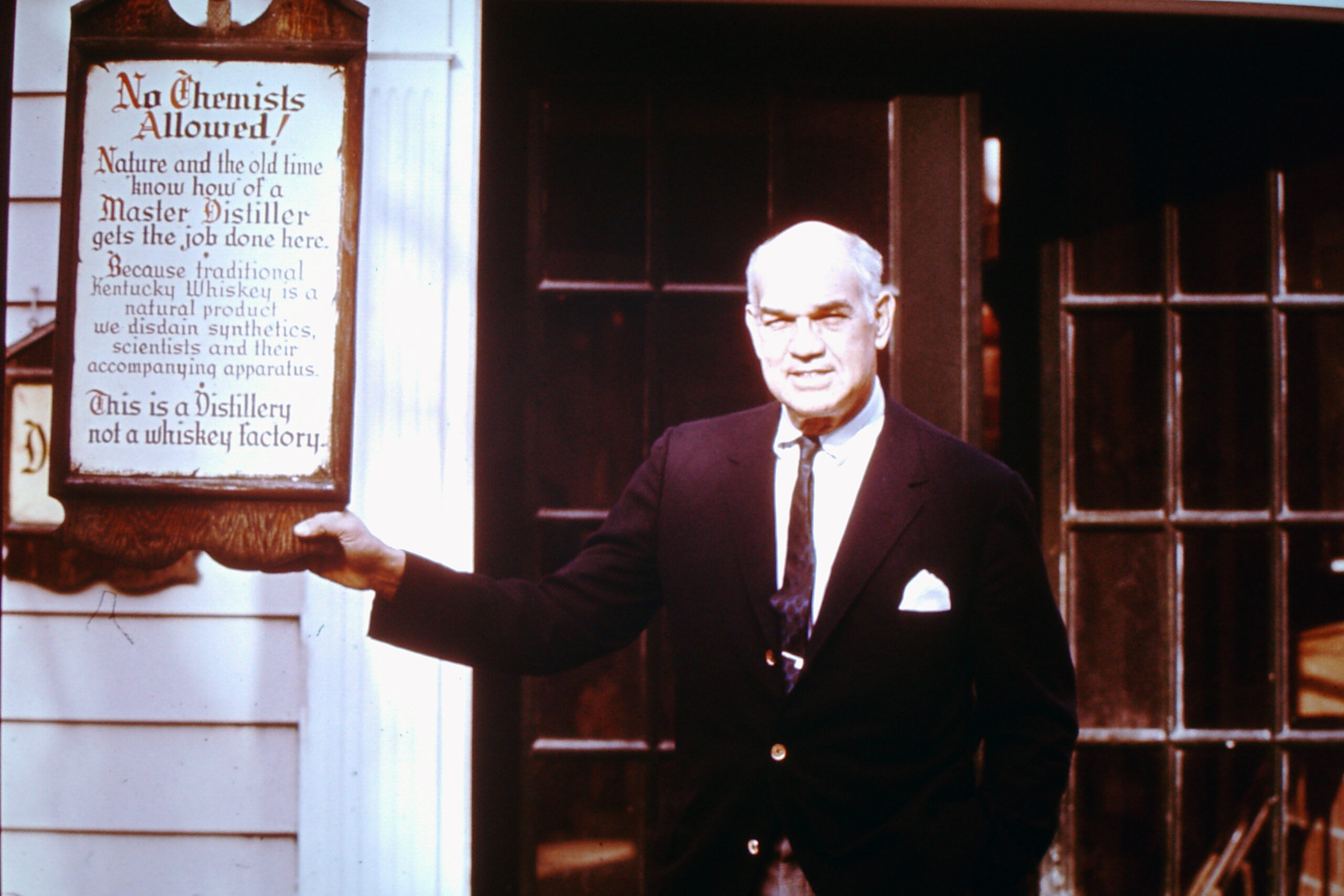
 We tend to think of distillers as chemists or scientists, even if Pappy Van Winkle adamantly refused to acknowledge the value of chemistry in his distillery. There’s no denying that distilling uses applied sciences- and many distilleries keep lab equipment on site for testing purposes. But modern distillers don’t usually have advanced degrees in chemistry. Many have engineering degrees or have backgrounds in brewing or winemaking. Others may have trained through college coursework or through practical means by working under other distillers before striking out on their own. Generally speaking, however, most distillers do not come from a previous career in pharmaceutical chemistry, micro-biology, or laboratory science. That being said, men with master’s degrees in chemistry were in demand during the late 19th century…not by distilling companies, but by the U.S. government which had a sudden and desperate need to understand what made the distilling industry tick. These men have left an indelible mark on the whiskey industry, whether they intended to or not. What began as a means to test for purity and taxability eventually began to inform the processes employed in Americas stillhouses.
While the U.S. Treasury has been realizing great sums of money through the taxation of distilled spirits since the early 1860s, it had also managed to be woefully behind the curve when it came to understanding the products it was taxing. The Department of Internal Revenue was always playing catch up with businesses subject to taxation. Every regulation seemed to inspire business owners to find a loophole or design a clever method to owe the least amount of tax possible.
Officers in the Internal Revenue Department would ask themselves questions like, “Why aren’t we collecting the amount of money our accountants are telling us we’re supposed to be taking in?” or “Why are these barrels not as full as they should be?” or “How do we prove that these distilling companies are ripping us off?” Congressional investigations into the industry were too often led by government employees who were ill equipped to properly question industry experts or grasp the intricacies of such a diverse, multifaceted industry. Eventually, the Internal Revenue Department concluded that they needed a cadre of their own experts!
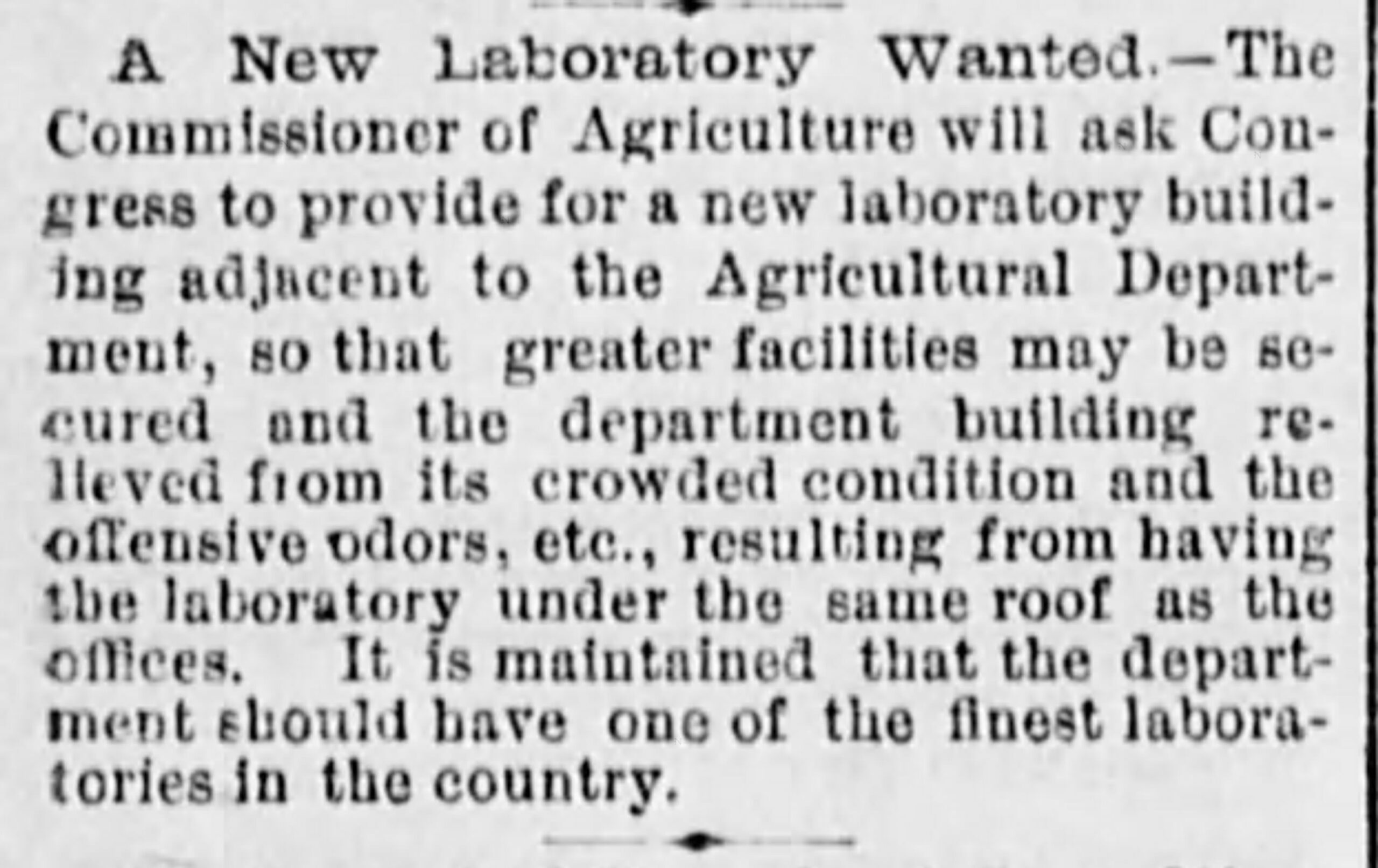
While U.S. Customs had been conducting experiments to determine purity in spirits since the Civil War, the need for a designated laboratory had become a necessity by the 1880s. Food purity, especially when it came to milk, sugar, and oleomargarine, needed more than cursory analyzation by customs agents- the government needed chemists.
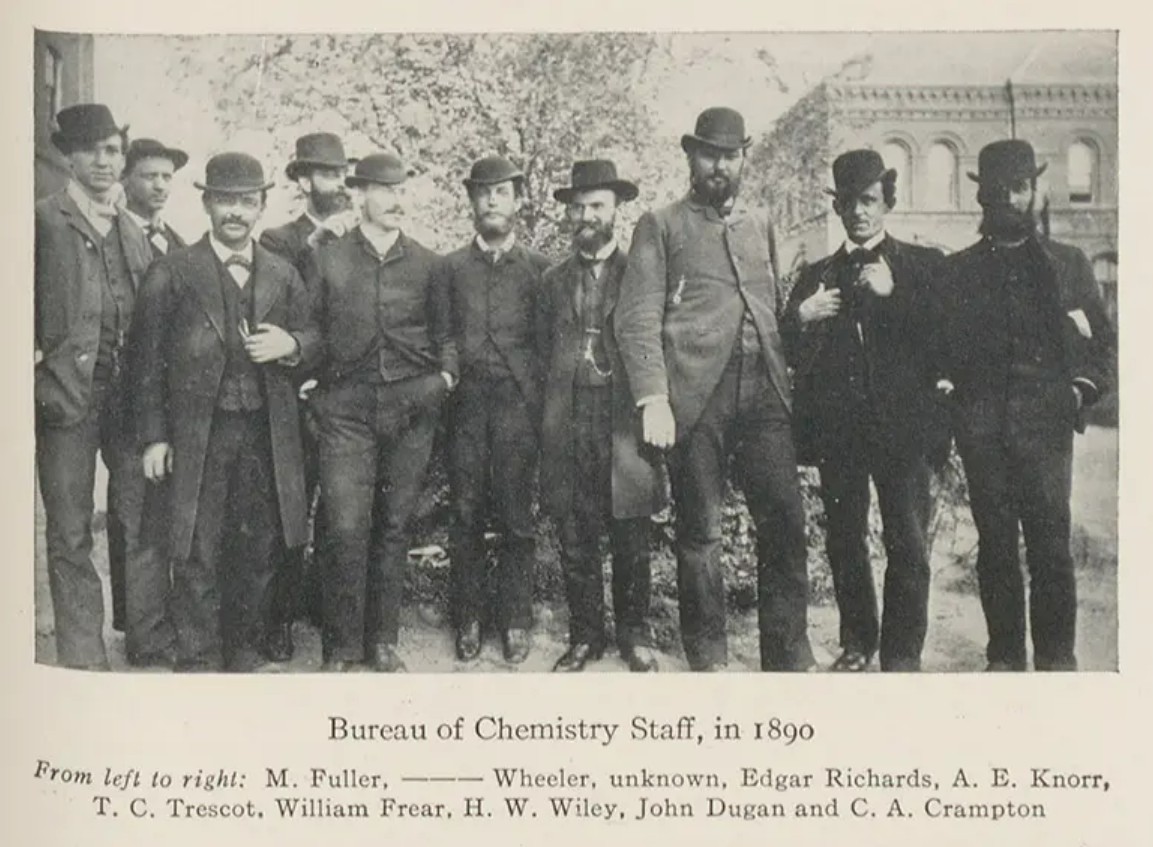 In 1883, Harvey W. Wiley established his small lab, known as the Bureau of Chemistry, within the newly established Department of Agriculture. Three years later, Wiley’s department was enlarged (relatively speaking) to include new equipment and new experts. He may have started small, but Harvey Wiley had ambition, and he used his large stature and personality to press his influence in Washington over the next 30 years.
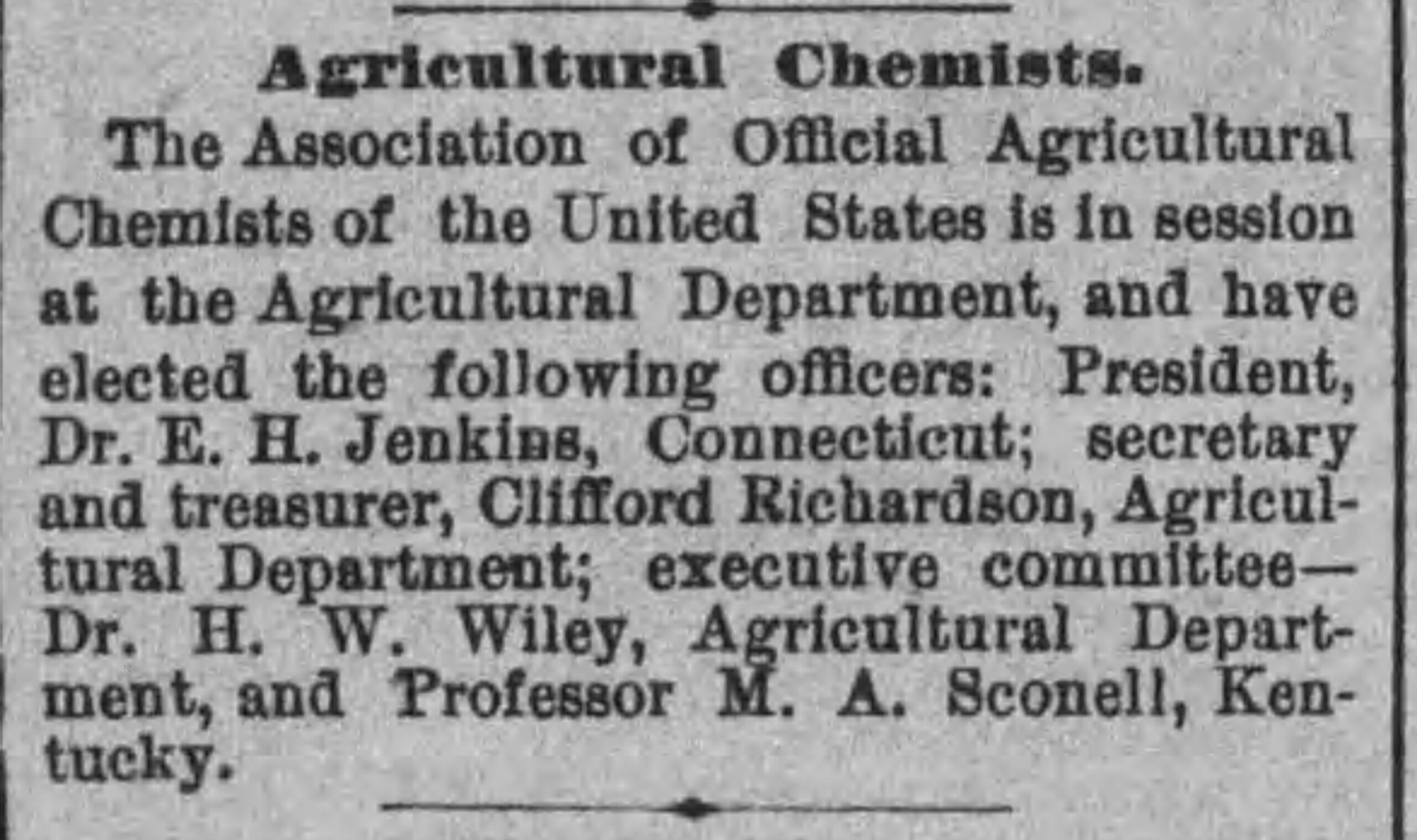
One of the earliest chemists to work directly with Wiley and the Department of Agriculture was Charles Albert Crampton. During the 1880s, Wiley and Crampton were focused on perfecting the extraction of sugar from sorghum. In fact, Wiley’s original purpose had been to improve the production of sugar in the United States. Crampton, while aiding Wiley in the lab, also focused on analyzing samples of beer for signs of adulteration. In 1887, at the age of 29, Crampton published a lengthy paper for the Dept. of Agriculture on the subject of food and food adulterants. His research led him to publicly advocate for the passage of laws to establish purity in bottled wines and the banning of adulterated wine across the state of New York. (Note the prequels here for purity in beer and wine over distilled spirits.) Between 1890 and 1893, C. A. Crampton served as chief chemist for the Internal Revenue Bureau. In true bureaucratic style, the chemists working for the Department of Internal Revenue were working separately from the chemists working for the Department of Agriculture- for differing amounts of pay.
To be clear, government-funded chemists like Wiley (Dept. of Ag.) and Crampton (Dept. of Int. Rev.) were not focused on whiskey- at least not yet! It just happened that whiskey became one of the substances that would fall under their purview, which isn’t surprising when one considers the amount of money wrapped up in the taxation of distilled spirits and the fact that both laboratory departments were funded by the Treasury Department! Lengthy studies into whiskey adulteration would not begin in earnest until the late 1890s. It should be said that Harvey Wiley was repeatedly accused of being paid to promote the Bottled-in-Bond Act, which was passed in 1897. He was accused of practicing “yellow chemistry” (a play on “yellow journalism”) by printing periodicals paid for by the straight whiskey interests- as if there was some sort of quid-pro-quo understanding between himself and wealthy whiskey men. (Wiley’s department was always better funded than others like it.)
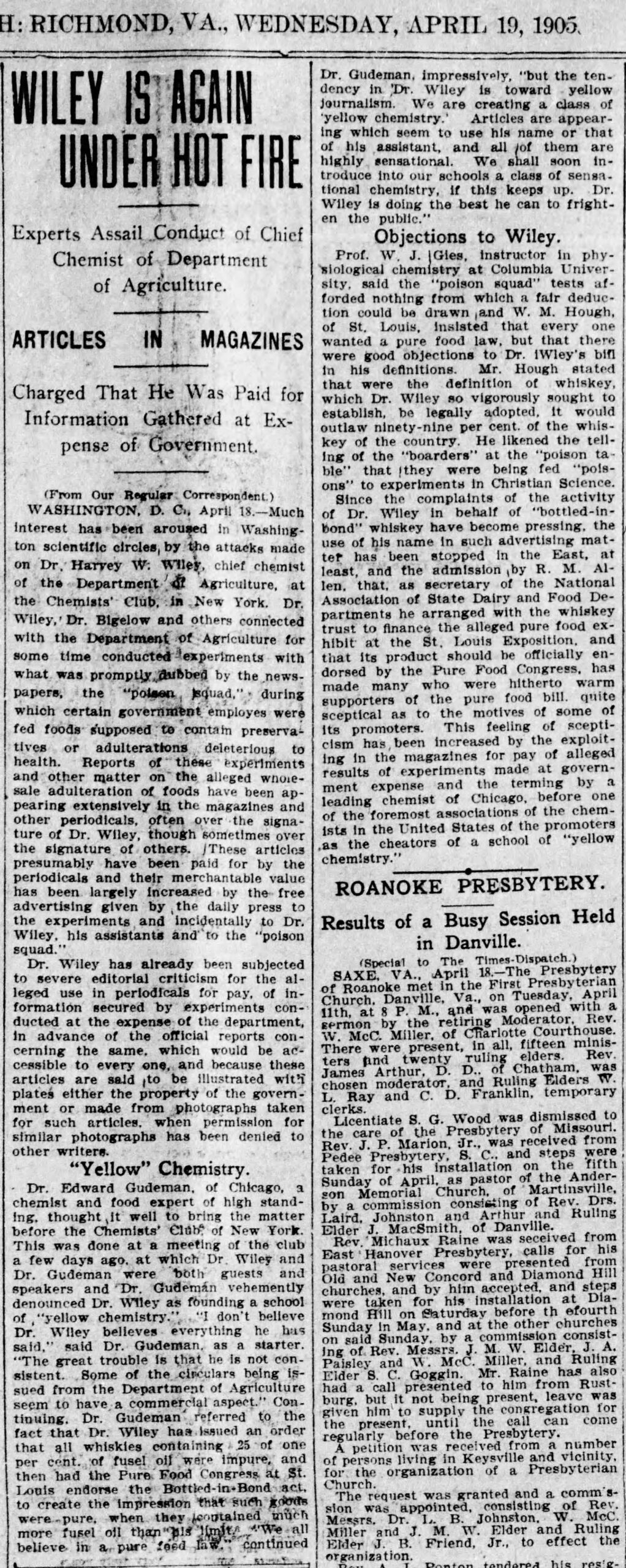
After the passage of the 1897 Bottled-in-Bond Act, the Department of Agriculture’s chemists began spending a lot more time focusing on the adulteration of whiskey. In 1898, 40-year-old Charles Crampton and his young, recently hired assistants, F.D. Simons (1896 graduate of the Univ. of Indiana with an M.S. in Chemistry) and Arthur B. Adams (graduate of George Washington University with an M.S. in Chemistry), began their research into the chemical changes taking place in whiskey after being stored in wood. About two years into the study, the men were joined by another young chemist named Lucius Moody Tolman who had been pursuing graduate work at Berkley before being recruited to join the team in D.C. The whiskey maturation study spanned 8 years, between 1898 and 1906. The final year of the study was spent analyzing samples from 31 different barrels of rye and bourbon whiskeys from as many different distilleries. The research they conducted had already been done privately by individual distilleries for decades, but the government was just getting around to finding out what the distillers already knew. The experiments were conducted this way (as explained in the study):
“Each year for eight years during the bonded period, the seals on the packages were broken and a quart was taken for analysis. These samples were all set aside in glass containers and a complete chemical examination made in 1906, after all of the samples from the various packages had been received, except that the determinations of alcohol, solids, color and color soluble in ether were made each year as the samples were received.”
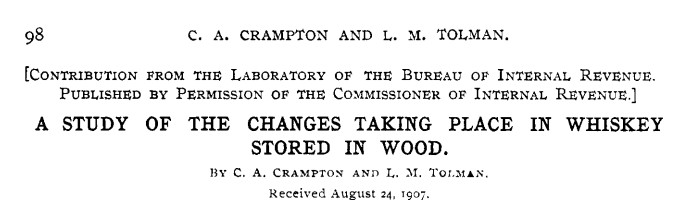

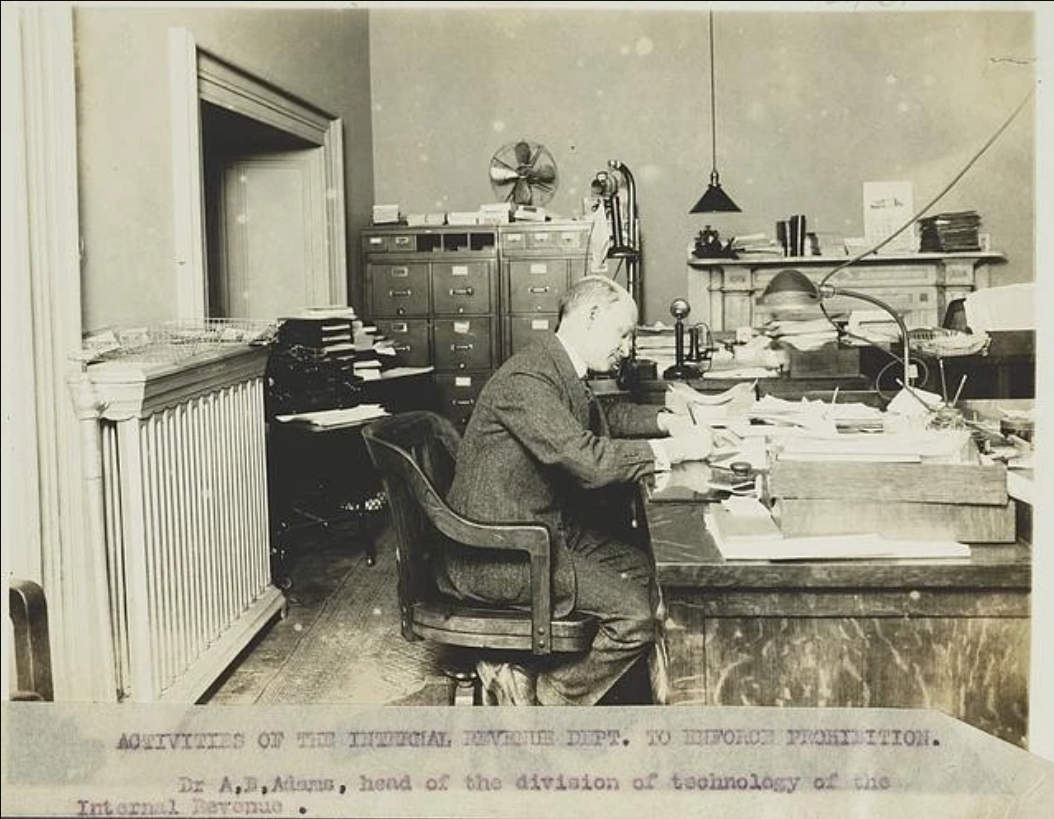
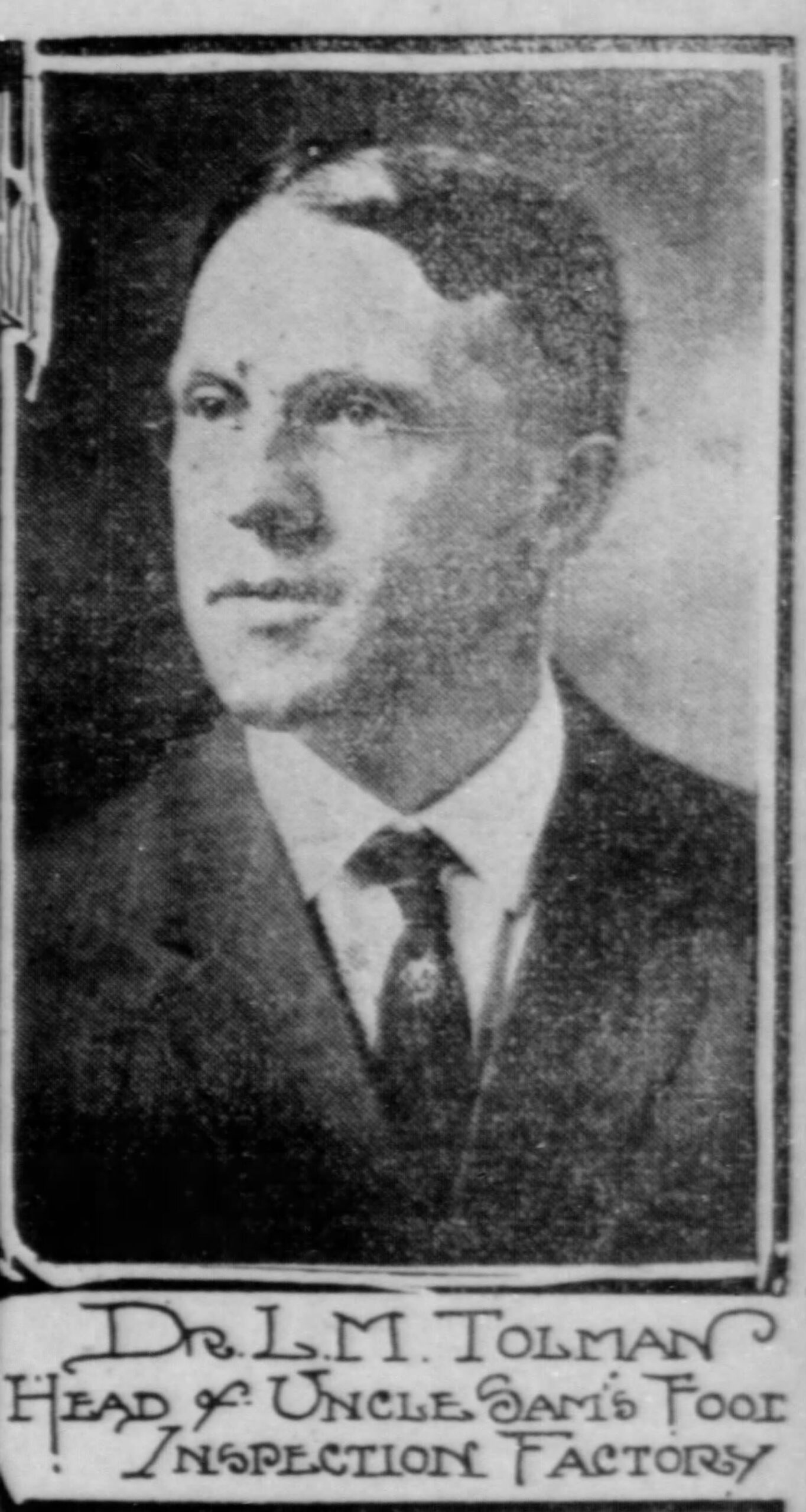
Most of the chemists in the government labs contributed in one way or another toward the study, but Lucius M. Tolman, by 1906, had been appointed head chemist, which made him responsible for organizing the compiled data for publication. None of Tolman’s work was happening in a vacuum, by the way. Charles Crampton had been focusing his efforts as chief chemist in charge of denatured alcohol work. Harvey W. Wiley had been lobbying for the passage of his Pure Food and Drug Act which was passed by Congress and signed into law by President Theodore Roosevelt on June 30, 1906. C. A. Crampton and L.M. Tolman’s “A STUDY OF THE CHANGES TAKING PLACE IN WHISKEY STORED IN WOOD” was published during the summer of 1907. Around the same time the paper was published, Lucius Tolman left his position at the Dept. of Internal Revenue to take a better paying job with Wiley at the Dept. of Agriculture. Tolman’s position as head chemist was passed to Arthur B. Adams who had been working his way up since joining the lab in 1898.
The research teams in Washington D.C. and their field teams in other major cities around the country continued to expose adulterations in food and beverages, but they were wildly understaffed to handle the number of samples they were being asked to analyze. They were often called as expert witnesses to testify in court against companies accused of adulterating their products. Their job had always been to serve the interests of the Treasury Department.
After becoming head chemist for the Dept. of Internal Revenue in 1907, A.B. Adams set up his own distillery in his offices, constantly tinkering and experimenting with his set-ups. He published several important papers based on his research:
1909- The Distillation of Whiskey, by A.B. Adams.
– This research focused on the different processes employed by rye and bourbon producers.
1911- The Distillation of Alcohol, by A.B. Adams.
– This research centered around the production of industrial alcohol.
1912- Some Data on the Manufacture of Smoking Opium and its Chemical Composition, by A.B. Adams and J.M. Doran.
– The importation of smoking opium had not been restricted until 1909. The new laws required an understanding of opium itself, its manufacture, and the trade which had recently become illegal.
(other things to consider while all this was happening)
1909- The Taft Decision
1911- William Robins of Hiram Walker & Sons published “A Plot Against the People: A History of the Audacious Attempt by Certain Kentucky “Straight Whiskey” Interests to Pervert the Pure Food Law in Order to Create a Monopoly for Their Fusel Oil Whiskies and to Outlaw all Refined Whiskies.”
– Long title, but pretty self-explanatory. Harvey Wiley had been creating enemies within the whiskey industry for years.
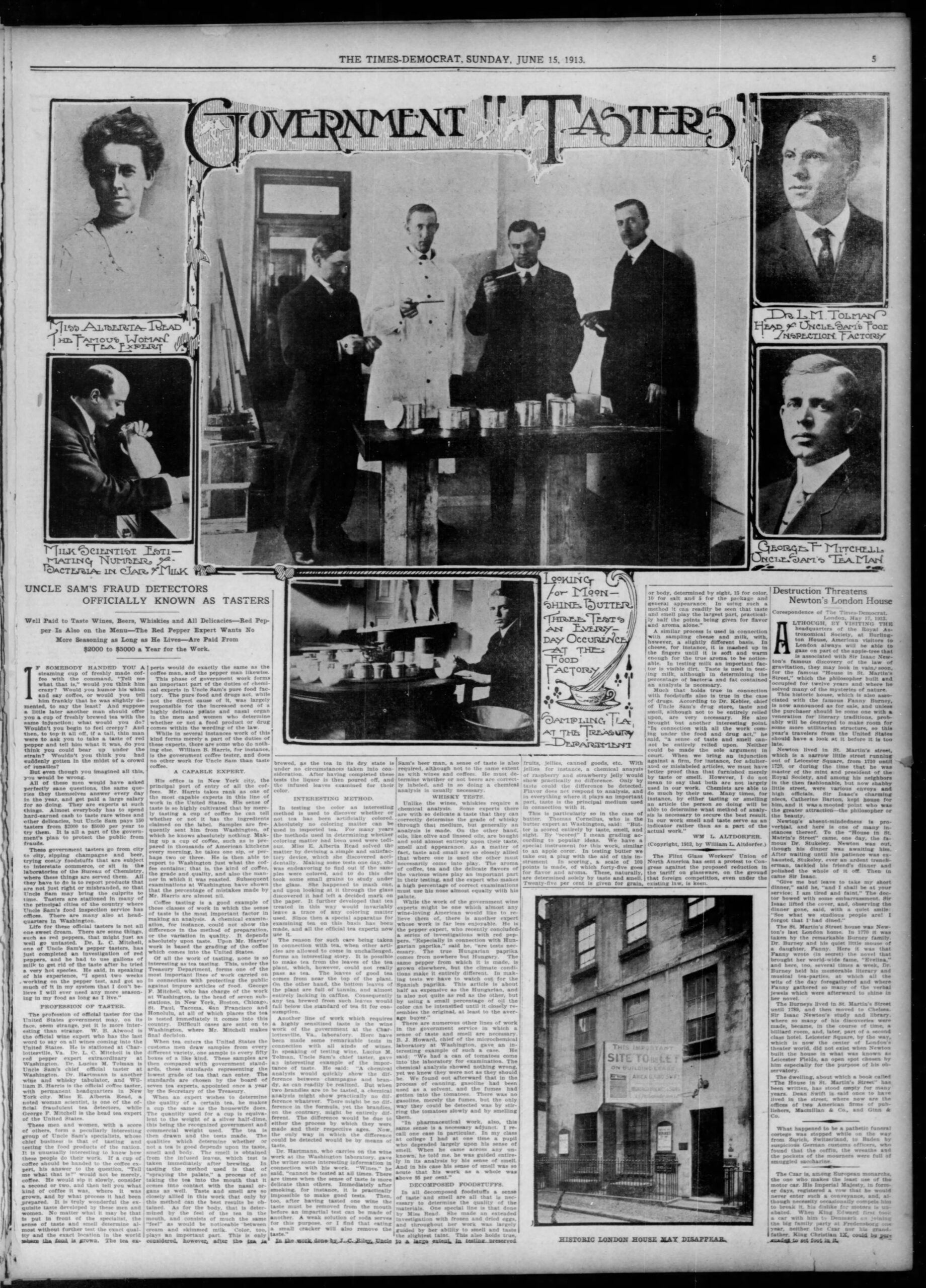
In 1913, newspapers across the country published articles on the government’s chemists and laboratory experts as “tasters” of brewed, fermented, and distilled products. The chemists were described as men (and a woman!) with expertise in recognizing certain flavors and as having the ability to discern the difference between products simply by smelling and tasting them. This is a curious article because Harvey Wiley had recently resigned from his leadership position as head of the U.S. Bureau of Chemistry within the Dept. of Agriculture. It appears to be a promotional article to improve the public’s opinion on the government’s chemists.
Harvey W. Wiley was pushed out for being controversial, even as he was being supported by President Taft. Between 1906 and his departure in 1912, Wiley had effectively increased his staff at the Bureau of Chemistry from 110 to 146. He also increased appropriations to his department from $110,000 to just under a million dollars a year during that same time. He left the Dept. of Agriculture to take a position leading the laboratory at Good Housekeeping magazine. He would remain with that company for the rest of his life.
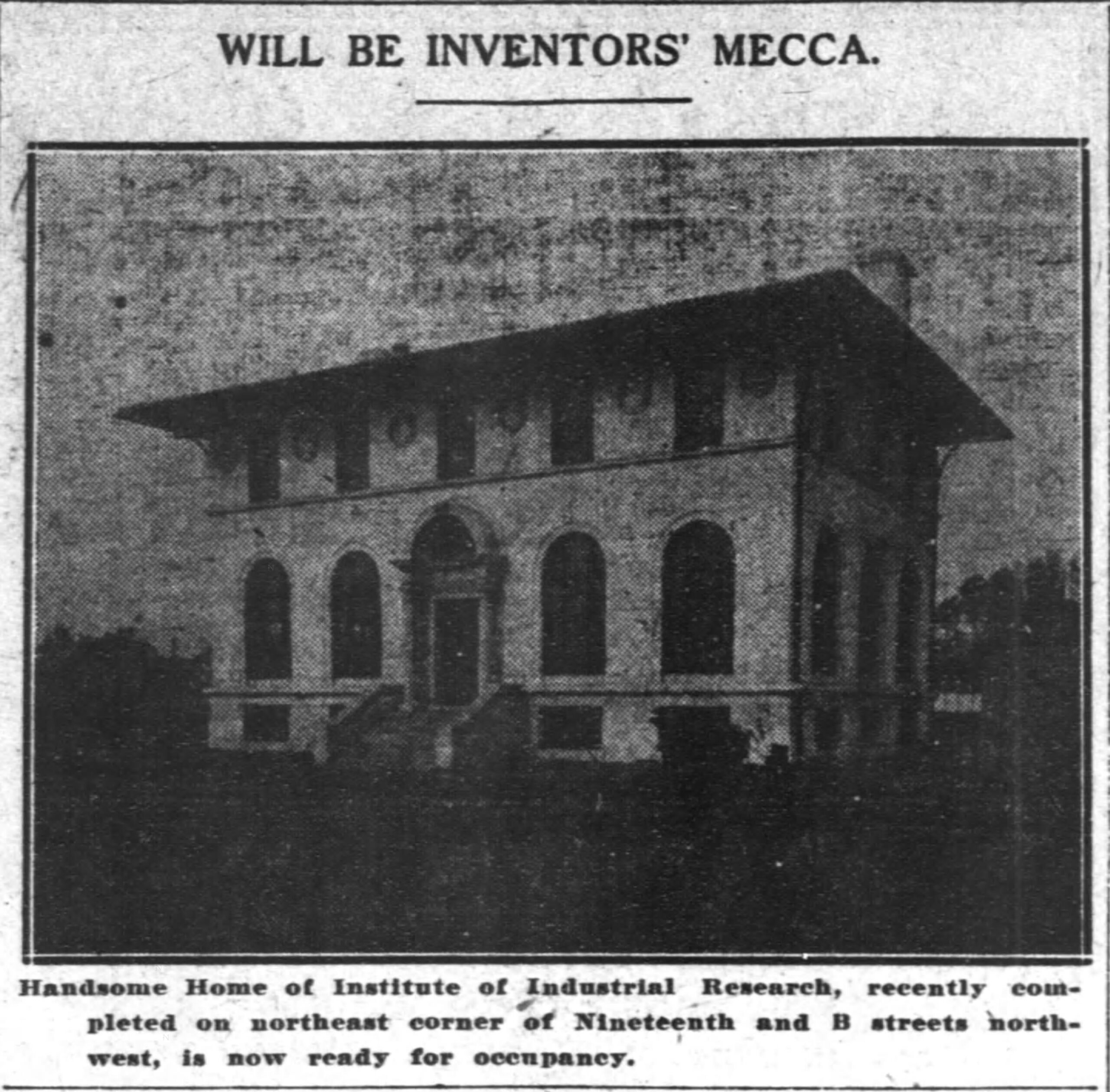
Charles Crampton chose to retire in 1910 to pursue private sector work with the Institute of Industrial Research, a corporation he co-founded to apply his knowledge and experience toward paying customers. Crampton died in 1915.
Lucius M. Tolman left his government job in 1918 to take a position with a Chicago meatpacker. This was a curious move on his part, especially due to the controversy stirred up by Upton Sinclair’s book, but one assumes he wanted to work to improve things from the inside. Wilson & Co. was a relatively new company, and they sought to promote the high quality of their goods. Tolman remained with Wilson and Company as chief chemist until moving up to become director of the company’s research and technical department. Tolman lived to be 74 and died in Chicago in 1949.
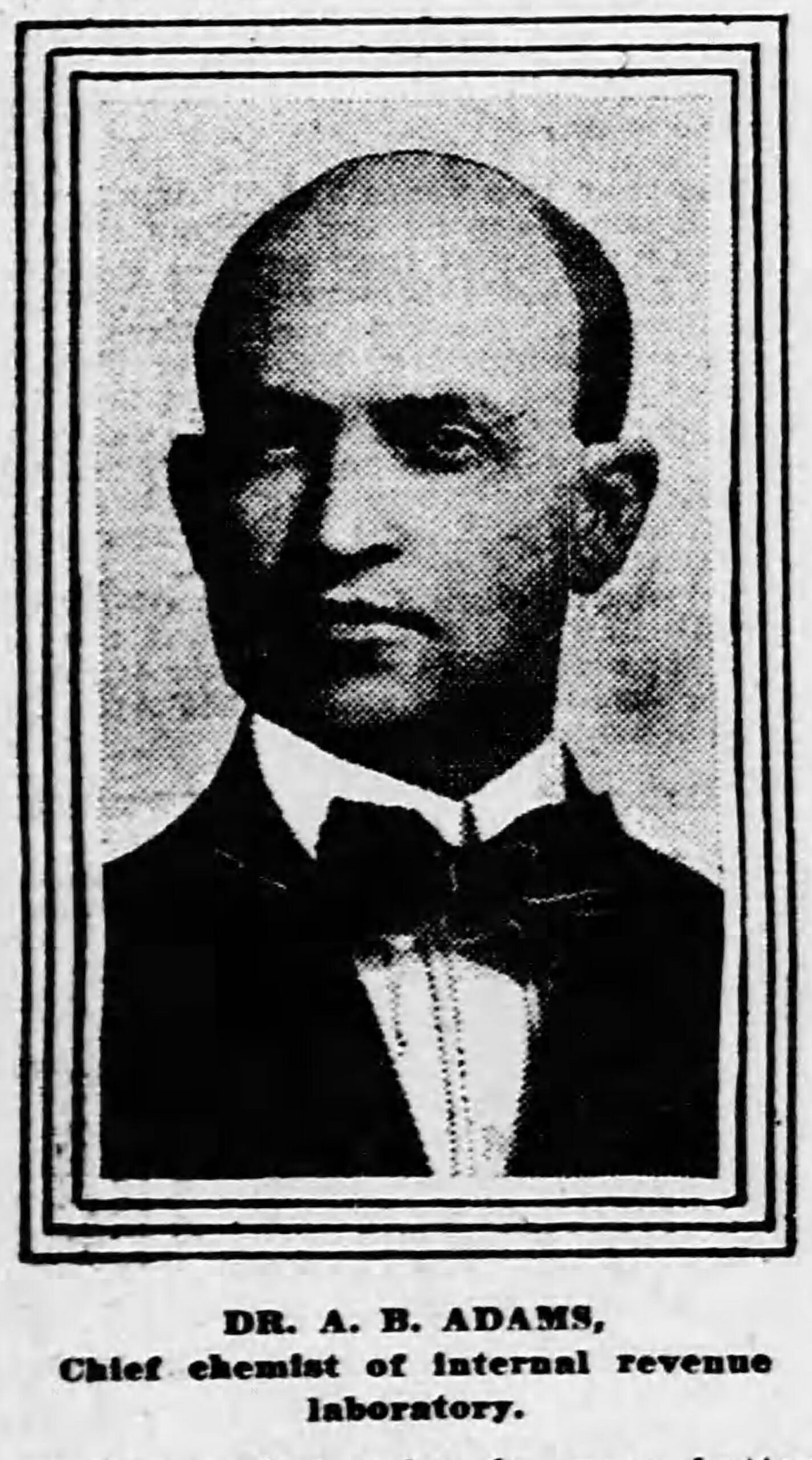
Arthur B. Adams would serve in a leadership position at the Department of Internal Revenue until 1920. In 1919, Adams technique for isolating glycerin from black strap molasses was splashed across America’s newspapers. This new technique could be used to make explosives (nitro-glycerin), even as the 1st world War had come to an end. (See article below.) 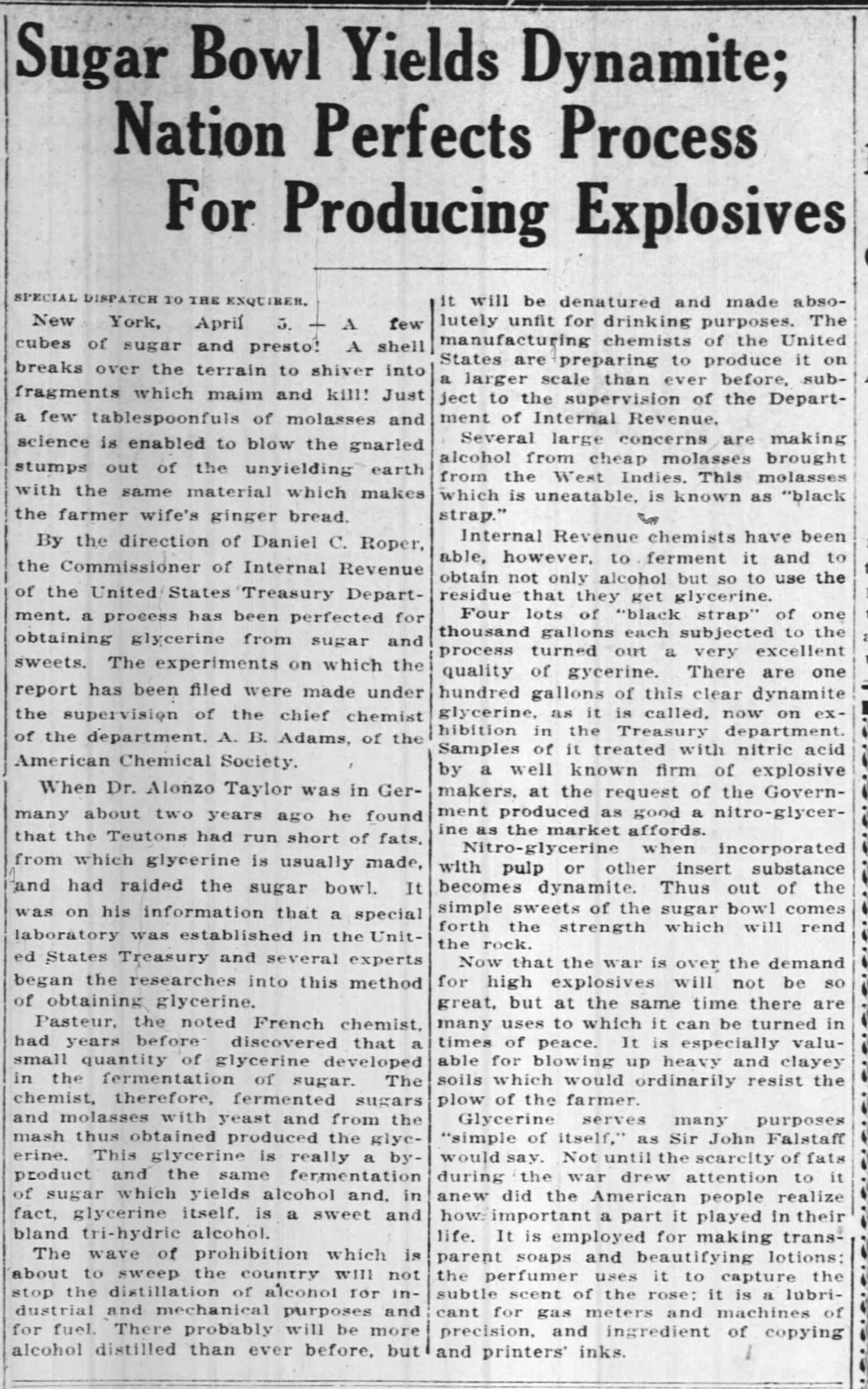
A.B. Adams left his position within the U.S. Internal Revenue Bureau in 1920 after 22 years. He took on a new career as a consulting chemist for the Hostetter Bitters Company. While the Hostetter Company was based in Pittsburgh, Pennsylvania, Adams continued to reside in D.C. By the end of Prohibition, he had been promoted to vice-president of the company. Hostetter Bitters were a hugely popular and very well-known household brand name and the Hostetters were a famously wealthy family.
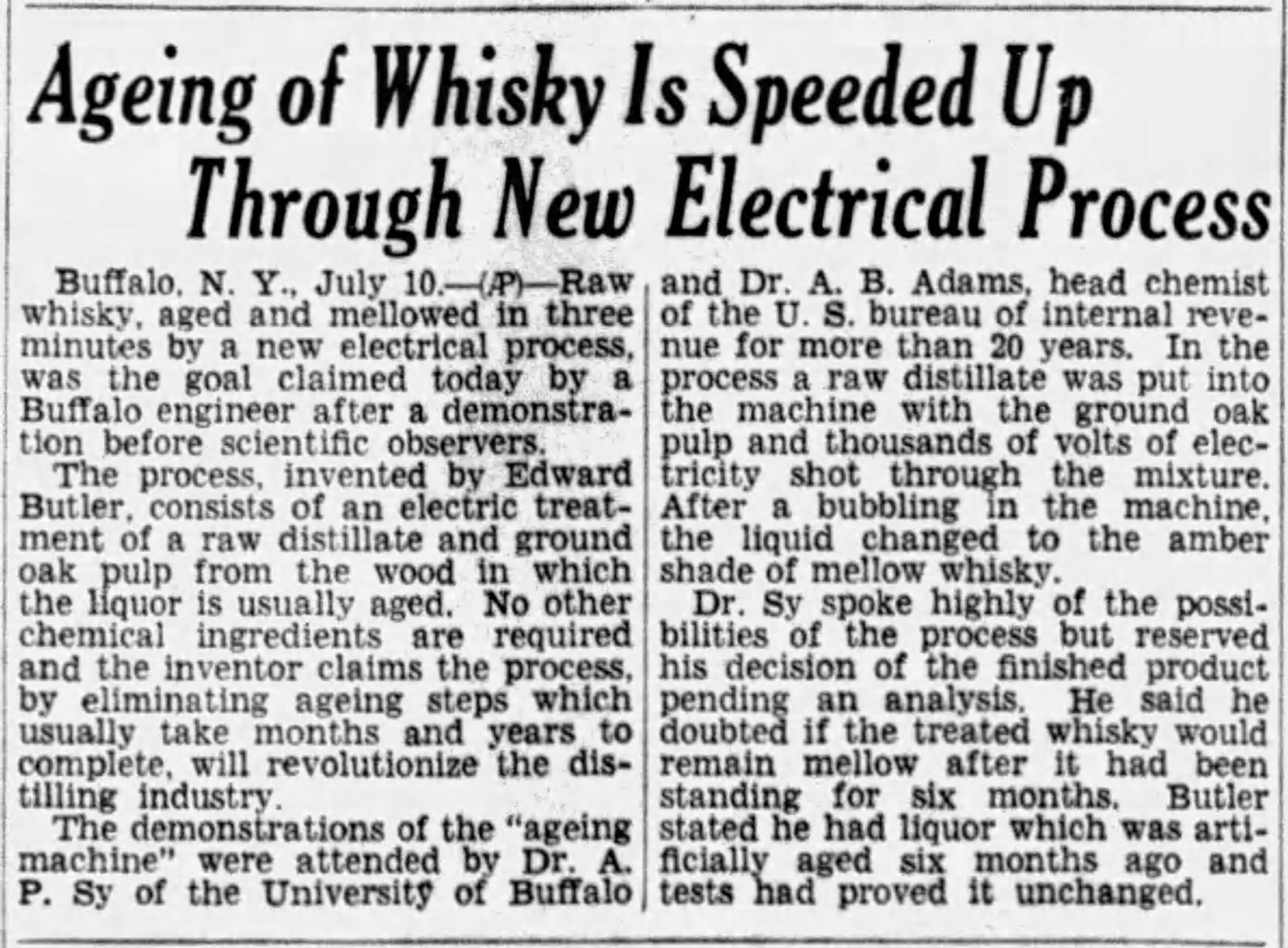
Arguably, the most impactful chemist in Washington, when it comes to the modern whiskey industry, was James M. Doran. His name was mentioned briefly above in reference to his being an assistant to A.B. Adams in the early 19-teens; They co-wrote a research paper on the composition of smoking opium (published in 1912). I’ve written a separate blog post on Mr. Doran, which I feel he deserves. While Doran remains a relatively unknown figure in the modern whiskey industry, he was an incredibly impactful character during and after Prohibition. His story exposes the crossover between the government’s laboratories, the Prohibition Commission, and the whiskey industry during the 1920s and 30s. It also helps to show how impactful those crossovers were for America’s whiskey producers.
In the end, the research conducted by the chemists in Washington could not help but have a huge impact on the whiskey industry. The men that worked in those labs didn’t just work for the Treasury Department. All of their tinkering away was attempting to fix something that was never really broken. While their research into whiskey is often praised, we should remember that their research was not conducted for the benefit of the whiskey industry. The research was done to investigate what the whiskey industry had always known but the government did not. These men were not distillers, and most of the research they were doing had very little to do with whiskey. Their jobs were to test for adulterations in food under the guidance of Harvey Wiley. Prohibition placed these chemists in leadership roles that they would never have been thrust upon them under normal circumstances. Nevertheless, their influence as leaders can be seen in the increased scale in production of industrial alcohol and in new efforts to increase the speed of barrel maturation. They, through the influence of Harvey Wiley, helped to build public distrust in the rectification and blending of spirits. This public distrust can still be felt today. As chemists became more influential within the whiskey industry after Prohibition, the rectification column became far more appealing to distillery owners. The need to reduce costs and increase alcohol yields would change the whiskey industry forever. The tax man, through his chemists and scientists, gained more influence upon how whiskey was made than ever before. Is it any wonder that Pappy Van Winkle was so staunchly opposed to scientists and chemists in his distillery?
Sometimes, it seems, a laboratory setting can sanitize an otherwise creative and organic atmosphere. I tend to believe in a balanced approach when it comes to whiskey. Science and chemistry is all well and good, but we must remember to allow for a little magic and a bit of artistry in whiskey production. These chemists in the early 1900s were the first men to hold those jobs. They couldn’t have know the impact they would have on the whiskey industry. But that’s why it’s important to know who they were and how their small laboratories, first in Washington D.C. and later all over the country, influenced the way whiskey is made today.