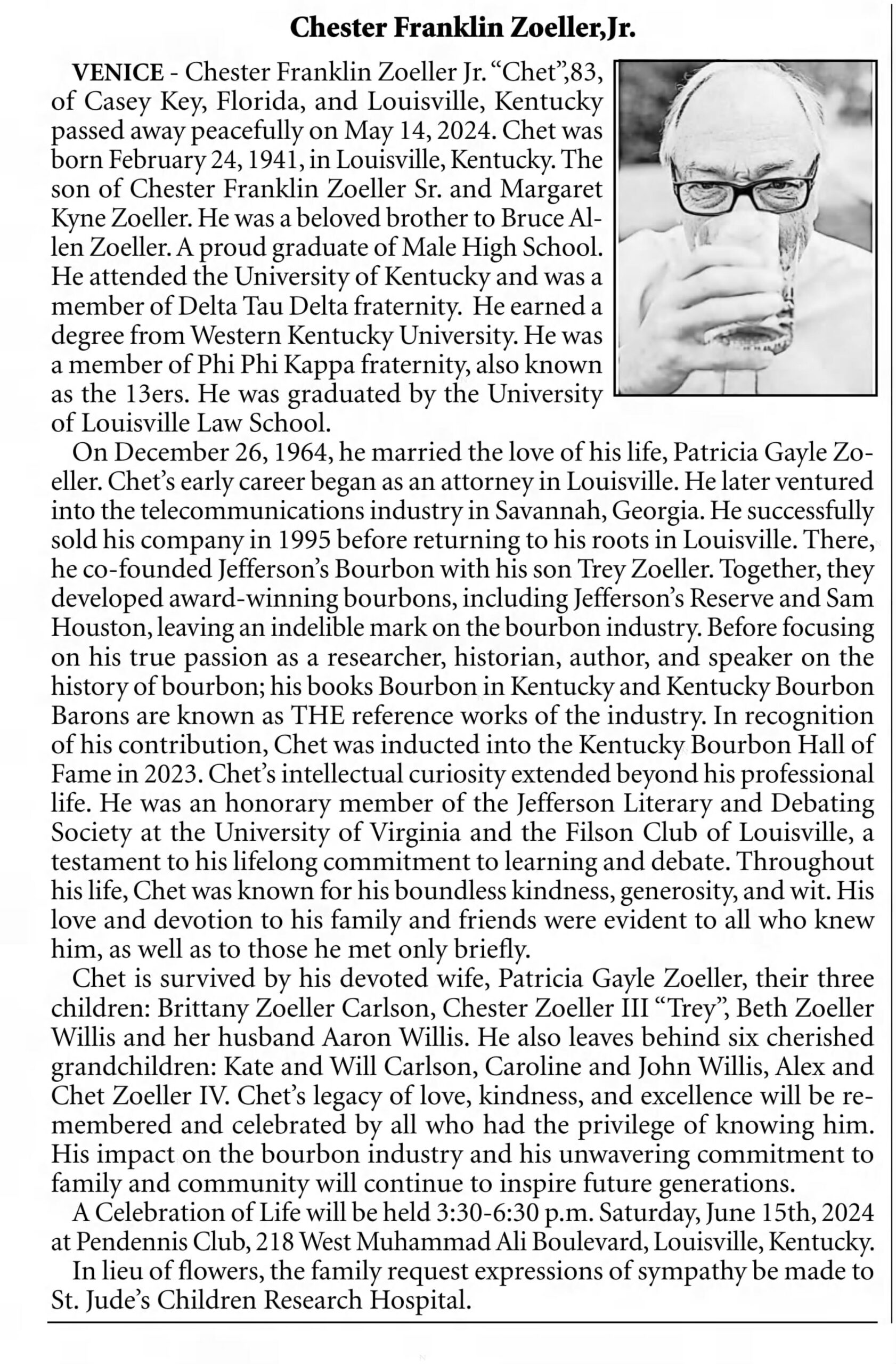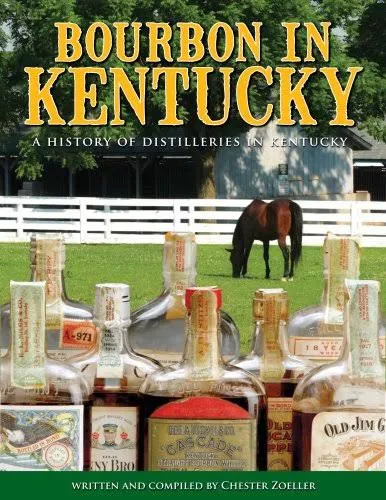
In my opinion, Chet Zoeller was the finest bourbon whiskey historian of all time. He wasn’t just a prolific recorder of historic information, he was also incredibly kind man, open to sharing his knowledge with other like-minded researchers. While I don’t focus my research specifically on bourbon, whenever I’ve needed to find information about a specific bourbon distillery, my go-to reference guide has always been his book, “Bourbon in Kentucky: A History of Distilleries in Kentucky.” When Chet passed away in May 2024, I remember feeling the loss acutely- not because I knew him terribly well (I only spoke to him once over the phone), but because I knew I’d never get to thank him in person for how much he’d inspired me. The following is the post I wrote on February 7, 2023 (Facebook.com/@AmericanWhiskeyHistory):
I had the most wonderful conversation yesterday afternoon with Mr. Chet Zoeller. As it turns out, we have very similar approaches to research. While his research was focused exclusively on Kentucky’s Pre-Prohibition distilleries, mine has been centered around Pennsylvania’s pre-Prohibition rye whiskey distilleries. We had a lot to talk about! It was such a pleasure to discuss his experience with founding the Jefferson’s brand and the inspiration behind his book, “Bourbon in Kentucky: A History of Distilleries in Kentucky.” If you haven’t picked up a copy, you should! The details about all of those pre-pro distilleries are priceless. What a thrill to have the opportunity to talk history and bounce ideas off such a knowledgeable and interesting person.
One of the topics discussed was how we went about identifying defunct distillery sites. Mr. Zoeller has visited many of the old sites in Kentucky, but first he had to locate them using topographical and regional maps from historic archives. While I had also used old maps, I brought up how magical it was to be able to see the sites from above using satellite imagery. He said he had not done that, which drove home how much access we now have to technology and how much I take it all for granted! Google maps doesn’t help locate the old sites, of course. The research gives you a location, but satellite imagery allows you to see a reasonably recent picture of what, if anything, remains of the old distillery. I know his book has inspired many people to also go out and find old sites in Kentucky. I hope my research will inspire the same in Pennsylvanians. I am very much looking forward to meeting Mr. Zoeller one day (hopefully at the American Whiskey Convention)…and getting him to sign my copy of his book😊It’s so refreshing to know that the curiosity and the desire to keep digging never goes away!
The phone conversation I had with Mr. Zoeller was made possible through a mutual friend, Curt Kolcun. (Thank you, Curt!) Mr. Kolcun connected Chet and I through email- From there, we were able to connect over the phone. It was wonderful to speak with someone that had such a similar approach to research- tackling one distillery at a time and digging into each unique location with the same level of determination, always with an aim to uncover information, regardless of each distillery’s hierarchical status. During our conversation, I discovered that Chet and I had a common appreciation for minutia and for the individuals who built the industry.
Chet explained how excited he was about a new release in the works for Jefferson’s Bourbon– the Marian McLain limited edition 11 year old bourbon, which had not yet been released (at the time). He had done the research on Marian McLain, his own ancestor, who had been arrested in 1799 for selling/trafficking whiskey illegally…though, sadly, I can’t remember the details as he explained them. He was very proud of his son and their efforts to connect their own family history to one of Jefferson’s brand releases. It was wonderful to hear him beam over the chance to connect his own work to their company’s identity.
We also discussed the fact that he was constantly updating his book- that it was on its 8th reprint, and that the work would never truly be complete because, for him, the research was continuously ongoing. He gave me hope when he explained that, where whiskey research was concerned, it takes a village to make sense of it all! History evolves as it gains insight, he explained. I love the fact that he was never satisfied with his own accuracy- that he was fully aware that new information was always coming to light that might alter his understanding of a distillery’s history…and that he was always updating and editing his work. Mr. Zoeller loved to research- something we had in common. I will forever be thankful that I had the opportunity to speak with him. It was extraordinary to be able to share time and insights with a kindred spirit. Research, regardless of the topic focused upon, is usually solitary work and can make a person feel isolated…but every once in a while, you come across someone that understands the feeling…and when that person has been doing it for SO MUCH longer than you THAT STILL LOVES IT?- EVEN AFTER ALL THOSE YEARS?! Well, nothing is quite as encouraging or motivating as making their acquaintance! Chet Zoeller was 81 (almost 82) when I spoke with him in February 2023, and he was just as enthusiastic about researching bourbon distilleries as he always had been! He was still excited to learn more and to update the research he had been conducting for years! I ask you…What could be more inspiring than that?! Thank you, Mr. Zoeller. Thank you for your hard work and for your inspiring enthusiasm for whiskey research. I will always be thankful for the chance to listen and learn from you. You will always be very fondly remembered. And your book will always be the highlight of my whiskey history library.
For more on Chet Zoeller, you can read about him HERE.